Event submissions
Published
This submission belongs to the session 1. Sustainable Animal Welfare, Ethics and Human–Animal Interactions of the event The 4th International Online Conference on Animals
Published date
12 Mar, 2026
Academic Editor
'%3e%3cpath%20d='M12.6657%2010.9104C12.4185%2010.325%2012.0599%209.79327%2011.6097%209.34482C11.1609%208.89508%2010.6293%208.5365%2010.0442%208.28888C10.0389%208.28626%2010.0337%208.28495%2010.0285%208.28233C10.8446%207.69279%2011.3752%206.73249%2011.3752%205.64904C11.3752%203.8542%209.92103%202.39999%208.1262%202.39999C6.33136%202.39999%204.87715%203.8542%204.87715%205.64904C4.87715%206.73249%205.40774%207.69279%206.22393%208.28364C6.21869%208.28626%206.21345%208.28757%206.20821%208.29019C5.62129%208.5378%205.09463%208.89284%204.64265%209.34613C4.1929%209.79493%203.83432%2010.3266%203.58671%2010.9117C3.34345%2011.4845%203.21226%2012.0987%203.20023%2012.7209C3.19988%2012.7349%203.20233%2012.7488%203.20744%2012.7619C3.21255%2012.7749%203.22022%2012.7867%203.22998%2012.7968C3.23975%2012.8068%203.25142%2012.8147%203.26431%2012.8202C3.2772%2012.8256%203.29105%2012.8284%203.30504%2012.8284H4.09109C4.14874%2012.8284%204.19459%2012.7825%204.1959%2012.7262C4.2221%2011.7148%204.62823%2010.7676%205.34617%2010.0497C6.08899%209.30683%207.0755%208.89808%208.1262%208.89808C9.17689%208.89808%2010.1634%209.30683%2010.9062%2010.0497C11.6242%2010.7676%2012.0303%2011.7148%2012.0565%2012.7262C12.0578%2012.7838%2012.1037%2012.8284%2012.1613%2012.8284H12.9474C12.9613%2012.8284%2012.9752%2012.8256%2012.9881%2012.8202C13.001%2012.8147%2013.0126%2012.8068%2013.0224%2012.7968C13.0322%2012.7867%2013.0398%2012.7749%2013.0449%2012.7619C13.0501%2012.7488%2013.0525%2012.7349%2013.0522%2012.7209C13.0391%2012.0947%2012.9094%2011.4855%2012.6657%2010.9104ZM8.1262%207.9024C7.52486%207.9024%206.9589%207.6679%206.53312%207.24211C6.10733%206.81633%205.87283%206.25037%205.87283%205.64904C5.87283%205.0477%206.10733%204.48174%206.53312%204.05596C6.9589%203.63018%207.52486%203.39567%208.1262%203.39567C8.72753%203.39567%209.29349%203.63018%209.71927%204.05596C10.1451%204.48174%2010.3796%205.0477%2010.3796%205.64904C10.3796%206.25037%2010.1451%206.81633%209.71927%207.24211C9.29349%207.6679%208.72753%207.9024%208.1262%207.9024Z'%20fill='%235D1EE1'/%3e%3c/g%3e%3c/svg%3e) Colin Scanes
Colin ScanesCitation
Michail Moroz, Izadora Oliveira, João Henrique Cardoso Costa, Ruan Rolnei Daros, Beef-on-dairy and Holstein Calves: should we mix or keep them separate? Behavioral impacts of Breed and Pair composition during the preweaning phase, in Proceedings of The 4th International Online Conference on Animals, 17 March–19 March 2026, MDPI: Basel, Switzerland
Share
Email
Facebook
Twitter
LinkedIn
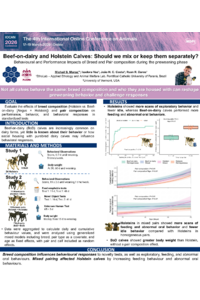
Beef-on-dairy and Holstein Calves: should we mix or keep them separate? Behavioral impacts of Breed and Pair composition during the preweaning phase
'%3e%3cpath%20d='M12.6647%2010.9104C12.4176%2010.325%2012.0589%209.7933%2011.6088%209.34485C11.16%208.89511%2010.6283%208.53653%2010.0432%208.28891C10.038%208.28629%2010.0327%208.28498%2010.0275%208.28236C10.8437%207.69282%2011.3743%206.73252%2011.3743%205.64907C11.3743%203.85423%209.92005%202.40002%208.12522%202.40002C6.33038%202.40002%204.87618%203.85423%204.87618%205.64907C4.87618%206.73252%205.40677%207.69282%206.22296%208.28367C6.21772%208.28629%206.21248%208.2876%206.20724%208.29022C5.62031%208.53783%205.09365%208.89287%204.64167%209.34616C4.19192%209.79496%203.83334%2010.3266%203.58573%2010.9117C3.34247%2011.4846%203.21128%2012.0987%203.19925%2012.721C3.1989%2012.735%203.20135%2012.7489%203.20646%2012.7619C3.21157%2012.7749%203.21924%2012.7868%203.22901%2012.7968C3.23877%2012.8068%203.25045%2012.8148%203.26334%2012.8202C3.27623%2012.8256%203.29007%2012.8284%203.30406%2012.8284H4.09012C4.14776%2012.8284%204.19362%2012.7825%204.19493%2012.7262C4.22113%2011.7148%204.62726%2010.7676%205.34519%2010.0497C6.08802%209.30686%207.07452%208.89811%208.12522%208.89811C9.17592%208.89811%2010.1624%209.30686%2010.9052%2010.0497C11.6232%2010.7676%2012.0293%2011.7148%2012.0555%2012.7262C12.0568%2012.7839%2012.1027%2012.8284%2012.1603%2012.8284H12.9464C12.9604%2012.8284%2012.9742%2012.8256%2012.9871%2012.8202C13%2012.8148%2013.0117%2012.8068%2013.0214%2012.7968C13.0312%2012.7868%2013.0389%2012.7749%2013.044%2012.7619C13.0491%2012.7489%2013.0515%2012.735%2013.0512%2012.721C13.0381%2012.0947%2012.9084%2011.4856%2012.6647%2010.9104ZM8.12522%207.90243C7.52388%207.90243%206.95792%207.66793%206.53214%207.24215C6.10636%206.81636%205.87185%206.2504%205.87185%205.64907C5.87185%205.04773%206.10636%204.48177%206.53214%204.05599C6.95792%203.63021%207.52388%203.3957%208.12522%203.3957C8.72655%203.3957%209.29252%203.63021%209.7183%204.05599C10.1441%204.48177%2010.3786%205.04773%2010.3786%205.64907C10.3786%206.2504%2010.1441%206.81636%209.7183%207.24215C9.29252%207.66793%208.72655%207.90243%208.12522%207.90243Z'%20fill='%235D1EE1'/%3e%3c/g%3e%3c/svg%3e)
Michail Moroz 1
Izadora Oliveira 1
João Henrique Cardoso Costa 2
Ruan Rolnei Daros 1
1. EthoLab – Applied Ethology and Animal Welfare Lab, Graduate Program in Animal Science, School of Medicine and Life Sciences, Pontifícia Universidade Católica do Paraná, Curitiba, Paraná, 80215-901, Brazil.
2. Department of Animal and Veterinary Sciences, The University of Vermont, Burlington, VT, 05405, USA.
Abstract
Beef-on-dairy (BoD) calves are increasingly common on dairy farms, yet little is known about their behavior or how social housing with purebred dairy calves may influence behavioral responses. This study evaluated the effects of breed composition (Holstein vs. BoD [Angus × Holstein]) and pair composition on behavior and behavioral responses in standardized tests. In Study 1 (n = 26; 18 Holstein, 8 BoD), calves were observed using scan sampling (5 d/wk) for behaviors including exploration, feeding, play, and abnormal oral behavior. A food neophobia test was conducted at 50 d of age. In Study 2 (n = 62; 37 Holstein, 25 BoD), calves were housed in Holstein, mixed, or BoD pairs. Behavioral observations were conducted weekly for 1 h around milk meals. Calves also underwent behavioral tests: food neophobia (19 ± 2 and 48 ± 2 d), novel object (16 ± 3 and 41 ± 2 d), novel human approach (65 ± 3 d), and regrouping (79 ± 2 d). Breed composition affected exploration (P<0.01) and feeding (P<0.01) behaviors: Holsteins explored more, whereas BoD calves performed more feeding behaviors. In the novel food test, Holsteins interacted less (OR: 0.28; 95% CI: 0.07–0.92; P=0.03), took longer to touch (P=0.04), and consumed less novel food than BoD calves (Holstein: 2.17 ± 0.96 g; BoD: 6.55 ± 1.89 g; P=0.03), while in the novel object test, they interacted more frequently (P=0.01), with similar latencies. Pair composition also affected calf behavior, particularly in Holstein calves housed with BoD peers. These calves showed increased feeding behavior (P < 0.001), greater abnormal oral behaviors (P < 0.01), and longer latencies to approach an unfamiliar human compared with Holstein calves housed in homogeneous pairs. Overall, breed composition and pair composition shaped preweaning calf behavior, with mixed housing positively influencing feeding behavior but negatively affecting oral behaviors.
Keywords
pair housing
feed behavior
food neophobia
social facilitation
crossbred calves.
Poster
IOCAN_MOROZ_2026.pdf
Agrivoltaic systems as a tool to improve dairy farming sustainability—A case study
Agricultural fairs: The tension between spectacle and the ethics of care