Event submissions
Published
This submission belongs to the session 1. Sustainable Animal Welfare, Ethics and Human–Animal Interactions of the event The 4th International Online Conference on Animals
Published date
12 Mar, 2026
Academic Editor
'%3e%3cpath%20d='M12.6657%2010.9104C12.4185%2010.325%2012.0599%209.79327%2011.6097%209.34482C11.1609%208.89508%2010.6293%208.5365%2010.0442%208.28888C10.0389%208.28626%2010.0337%208.28495%2010.0285%208.28233C10.8446%207.69279%2011.3752%206.73249%2011.3752%205.64904C11.3752%203.8542%209.92103%202.39999%208.1262%202.39999C6.33136%202.39999%204.87715%203.8542%204.87715%205.64904C4.87715%206.73249%205.40774%207.69279%206.22393%208.28364C6.21869%208.28626%206.21345%208.28757%206.20821%208.29019C5.62129%208.5378%205.09463%208.89284%204.64265%209.34613C4.1929%209.79493%203.83432%2010.3266%203.58671%2010.9117C3.34345%2011.4845%203.21226%2012.0987%203.20023%2012.7209C3.19988%2012.7349%203.20233%2012.7488%203.20744%2012.7619C3.21255%2012.7749%203.22022%2012.7867%203.22998%2012.7968C3.23975%2012.8068%203.25142%2012.8147%203.26431%2012.8202C3.2772%2012.8256%203.29105%2012.8284%203.30504%2012.8284H4.09109C4.14874%2012.8284%204.19459%2012.7825%204.1959%2012.7262C4.2221%2011.7148%204.62823%2010.7676%205.34617%2010.0497C6.08899%209.30683%207.0755%208.89808%208.1262%208.89808C9.17689%208.89808%2010.1634%209.30683%2010.9062%2010.0497C11.6242%2010.7676%2012.0303%2011.7148%2012.0565%2012.7262C12.0578%2012.7838%2012.1037%2012.8284%2012.1613%2012.8284H12.9474C12.9613%2012.8284%2012.9752%2012.8256%2012.9881%2012.8202C13.001%2012.8147%2013.0126%2012.8068%2013.0224%2012.7968C13.0322%2012.7867%2013.0398%2012.7749%2013.0449%2012.7619C13.0501%2012.7488%2013.0525%2012.7349%2013.0522%2012.7209C13.0391%2012.0947%2012.9094%2011.4855%2012.6657%2010.9104ZM8.1262%207.9024C7.52486%207.9024%206.9589%207.6679%206.53312%207.24211C6.10733%206.81633%205.87283%206.25037%205.87283%205.64904C5.87283%205.0477%206.10733%204.48174%206.53312%204.05596C6.9589%203.63018%207.52486%203.39567%208.1262%203.39567C8.72753%203.39567%209.29349%203.63018%209.71927%204.05596C10.1451%204.48174%2010.3796%205.0477%2010.3796%205.64904C10.3796%206.25037%2010.1451%206.81633%209.71927%207.24211C9.29349%207.6679%208.72753%207.9024%208.1262%207.9024Z'%20fill='%235D1EE1'/%3e%3c/g%3e%3c/svg%3e) Colin Scanes
Colin ScanesCitation
Letícia Cássia da Silva, Mateus Ribeiro Piza, Rafael Araujo Messias, Teresa Cristina Alves, Matheus Deniz, Alda Juliana Castro de Sousa, Marcelo Simão da Rosa, REACTION OF DAIRY CALVES TO COLORED MATS WITH INTERLACED COLORS, in Proceedings of The 4th International Online Conference on Animals, 17 March–19 March 2026, MDPI: Basel, Switzerland
Share
Email
Facebook
Twitter
LinkedIn
REACTION OF DAIRY CALVES TO COLORED MATS WITH INTERLACED COLORS
'%3e%3cpath%20d='M12.6647%2010.9104C12.4176%2010.325%2012.0589%209.7933%2011.6088%209.34485C11.16%208.89511%2010.6283%208.53653%2010.0432%208.28891C10.038%208.28629%2010.0327%208.28498%2010.0275%208.28236C10.8437%207.69282%2011.3743%206.73252%2011.3743%205.64907C11.3743%203.85423%209.92005%202.40002%208.12522%202.40002C6.33038%202.40002%204.87618%203.85423%204.87618%205.64907C4.87618%206.73252%205.40677%207.69282%206.22296%208.28367C6.21772%208.28629%206.21248%208.2876%206.20724%208.29022C5.62031%208.53783%205.09365%208.89287%204.64167%209.34616C4.19192%209.79496%203.83334%2010.3266%203.58573%2010.9117C3.34247%2011.4846%203.21128%2012.0987%203.19925%2012.721C3.1989%2012.735%203.20135%2012.7489%203.20646%2012.7619C3.21157%2012.7749%203.21924%2012.7868%203.22901%2012.7968C3.23877%2012.8068%203.25045%2012.8148%203.26334%2012.8202C3.27623%2012.8256%203.29007%2012.8284%203.30406%2012.8284H4.09012C4.14776%2012.8284%204.19362%2012.7825%204.19493%2012.7262C4.22113%2011.7148%204.62726%2010.7676%205.34519%2010.0497C6.08802%209.30686%207.07452%208.89811%208.12522%208.89811C9.17592%208.89811%2010.1624%209.30686%2010.9052%2010.0497C11.6232%2010.7676%2012.0293%2011.7148%2012.0555%2012.7262C12.0568%2012.7839%2012.1027%2012.8284%2012.1603%2012.8284H12.9464C12.9604%2012.8284%2012.9742%2012.8256%2012.9871%2012.8202C13%2012.8148%2013.0117%2012.8068%2013.0214%2012.7968C13.0312%2012.7868%2013.0389%2012.7749%2013.044%2012.7619C13.0491%2012.7489%2013.0515%2012.735%2013.0512%2012.721C13.0381%2012.0947%2012.9084%2011.4856%2012.6647%2010.9104ZM8.12522%207.90243C7.52388%207.90243%206.95792%207.66793%206.53214%207.24215C6.10636%206.81636%205.87185%206.2504%205.87185%205.64907C5.87185%205.04773%206.10636%204.48177%206.53214%204.05599C6.95792%203.63021%207.52388%203.3957%208.12522%203.3957C8.72655%203.3957%209.29252%203.63021%209.7183%204.05599C10.1441%204.48177%2010.3786%205.04773%2010.3786%205.64907C10.3786%206.2504%2010.1441%206.81636%209.7183%207.24215C9.29252%207.66793%208.72655%207.90243%208.12522%207.90243Z'%20fill='%235D1EE1'/%3e%3c/g%3e%3c/svg%3e)
Letícia Cássia da Silva 1
Mateus Ribeiro Piza 2
Rafael Araujo Messias 3

Teresa Cristina Alves 4

Matheus Deniz 5
Alda Juliana Castro de Sousa 6
Marcelo Simão da Rosa 3
1. Department of Animal Science, School of Animal Science and Food Engineering, University of São Paulo
(FZEA/USP), Pirassununga, SP, Brazil.
2. Federal University of Lavras, Lavras, Minas Gerais, Brazil
3. Federal Institute of Education, Science and Technology of Southern Minas Gerais, Muzambinho campus, Brazil.
4. Brazilian Agricultural Research Corporation, Embrapa Southeast Livestock, São Carlos, São Paulo, Brazil.
5. Dairy Cattle Study Group, School of Veterinary Medicine and Animal Science, São Paulo State University, Botucatu, São Paulo, Brazil.
6. Graduate Program in Animal Science, School of Veterinary Medicine and Animal Science, São Paulo State University, Botucatu, São Paulo, Brazil.
Abstract
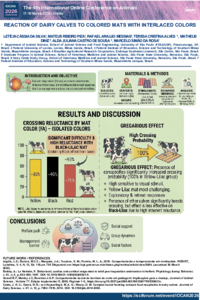
The rational management of young animals often involves novel situations that may cause reluctance and stress, making it essential to understand how visual stimuli influence their behavioral responses. The present study evaluated the reaction of dairy calves aged 0 to 6 months to colored mats placed at transition points between areas, considering different environments and social contexts. The research was conducted at the Federal Institute of Education, Science and Technology of Southern Minas Gerais, Muzambinho Campus, Brazil. Six Holstein calves raised in an intensive system were used, assessed both individually and in groups, in familiar (FA) and unfamiliar (UA) locations. The mats were made with horizontal interlaced stripes in lilac and red, lilac and black, and lilac and yellow, in addition to a control condition without mats. Behavioral responses were recorded using an ethogram, including the behaviors crossing, reluctant crossing, exploration, retreat, and attempt to jump, based on direct observation. Statistical analysis was performed using the nonparametric Kruskal–Wallis and Nemenyi tests. The calves showed high sensitivity to visual stimuli, with a predominance of the “reluctant crossing” behavior, even in the absence of mats (66.67% in FA). The yellow–lilac mat elicited the highest frequency of this behavior (100% in group and 94.44% individual in FA), followed by the red–lilac (70.06%) and black–lilac (58.69%) mats. The red–lilac and black–lilac combinations also induced exploratory and retreat behaviors, especially under individual conditions in UA, suggesting perception of depth and uncertainty in response to contrasts. The presence of conspecifics significantly increased the likelihood of crossing, highlighting the gregarious effect. It is concluded that young calves display more cautious and exploratory responses to contrasting visual stimuli and that visual and social factors should be considered in management practices to promote safety and animal welfare.
Keywords
Reactivity
Rational Management
Vision
Practicality
Poster
sciforum-157596 Letícia Cássia da Silva.pdf
Agricultural fairs: The tension between spectacle and the ethics of care
Quantifying Drivers of Welfare Risk in Cattle During Preslaughter Handling