Event submissions
Published
This submission belongs to the session 1. Sustainable Animal Welfare, Ethics and Human–Animal Interactions of the event The 4th International Online Conference on Animals
Published date
12 Mar, 2026
Academic Editor
'%3e%3cpath%20d='M12.6657%2010.9104C12.4185%2010.325%2012.0599%209.79327%2011.6097%209.34482C11.1609%208.89508%2010.6293%208.5365%2010.0442%208.28888C10.0389%208.28626%2010.0337%208.28495%2010.0285%208.28233C10.8446%207.69279%2011.3752%206.73249%2011.3752%205.64904C11.3752%203.8542%209.92103%202.39999%208.1262%202.39999C6.33136%202.39999%204.87715%203.8542%204.87715%205.64904C4.87715%206.73249%205.40774%207.69279%206.22393%208.28364C6.21869%208.28626%206.21345%208.28757%206.20821%208.29019C5.62129%208.5378%205.09463%208.89284%204.64265%209.34613C4.1929%209.79493%203.83432%2010.3266%203.58671%2010.9117C3.34345%2011.4845%203.21226%2012.0987%203.20023%2012.7209C3.19988%2012.7349%203.20233%2012.7488%203.20744%2012.7619C3.21255%2012.7749%203.22022%2012.7867%203.22998%2012.7968C3.23975%2012.8068%203.25142%2012.8147%203.26431%2012.8202C3.2772%2012.8256%203.29105%2012.8284%203.30504%2012.8284H4.09109C4.14874%2012.8284%204.19459%2012.7825%204.1959%2012.7262C4.2221%2011.7148%204.62823%2010.7676%205.34617%2010.0497C6.08899%209.30683%207.0755%208.89808%208.1262%208.89808C9.17689%208.89808%2010.1634%209.30683%2010.9062%2010.0497C11.6242%2010.7676%2012.0303%2011.7148%2012.0565%2012.7262C12.0578%2012.7838%2012.1037%2012.8284%2012.1613%2012.8284H12.9474C12.9613%2012.8284%2012.9752%2012.8256%2012.9881%2012.8202C13.001%2012.8147%2013.0126%2012.8068%2013.0224%2012.7968C13.0322%2012.7867%2013.0398%2012.7749%2013.0449%2012.7619C13.0501%2012.7488%2013.0525%2012.7349%2013.0522%2012.7209C13.0391%2012.0947%2012.9094%2011.4855%2012.6657%2010.9104ZM8.1262%207.9024C7.52486%207.9024%206.9589%207.6679%206.53312%207.24211C6.10733%206.81633%205.87283%206.25037%205.87283%205.64904C5.87283%205.0477%206.10733%204.48174%206.53312%204.05596C6.9589%203.63018%207.52486%203.39567%208.1262%203.39567C8.72753%203.39567%209.29349%203.63018%209.71927%204.05596C10.1451%204.48174%2010.3796%205.0477%2010.3796%205.64904C10.3796%206.25037%2010.1451%206.81633%209.71927%207.24211C9.29349%207.6679%208.72753%207.9024%208.1262%207.9024Z'%20fill='%235D1EE1'/%3e%3c/g%3e%3c/svg%3e) Colin Scanes
Colin ScanesCitation
Cynthia Schuck Paim, Wladimir Alonso, Camila Pereira de Oliveira, Vinícius de França Carvalho Fonseca, Denys Leandro Zanini Silva, Beatriz Delamain Martyniuk, Tâmara Duarte Borges, Quantifying Drivers of Welfare Risk in Cattle During Preslaughter Handling, in Proceedings of The 4th International Online Conference on Animals, 17 March–19 March 2026, MDPI: Basel, Switzerland
Share
Email
Facebook
Twitter
LinkedIn
Quantifying Drivers of Welfare Risk in Cattle During Preslaughter Handling
'%3e%3cpath%20d='M12.6647%2010.9104C12.4176%2010.325%2012.0589%209.7933%2011.6088%209.34485C11.16%208.89511%2010.6283%208.53653%2010.0432%208.28891C10.038%208.28629%2010.0327%208.28498%2010.0275%208.28236C10.8437%207.69282%2011.3743%206.73252%2011.3743%205.64907C11.3743%203.85423%209.92005%202.40002%208.12522%202.40002C6.33038%202.40002%204.87618%203.85423%204.87618%205.64907C4.87618%206.73252%205.40677%207.69282%206.22296%208.28367C6.21772%208.28629%206.21248%208.2876%206.20724%208.29022C5.62031%208.53783%205.09365%208.89287%204.64167%209.34616C4.19192%209.79496%203.83334%2010.3266%203.58573%2010.9117C3.34247%2011.4846%203.21128%2012.0987%203.19925%2012.721C3.1989%2012.735%203.20135%2012.7489%203.20646%2012.7619C3.21157%2012.7749%203.21924%2012.7868%203.22901%2012.7968C3.23877%2012.8068%203.25045%2012.8148%203.26334%2012.8202C3.27623%2012.8256%203.29007%2012.8284%203.30406%2012.8284H4.09012C4.14776%2012.8284%204.19362%2012.7825%204.19493%2012.7262C4.22113%2011.7148%204.62726%2010.7676%205.34519%2010.0497C6.08802%209.30686%207.07452%208.89811%208.12522%208.89811C9.17592%208.89811%2010.1624%209.30686%2010.9052%2010.0497C11.6232%2010.7676%2012.0293%2011.7148%2012.0555%2012.7262C12.0568%2012.7839%2012.1027%2012.8284%2012.1603%2012.8284H12.9464C12.9604%2012.8284%2012.9742%2012.8256%2012.9871%2012.8202C13%2012.8148%2013.0117%2012.8068%2013.0214%2012.7968C13.0312%2012.7868%2013.0389%2012.7749%2013.044%2012.7619C13.0491%2012.7489%2013.0515%2012.735%2013.0512%2012.721C13.0381%2012.0947%2012.9084%2011.4856%2012.6647%2010.9104ZM8.12522%207.90243C7.52388%207.90243%206.95792%207.66793%206.53214%207.24215C6.10636%206.81636%205.87185%206.2504%205.87185%205.64907C5.87185%205.04773%206.10636%204.48177%206.53214%204.05599C6.95792%203.63021%207.52388%203.3957%208.12522%203.3957C8.72655%203.3957%209.29252%203.63021%209.7183%204.05599C10.1441%204.48177%2010.3786%205.04773%2010.3786%205.64907C10.3786%206.2504%2010.1441%206.81636%209.7183%207.24215C9.29252%207.66793%208.72655%207.90243%208.12522%207.90243Z'%20fill='%235D1EE1'/%3e%3c/g%3e%3c/svg%3e)
Cynthia Schuck Paim 1
Wladimir Alonso 1
Camila Pereira de Oliveira 2
Vinícius de França Carvalho Fonseca 3
Denys Leandro Zanini Silva 2
Beatriz Delamain Martyniuk 2
Tâmara Duarte Borges 2
1. Animal Welfare Department, Center for Welfare Metrics, São Paulo, 04795-100, Brazil
2. Animal Welfare Department, Minerva Foods S.A., Barretos, SP, 14781-538, Brazil
3. Animal Science Department, Instituto Federal Baiano, Santa Inês, Bahia, 45320-000, Brazil
Abstract
Introduction: Preslaughter management represents a critical period for cattle welfare, as animals are subjected to multiple stressors over time. Despite long-standing attention to handling practices, the welfare impact of preslaughter conditions has rarely been quantified in a way that integrates both the intensity and duration of stress exposure.
Methods: The Welfare Footprint Framework was applied to estimate welfare impacts across the main preslaughter stages—unloading, lairage, handling/movement, and restraint—under commercial conditions in tropical and subtropical South American regions. It combined estimates of duration and severity of stressful circumstances to identify which phases and stressors contributed most to cumulative welfare burden and evaluate potential mitigation strategies. Parameterization represented typical high-throughput operations. Climate data were analyzed from 636 beef-producing locations across Brazil, Argentina, Colombia, Paraguay, and Uruguay.
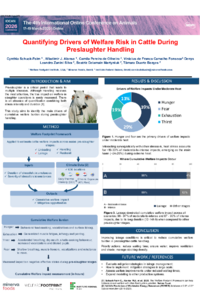
Results: In well-managed operations, heat stress contributed 19-33% of an individual time in moderate-to-intense pain and discomfort. Under moderate heat stress, hunger, physical exhaustion, thirst and fear accounted respectively for 30-32%, 15-16%, 7-13%, and 23-24% of welfare impacts, with their relative contribution decreasing in scenarios of extreme heat. In such cases, heat stress became the main harm experienced, with a welfare impact similar to severe contusions when present (24-25%). Lairage dominated cumulative welfare impacts across all scenarios: 96-97% of moderate-to-intense and 87-90% of intense impacts. Handling stages were associated with shorter but more severe distress per unit of time, given the potential use of electric prods and greater risk of contusions.
Conclusions: Lairage management emerged as a primary leverage point for welfare improvement in tropical and subtropical systems. Reducing lairage duration can substantially lower cumulative discomfort. Ensuring water access, limiting density, improving ventilation and shading are also critical to reduce the impact of heat stress. Quantifying welfare impacts, such as time in negative states of varying intensities, can guide targeted welfare improvements in commercial slaughter operations.
Keywords
Heat Stress
Welfare Footprint Framework
Lairage
South American Regions
Poster
Banner - IOCAN 2026 06-03-26.pdf
REACTION OF DAIRY CALVES TO COLORED MATS WITH INTERLACED COLORS
Influence of agrivoltaic systems on the thermal comfort of dairy cows in a tropical climate