Event submissions
Published
This submission belongs to the session 1. Sustainable Animal Welfare, Ethics and Human–Animal Interactions of the event The 4th International Online Conference on Animals
Published date
12 Mar, 2026
Academic Editor
'%3e%3cpath%20d='M12.6657%2010.9104C12.4185%2010.325%2012.0599%209.79327%2011.6097%209.34482C11.1609%208.89508%2010.6293%208.5365%2010.0442%208.28888C10.0389%208.28626%2010.0337%208.28495%2010.0285%208.28233C10.8446%207.69279%2011.3752%206.73249%2011.3752%205.64904C11.3752%203.8542%209.92103%202.39999%208.1262%202.39999C6.33136%202.39999%204.87715%203.8542%204.87715%205.64904C4.87715%206.73249%205.40774%207.69279%206.22393%208.28364C6.21869%208.28626%206.21345%208.28757%206.20821%208.29019C5.62129%208.5378%205.09463%208.89284%204.64265%209.34613C4.1929%209.79493%203.83432%2010.3266%203.58671%2010.9117C3.34345%2011.4845%203.21226%2012.0987%203.20023%2012.7209C3.19988%2012.7349%203.20233%2012.7488%203.20744%2012.7619C3.21255%2012.7749%203.22022%2012.7867%203.22998%2012.7968C3.23975%2012.8068%203.25142%2012.8147%203.26431%2012.8202C3.2772%2012.8256%203.29105%2012.8284%203.30504%2012.8284H4.09109C4.14874%2012.8284%204.19459%2012.7825%204.1959%2012.7262C4.2221%2011.7148%204.62823%2010.7676%205.34617%2010.0497C6.08899%209.30683%207.0755%208.89808%208.1262%208.89808C9.17689%208.89808%2010.1634%209.30683%2010.9062%2010.0497C11.6242%2010.7676%2012.0303%2011.7148%2012.0565%2012.7262C12.0578%2012.7838%2012.1037%2012.8284%2012.1613%2012.8284H12.9474C12.9613%2012.8284%2012.9752%2012.8256%2012.9881%2012.8202C13.001%2012.8147%2013.0126%2012.8068%2013.0224%2012.7968C13.0322%2012.7867%2013.0398%2012.7749%2013.0449%2012.7619C13.0501%2012.7488%2013.0525%2012.7349%2013.0522%2012.7209C13.0391%2012.0947%2012.9094%2011.4855%2012.6657%2010.9104ZM8.1262%207.9024C7.52486%207.9024%206.9589%207.6679%206.53312%207.24211C6.10733%206.81633%205.87283%206.25037%205.87283%205.64904C5.87283%205.0477%206.10733%204.48174%206.53312%204.05596C6.9589%203.63018%207.52486%203.39567%208.1262%203.39567C8.72753%203.39567%209.29349%203.63018%209.71927%204.05596C10.1451%204.48174%2010.3796%205.0477%2010.3796%205.64904C10.3796%206.25037%2010.1451%206.81633%209.71927%207.24211C9.29349%207.6679%208.72753%207.9024%208.1262%207.9024Z'%20fill='%235D1EE1'/%3e%3c/g%3e%3c/svg%3e) Colin Scanes
Colin ScanesCitation
Emanueli Bortolin Leme de Andrade, Taynara de Oliveira Cezario, Ana Cristina Silva Gonçalves, Isis Thainá Silva de Oliveira, Elen Kaline Sartori, Karolini Tenffen De-Sousa, Matheus Deniz, Influence of agrivoltaic systems on the thermal comfort of dairy cows in a tropical climate, in Proceedings of The 4th International Online Conference on Animals, 17 March–19 March 2026, MDPI: Basel, Switzerland
Share
Email
Facebook
Twitter
LinkedIn
Influence of agrivoltaic systems on the thermal comfort of dairy cows in a tropical climate
'%3e%3cpath%20d='M12.6647%2010.9104C12.4176%2010.325%2012.0589%209.7933%2011.6088%209.34485C11.16%208.89511%2010.6283%208.53653%2010.0432%208.28891C10.038%208.28629%2010.0327%208.28498%2010.0275%208.28236C10.8437%207.69282%2011.3743%206.73252%2011.3743%205.64907C11.3743%203.85423%209.92005%202.40002%208.12522%202.40002C6.33038%202.40002%204.87618%203.85423%204.87618%205.64907C4.87618%206.73252%205.40677%207.69282%206.22296%208.28367C6.21772%208.28629%206.21248%208.2876%206.20724%208.29022C5.62031%208.53783%205.09365%208.89287%204.64167%209.34616C4.19192%209.79496%203.83334%2010.3266%203.58573%2010.9117C3.34247%2011.4846%203.21128%2012.0987%203.19925%2012.721C3.1989%2012.735%203.20135%2012.7489%203.20646%2012.7619C3.21157%2012.7749%203.21924%2012.7868%203.22901%2012.7968C3.23877%2012.8068%203.25045%2012.8148%203.26334%2012.8202C3.27623%2012.8256%203.29007%2012.8284%203.30406%2012.8284H4.09012C4.14776%2012.8284%204.19362%2012.7825%204.19493%2012.7262C4.22113%2011.7148%204.62726%2010.7676%205.34519%2010.0497C6.08802%209.30686%207.07452%208.89811%208.12522%208.89811C9.17592%208.89811%2010.1624%209.30686%2010.9052%2010.0497C11.6232%2010.7676%2012.0293%2011.7148%2012.0555%2012.7262C12.0568%2012.7839%2012.1027%2012.8284%2012.1603%2012.8284H12.9464C12.9604%2012.8284%2012.9742%2012.8256%2012.9871%2012.8202C13%2012.8148%2013.0117%2012.8068%2013.0214%2012.7968C13.0312%2012.7868%2013.0389%2012.7749%2013.044%2012.7619C13.0491%2012.7489%2013.0515%2012.735%2013.0512%2012.721C13.0381%2012.0947%2012.9084%2011.4856%2012.6647%2010.9104ZM8.12522%207.90243C7.52388%207.90243%206.95792%207.66793%206.53214%207.24215C6.10636%206.81636%205.87185%206.2504%205.87185%205.64907C5.87185%205.04773%206.10636%204.48177%206.53214%204.05599C6.95792%203.63021%207.52388%203.3957%208.12522%203.3957C8.72655%203.3957%209.29252%203.63021%209.7183%204.05599C10.1441%204.48177%2010.3786%205.04773%2010.3786%205.64907C10.3786%206.2504%2010.1441%206.81636%209.7183%207.24215C9.29252%207.66793%208.72655%207.90243%208.12522%207.90243Z'%20fill='%235D1EE1'/%3e%3c/g%3e%3c/svg%3e)
Emanueli Bortolin Leme de Andrade 1
Taynara de Oliveira Cezario 1
Ana Cristina Silva Gonçalves 1
Isis Thainá Silva de Oliveira 1
Elen Kaline Sartori 1

Karolini Tenffen De-Sousa 1

Matheus Deniz 1
1. Grupo de Estudos em Bovinos Leiteiros, Faculdade de Medicina Veterinária e Zootecnia, Universidade Estadual Paulista, Botucatu, São Paulo, Brazil.
Abstract
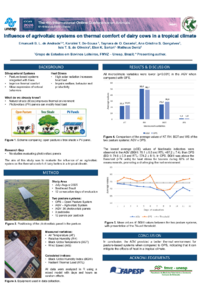
In this study, we evaluate the influence of an agrivoltaic system on the thermal comfort of dairy heifers in a tropical climate. The research was conducted between July and August 2025 in south-eastern Brazil. During 12 consecutive days, two pasture systems were assessed: an open pasture system (OPS) and an agrivoltaic system (AGV). In the AGV, 36 photovoltaic panels were arranged across three paddocks (12 panels/ paddock). Microclimate variables such as air temperature (AT), relative humidity (RH), black globe temperature (BGT), and wind speed (WS) were assessed by sets of autonomous sensors. In the OPS, a set of sensors were installed at the center of the paddock, and in the AGV, a set of sensors were installed in full sun and the shaded areas beneath the panels. With these data, we calculated the black globe–humidity index (BGHI) and radiant thermal load (RTL). All analyses were performed in R using Generalized Mixed Models, with days and hours included as random effects. All microclimatic variables were lower (p<0.001) in the AGV (AT: 22.1 ± 0.9; BGT: 24.4 ± 1.8; WS: 1.4 ± 0.09) compared with the OPS (AT: 23.01 ± 0.9; BGT: 28.8 ± 1.2; WS: 1.6 ± 0.1), except for RH (AGV: 50.4 ± 3.9; OPS: 48.7 ± 3.3). Additionally, the lowest mean (± SE) values of bioclimatic indicators were recorded in the AGV (BGHI: 70.1 ± 0.8; RTL: 487.2 ± 7.4) than in the OPS (BGHI: 74.6 ± 0.9; RTL: 574.2 ± 8.1). In the OPS, BGHI exceeded the heat-stress threshold for cattle (>74 units) during 62% of measurements, indicating a challenging thermal environment. In conclusion, the agrivoltaic system provided a more comfortable thermal environment for pasture-based dairy production compared with the open pasture system, demonstrating its potential to mitigate heat stress in tropical climates.
Keywords
Keywords: thermal environment
microclimate
shading
BGHI
Poster
sciforum-157379 Emanueli Bortolin Leme de Andrade.pdf
Quantifying Drivers of Welfare Risk in Cattle During Preslaughter Handling
Correlation between perceived elements and recommended practices for dairy cattle welfare