Event submissions
Published
This submission belongs to the session 3. Sustainable Animal Nutrition of the event The 4th International Online Conference on Animals
Published date
12 Mar, 2026
Academic Editor
'%3e%3cpath%20d='M12.6657%2010.9104C12.4185%2010.325%2012.0599%209.79327%2011.6097%209.34482C11.1609%208.89508%2010.6293%208.5365%2010.0442%208.28888C10.0389%208.28626%2010.0337%208.28495%2010.0285%208.28233C10.8446%207.69279%2011.3752%206.73249%2011.3752%205.64904C11.3752%203.8542%209.92103%202.39999%208.1262%202.39999C6.33136%202.39999%204.87715%203.8542%204.87715%205.64904C4.87715%206.73249%205.40774%207.69279%206.22393%208.28364C6.21869%208.28626%206.21345%208.28757%206.20821%208.29019C5.62129%208.5378%205.09463%208.89284%204.64265%209.34613C4.1929%209.79493%203.83432%2010.3266%203.58671%2010.9117C3.34345%2011.4845%203.21226%2012.0987%203.20023%2012.7209C3.19988%2012.7349%203.20233%2012.7488%203.20744%2012.7619C3.21255%2012.7749%203.22022%2012.7867%203.22998%2012.7968C3.23975%2012.8068%203.25142%2012.8147%203.26431%2012.8202C3.2772%2012.8256%203.29105%2012.8284%203.30504%2012.8284H4.09109C4.14874%2012.8284%204.19459%2012.7825%204.1959%2012.7262C4.2221%2011.7148%204.62823%2010.7676%205.34617%2010.0497C6.08899%209.30683%207.0755%208.89808%208.1262%208.89808C9.17689%208.89808%2010.1634%209.30683%2010.9062%2010.0497C11.6242%2010.7676%2012.0303%2011.7148%2012.0565%2012.7262C12.0578%2012.7838%2012.1037%2012.8284%2012.1613%2012.8284H12.9474C12.9613%2012.8284%2012.9752%2012.8256%2012.9881%2012.8202C13.001%2012.8147%2013.0126%2012.8068%2013.0224%2012.7968C13.0322%2012.7867%2013.0398%2012.7749%2013.0449%2012.7619C13.0501%2012.7488%2013.0525%2012.7349%2013.0522%2012.7209C13.0391%2012.0947%2012.9094%2011.4855%2012.6657%2010.9104ZM8.1262%207.9024C7.52486%207.9024%206.9589%207.6679%206.53312%207.24211C6.10733%206.81633%205.87283%206.25037%205.87283%205.64904C5.87283%205.0477%206.10733%204.48174%206.53312%204.05596C6.9589%203.63018%207.52486%203.39567%208.1262%203.39567C8.72753%203.39567%209.29349%203.63018%209.71927%204.05596C10.1451%204.48174%2010.3796%205.0477%2010.3796%205.64904C10.3796%206.25037%2010.1451%206.81633%209.71927%207.24211C9.29349%207.6679%208.72753%207.9024%208.1262%207.9024Z'%20fill='%235D1EE1'/%3e%3c/g%3e%3c/svg%3e) Elisabete Matos
Elisabete MatosCitation
Fernando Gonçalves Vieira, Iury de Aguiar Reis, Darcilene Maria de Figueiredo, Talita Andrade Ferreira, JULIÃO RIBEIRO LESSA COUTO, Matheus Oliveira Cardoso, Alan Araújo Vieira, Average Daily Gain of Ewe Lambs under Different Environmental Conditions in Confinement, in Proceedings of The 4th International Online Conference on Animals, 17 March–19 March 2026, MDPI: Basel, Switzerland
Share
Email
Facebook
Twitter
LinkedIn
Average Daily Gain of Ewe Lambs under Different Environmental Conditions in Confinement
'%3e%3cpath%20d='M12.6647%2010.9104C12.4176%2010.325%2012.0589%209.7933%2011.6088%209.34485C11.16%208.89511%2010.6283%208.53653%2010.0432%208.28891C10.038%208.28629%2010.0327%208.28498%2010.0275%208.28236C10.8437%207.69282%2011.3743%206.73252%2011.3743%205.64907C11.3743%203.85423%209.92005%202.40002%208.12522%202.40002C6.33038%202.40002%204.87618%203.85423%204.87618%205.64907C4.87618%206.73252%205.40677%207.69282%206.22296%208.28367C6.21772%208.28629%206.21248%208.2876%206.20724%208.29022C5.62031%208.53783%205.09365%208.89287%204.64167%209.34616C4.19192%209.79496%203.83334%2010.3266%203.58573%2010.9117C3.34247%2011.4846%203.21128%2012.0987%203.19925%2012.721C3.1989%2012.735%203.20135%2012.7489%203.20646%2012.7619C3.21157%2012.7749%203.21924%2012.7868%203.22901%2012.7968C3.23877%2012.8068%203.25045%2012.8148%203.26334%2012.8202C3.27623%2012.8256%203.29007%2012.8284%203.30406%2012.8284H4.09012C4.14776%2012.8284%204.19362%2012.7825%204.19493%2012.7262C4.22113%2011.7148%204.62726%2010.7676%205.34519%2010.0497C6.08802%209.30686%207.07452%208.89811%208.12522%208.89811C9.17592%208.89811%2010.1624%209.30686%2010.9052%2010.0497C11.6232%2010.7676%2012.0293%2011.7148%2012.0555%2012.7262C12.0568%2012.7839%2012.1027%2012.8284%2012.1603%2012.8284H12.9464C12.9604%2012.8284%2012.9742%2012.8256%2012.9871%2012.8202C13%2012.8148%2013.0117%2012.8068%2013.0214%2012.7968C13.0312%2012.7868%2013.0389%2012.7749%2013.044%2012.7619C13.0491%2012.7489%2013.0515%2012.735%2013.0512%2012.721C13.0381%2012.0947%2012.9084%2011.4856%2012.6647%2010.9104ZM8.12522%207.90243C7.52388%207.90243%206.95792%207.66793%206.53214%207.24215C6.10636%206.81636%205.87185%206.2504%205.87185%205.64907C5.87185%205.04773%206.10636%204.48177%206.53214%204.05599C6.95792%203.63021%207.52388%203.3957%208.12522%203.3957C8.72655%203.3957%209.29252%203.63021%209.7183%204.05599C10.1441%204.48177%2010.3786%205.04773%2010.3786%205.64907C10.3786%206.2504%2010.1441%206.81636%209.7183%207.24215C9.29252%207.66793%208.72655%207.90243%208.12522%207.90243Z'%20fill='%235D1EE1'/%3e%3c/g%3e%3c/svg%3e)
Fernando Gonçalves Vieira 1
Iury de Aguiar Reis 1
Darcilene Maria de Figueiredo 1
Talita Andrade Ferreira 1
JULIÃO RIBEIRO LESSA COUTO 1
Matheus Oliveira Cardoso 1
Alan Araújo Vieira 1
1. Departamento de Zootecnia- Universidade Federal dos Vales do jequitinhonha e Mucuri
Abstract
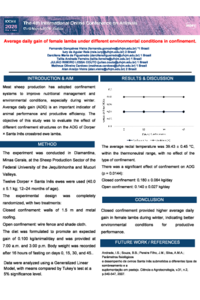
Meat sheep farming has improved its production systems by adopting confinement as a strategy to optimize nutritional management and environmental control, especially during winter. Average daily gain (ADG) is a key indicator reflecting diet efficiency and thermal comfort in facilities. This study aimed to evaluate the effect of different confinement structures during winter on the ADG of hair ewe lambs. The experiment was conducted at the Meat Sheep Sector – UFVJM, Campus JK, in Diamantina-MG, using 12 crossbred Dorper × Santa Inês ewe lambs, averaging 40 kg live weight and 12–24 months of age. Animals were distributed in a completely randomized design with two treatments: closed confinement (1.5 m walls and metal roof) and open confinement (fenced with wire mesh and shaded by shade cloth). The diet was formulated for an expected gain of 0.100 kg/head/day, provided twice daily (7:00 a.m. and 3:00 p.m.). Weighings were performed after a 16-hour solid fasting on July 25, August 8, August 22, and September 12, 2025, totaling 51 days of evaluation. Environmental and rectal temperatures, and wind speeds, were recorded on the same dates, ranging from 12.3 to 22.5 °C and 0.1 to 0.9 m/s in the closed confinement, and from 14.4 to 25.3 °C and 1.6 to 6.5 m/s in the open system. Data were analyzed using a Generalized Linear Model, and means were compared by Tukey’s test at a 5% significance level. Rectal temperatures averaged 39.43 °C, within the species’ thermoneutral zone. Confinement type significantly affected ADG (p<0.05), with mean values of 0.180 kg/day in the closed and 0.140 kg/day in the open system. The higher gain observed in the closed environment indicates better energy efficiency associated with reduced thermal fluctuations and wind exposure. It is concluded that confinement with half walls and metal roofing provided better productive performance during winter, demonstrating suitable adaptation and efficient nutritional management.
Keywords
thermal comfort
confinement
nutrition
meat sheep farming.
Poster
banner2.pdf
Sensor-Derived Heat-Tolerance Traits in Sheep: Heritability, Prediction, and On-Farm Decision Triggers
Characterizations of the Production System and Breeding Practices of Surma Cattle Population in Bench Maji Zone, Southwest Ethiopia