Event submissions
Published
This submission belongs to the session 3. Sustainable Animal Nutrition of the event The 4th International Online Conference on Animals
Published date
12 Mar, 2026
Academic Editor
'%3e%3cpath%20d='M12.6657%2010.9104C12.4185%2010.325%2012.0599%209.79327%2011.6097%209.34482C11.1609%208.89508%2010.6293%208.5365%2010.0442%208.28888C10.0389%208.28626%2010.0337%208.28495%2010.0285%208.28233C10.8446%207.69279%2011.3752%206.73249%2011.3752%205.64904C11.3752%203.8542%209.92103%202.39999%208.1262%202.39999C6.33136%202.39999%204.87715%203.8542%204.87715%205.64904C4.87715%206.73249%205.40774%207.69279%206.22393%208.28364C6.21869%208.28626%206.21345%208.28757%206.20821%208.29019C5.62129%208.5378%205.09463%208.89284%204.64265%209.34613C4.1929%209.79493%203.83432%2010.3266%203.58671%2010.9117C3.34345%2011.4845%203.21226%2012.0987%203.20023%2012.7209C3.19988%2012.7349%203.20233%2012.7488%203.20744%2012.7619C3.21255%2012.7749%203.22022%2012.7867%203.22998%2012.7968C3.23975%2012.8068%203.25142%2012.8147%203.26431%2012.8202C3.2772%2012.8256%203.29105%2012.8284%203.30504%2012.8284H4.09109C4.14874%2012.8284%204.19459%2012.7825%204.1959%2012.7262C4.2221%2011.7148%204.62823%2010.7676%205.34617%2010.0497C6.08899%209.30683%207.0755%208.89808%208.1262%208.89808C9.17689%208.89808%2010.1634%209.30683%2010.9062%2010.0497C11.6242%2010.7676%2012.0303%2011.7148%2012.0565%2012.7262C12.0578%2012.7838%2012.1037%2012.8284%2012.1613%2012.8284H12.9474C12.9613%2012.8284%2012.9752%2012.8256%2012.9881%2012.8202C13.001%2012.8147%2013.0126%2012.8068%2013.0224%2012.7968C13.0322%2012.7867%2013.0398%2012.7749%2013.0449%2012.7619C13.0501%2012.7488%2013.0525%2012.7349%2013.0522%2012.7209C13.0391%2012.0947%2012.9094%2011.4855%2012.6657%2010.9104ZM8.1262%207.9024C7.52486%207.9024%206.9589%207.6679%206.53312%207.24211C6.10733%206.81633%205.87283%206.25037%205.87283%205.64904C5.87283%205.0477%206.10733%204.48174%206.53312%204.05596C6.9589%203.63018%207.52486%203.39567%208.1262%203.39567C8.72753%203.39567%209.29349%203.63018%209.71927%204.05596C10.1451%204.48174%2010.3796%205.0477%2010.3796%205.64904C10.3796%206.25037%2010.1451%206.81633%209.71927%207.24211C9.29349%207.6679%208.72753%207.9024%208.1262%207.9024Z'%20fill='%235D1EE1'/%3e%3c/g%3e%3c/svg%3e) Elisabete Matos
Elisabete MatosCitation
Fernando Gonçalves Vieira, Darcilene Maria de Figueiredo, Iury de Aguiar Reis, Jéssica Mirela Almeida Barbosa, Talita Andrade Ferreira, Fabiola Aparecida Dias Messias, Evaluation of Body Condition Score in Ewe Lambs Under Different Environmental Confinement Conditions, in Proceedings of The 4th International Online Conference on Animals, 17 March–19 March 2026, MDPI: Basel, Switzerland
Share
Email
Facebook
Twitter
LinkedIn
Evaluation of Body Condition Score in Ewe Lambs Under Different Environmental Confinement Conditions
'%3e%3cpath%20d='M12.6647%2010.9104C12.4176%2010.325%2012.0589%209.7933%2011.6088%209.34485C11.16%208.89511%2010.6283%208.53653%2010.0432%208.28891C10.038%208.28629%2010.0327%208.28498%2010.0275%208.28236C10.8437%207.69282%2011.3743%206.73252%2011.3743%205.64907C11.3743%203.85423%209.92005%202.40002%208.12522%202.40002C6.33038%202.40002%204.87618%203.85423%204.87618%205.64907C4.87618%206.73252%205.40677%207.69282%206.22296%208.28367C6.21772%208.28629%206.21248%208.2876%206.20724%208.29022C5.62031%208.53783%205.09365%208.89287%204.64167%209.34616C4.19192%209.79496%203.83334%2010.3266%203.58573%2010.9117C3.34247%2011.4846%203.21128%2012.0987%203.19925%2012.721C3.1989%2012.735%203.20135%2012.7489%203.20646%2012.7619C3.21157%2012.7749%203.21924%2012.7868%203.22901%2012.7968C3.23877%2012.8068%203.25045%2012.8148%203.26334%2012.8202C3.27623%2012.8256%203.29007%2012.8284%203.30406%2012.8284H4.09012C4.14776%2012.8284%204.19362%2012.7825%204.19493%2012.7262C4.22113%2011.7148%204.62726%2010.7676%205.34519%2010.0497C6.08802%209.30686%207.07452%208.89811%208.12522%208.89811C9.17592%208.89811%2010.1624%209.30686%2010.9052%2010.0497C11.6232%2010.7676%2012.0293%2011.7148%2012.0555%2012.7262C12.0568%2012.7839%2012.1027%2012.8284%2012.1603%2012.8284H12.9464C12.9604%2012.8284%2012.9742%2012.8256%2012.9871%2012.8202C13%2012.8148%2013.0117%2012.8068%2013.0214%2012.7968C13.0312%2012.7868%2013.0389%2012.7749%2013.044%2012.7619C13.0491%2012.7489%2013.0515%2012.735%2013.0512%2012.721C13.0381%2012.0947%2012.9084%2011.4856%2012.6647%2010.9104ZM8.12522%207.90243C7.52388%207.90243%206.95792%207.66793%206.53214%207.24215C6.10636%206.81636%205.87185%206.2504%205.87185%205.64907C5.87185%205.04773%206.10636%204.48177%206.53214%204.05599C6.95792%203.63021%207.52388%203.3957%208.12522%203.3957C8.72655%203.3957%209.29252%203.63021%209.7183%204.05599C10.1441%204.48177%2010.3786%205.04773%2010.3786%205.64907C10.3786%206.2504%2010.1441%206.81636%209.7183%207.24215C9.29252%207.66793%208.72655%207.90243%208.12522%207.90243Z'%20fill='%235D1EE1'/%3e%3c/g%3e%3c/svg%3e)
Fernando Gonçalves Vieira 1
Darcilene Maria de Figueiredo 1
Iury de Aguiar Reis 1
Jéssica Mirela Almeida Barbosa 1
Talita Andrade Ferreira 1
Fabiola Aparecida Dias Messias 1
1. Depatarmento de zootecnia_ Universidade Federal dos vales do Jequitinhonha e Mucuri
Abstract
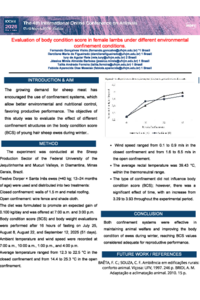
The growing demand for sheep meat has encouraged the adoption of confinement systems, which allow greater environmental and nutritional control, improving animal productive performance. This study aimed to evaluate different confinement structures during the winter on the body condition score (BCS) of hair ewe lambs. The experiment was carried out at the Sheep Production Sector, UFVJM, Diamantina-MG, using 12 Dorper × Santa Inês crossbred ewe lambs, with an average body weight of 40 kg and aged 12 to 24 months, distributed in a completely randomized design with two treatments: closed confinement (1.5 m walls and metal roof) and open confinement (wire fence and shade cloth cover). The animals received a diet formulated for an average daily gain of 0.100 kg/day, offered twice daily at 7 a.m. and 3 p.m. The BCS assessments and weighings were performed after 16 hours of fasting on July 25th, August 8th, August 22nd, and September 12th, 2025, totaling 51 days of evaluation. On the same dates, environmental temperature and wind speed were recorded at 7 a.m., 10 a.m., 1 p.m., and 4 p.m. using a thermometer and anemometer. Temperature and wind speed averaged 12.3–22.5 °C and 0.1–0.9 m/s in the closed confinement and 14.4–25.3 °C and 1.6–6.5 m/s in the open one. Rectal temperatures, measured on weighing days, remained within the thermoneutral range, averaging 39.43 °C, with no difference between confinements (p<0.05). The type of confinement did not influence BCS (p<0.05), but there was a significant effect of time (p<0.001), increasing from 3.29 to 3.93 throughout the experimental period. BCS values ≥3.0 before mating are recommended for better reproductive performance. It is concluded that both systems were effective in maintaining welfare and improving ewe body condition during winter.
Keywords
Welfare
confinement
productive performance
animal nutrition
hair sheep
Poster
banner3.pdf
Effects of in ovo injection of aqueous extracts of phytobiotics on growth performance, blood profile and sex ratio of egg-type chickens
Protective effect of the ethanolic extract of Punica granatum L. during the cooling of bovine ovarian tissue.