Event submissions
Published
This submission belongs to the session 3. Sustainable Animal Nutrition of the event The 4th International Online Conference on Animals
Published date
12 Mar, 2026
Academic Editor
'%3e%3cpath%20d='M12.6657%2010.9104C12.4185%2010.325%2012.0599%209.79327%2011.6097%209.34482C11.1609%208.89508%2010.6293%208.5365%2010.0442%208.28888C10.0389%208.28626%2010.0337%208.28495%2010.0285%208.28233C10.8446%207.69279%2011.3752%206.73249%2011.3752%205.64904C11.3752%203.8542%209.92103%202.39999%208.1262%202.39999C6.33136%202.39999%204.87715%203.8542%204.87715%205.64904C4.87715%206.73249%205.40774%207.69279%206.22393%208.28364C6.21869%208.28626%206.21345%208.28757%206.20821%208.29019C5.62129%208.5378%205.09463%208.89284%204.64265%209.34613C4.1929%209.79493%203.83432%2010.3266%203.58671%2010.9117C3.34345%2011.4845%203.21226%2012.0987%203.20023%2012.7209C3.19988%2012.7349%203.20233%2012.7488%203.20744%2012.7619C3.21255%2012.7749%203.22022%2012.7867%203.22998%2012.7968C3.23975%2012.8068%203.25142%2012.8147%203.26431%2012.8202C3.2772%2012.8256%203.29105%2012.8284%203.30504%2012.8284H4.09109C4.14874%2012.8284%204.19459%2012.7825%204.1959%2012.7262C4.2221%2011.7148%204.62823%2010.7676%205.34617%2010.0497C6.08899%209.30683%207.0755%208.89808%208.1262%208.89808C9.17689%208.89808%2010.1634%209.30683%2010.9062%2010.0497C11.6242%2010.7676%2012.0303%2011.7148%2012.0565%2012.7262C12.0578%2012.7838%2012.1037%2012.8284%2012.1613%2012.8284H12.9474C12.9613%2012.8284%2012.9752%2012.8256%2012.9881%2012.8202C13.001%2012.8147%2013.0126%2012.8068%2013.0224%2012.7968C13.0322%2012.7867%2013.0398%2012.7749%2013.0449%2012.7619C13.0501%2012.7488%2013.0525%2012.7349%2013.0522%2012.7209C13.0391%2012.0947%2012.9094%2011.4855%2012.6657%2010.9104ZM8.1262%207.9024C7.52486%207.9024%206.9589%207.6679%206.53312%207.24211C6.10733%206.81633%205.87283%206.25037%205.87283%205.64904C5.87283%205.0477%206.10733%204.48174%206.53312%204.05596C6.9589%203.63018%207.52486%203.39567%208.1262%203.39567C8.72753%203.39567%209.29349%203.63018%209.71927%204.05596C10.1451%204.48174%2010.3796%205.0477%2010.3796%205.64904C10.3796%206.25037%2010.1451%206.81633%209.71927%207.24211C9.29349%207.6679%208.72753%207.9024%208.1262%207.9024Z'%20fill='%235D1EE1'/%3e%3c/g%3e%3c/svg%3e) Elisabete Matos
Elisabete MatosCitation
Alda Juliana Castro de Sousa, Lívia Ferreira Pinho, Sophia Aparecida Morro Chamilete, Henrique Felipe da Silva, Teresa Cristina Alves, Matheus Deniz, Effect of concentrate moistening on feed intake of dairy cows in an automatic milking system, in Proceedings of The 4th International Online Conference on Animals, 17 March–19 March 2026, MDPI: Basel, Switzerland
Share
Email
Facebook
Twitter
LinkedIn
Effect of concentrate moistening on feed intake of dairy cows in an automatic milking system
'%3e%3cpath%20d='M12.6647%2010.9104C12.4176%2010.325%2012.0589%209.7933%2011.6088%209.34485C11.16%208.89511%2010.6283%208.53653%2010.0432%208.28891C10.038%208.28629%2010.0327%208.28498%2010.0275%208.28236C10.8437%207.69282%2011.3743%206.73252%2011.3743%205.64907C11.3743%203.85423%209.92005%202.40002%208.12522%202.40002C6.33038%202.40002%204.87618%203.85423%204.87618%205.64907C4.87618%206.73252%205.40677%207.69282%206.22296%208.28367C6.21772%208.28629%206.21248%208.2876%206.20724%208.29022C5.62031%208.53783%205.09365%208.89287%204.64167%209.34616C4.19192%209.79496%203.83334%2010.3266%203.58573%2010.9117C3.34247%2011.4846%203.21128%2012.0987%203.19925%2012.721C3.1989%2012.735%203.20135%2012.7489%203.20646%2012.7619C3.21157%2012.7749%203.21924%2012.7868%203.22901%2012.7968C3.23877%2012.8068%203.25045%2012.8148%203.26334%2012.8202C3.27623%2012.8256%203.29007%2012.8284%203.30406%2012.8284H4.09012C4.14776%2012.8284%204.19362%2012.7825%204.19493%2012.7262C4.22113%2011.7148%204.62726%2010.7676%205.34519%2010.0497C6.08802%209.30686%207.07452%208.89811%208.12522%208.89811C9.17592%208.89811%2010.1624%209.30686%2010.9052%2010.0497C11.6232%2010.7676%2012.0293%2011.7148%2012.0555%2012.7262C12.0568%2012.7839%2012.1027%2012.8284%2012.1603%2012.8284H12.9464C12.9604%2012.8284%2012.9742%2012.8256%2012.9871%2012.8202C13%2012.8148%2013.0117%2012.8068%2013.0214%2012.7968C13.0312%2012.7868%2013.0389%2012.7749%2013.044%2012.7619C13.0491%2012.7489%2013.0515%2012.735%2013.0512%2012.721C13.0381%2012.0947%2012.9084%2011.4856%2012.6647%2010.9104ZM8.12522%207.90243C7.52388%207.90243%206.95792%207.66793%206.53214%207.24215C6.10636%206.81636%205.87185%206.2504%205.87185%205.64907C5.87185%205.04773%206.10636%204.48177%206.53214%204.05599C6.95792%203.63021%207.52388%203.3957%208.12522%203.3957C8.72655%203.3957%209.29252%203.63021%209.7183%204.05599C10.1441%204.48177%2010.3786%205.04773%2010.3786%205.64907C10.3786%206.2504%2010.1441%206.81636%209.7183%207.24215C9.29252%207.66793%208.72655%207.90243%208.12522%207.90243Z'%20fill='%235D1EE1'/%3e%3c/g%3e%3c/svg%3e)
Alda Juliana Castro de Sousa 1,2
Lívia Ferreira Pinho 3
Sophia Aparecida Morro Chamilete 4
Henrique Felipe da Silva 5

Teresa Cristina Alves 6

Matheus Deniz 5
1. Prgrama de Pós-Graduação em Zootecnia, Faculdade de Medicina Veterinária e Zootecnia, Universidade Estadual Paulista, Botucatu/SP, Brazil
2. Grupo de estudos em Bovinos Leiteiros, Faculdade de Medicina Veterinária e Zootecnia, Universidade Estadual Paulista, Botucatu, SP;
3. Programa de Pós-Graduação em Ciência Animal, Universidade Federal do Pará, Castanhal, PA;
4. Escola Superior de Agricultura Luiz de Queiroz da Universidade de São Paulo, Piracicaba/SP
5. Grupo de estudos em Bovinos Leiteiros, Faculdade de Medicina Veterinária e Zootecnia, Universidade Estadual Paulista, Botucatu, SP
6. Embrapa Pecuária Sudeste, São Carlos/SP
Abstract
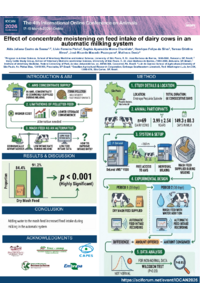
In automatic milking systems (AMS), the concentrate is commonly supplied in pelleted form due to its higher density and faster ingestion rate. However, this type of feed has a higher cost and lower storage convenience. As an alternative, the use of mash feed is economically advantageous but may result in a low intake rate during milking. Thus, adding water to mash feed can be a potential strategy to shorten feeding time during milking. This study aimed to evaluate the effect of adding water to mash feed on the intake of dairy cows managed in AMS. The study was conducted at Embrapa Pecuária Sudeste, São Carlos, SP, Brazil, during 60 consecutive days. Data from 69 dairy cows (3,99 ± 2,54 years; 149.3 ± 88.3 days in milk) were used. The animals had free access to an AMS (DeLaval VMS™ V300), located (~160 m) around the pasture area. During milking, the system automatically supplied mash feed in the trough, individually adjusted based on milk production data. The experiment was divided into two periods; in the first period (30d), dry mash feed was supplied, while in the second period (30d), the mash feed was offered with the addition of water. Individual intake was automatically recorded by the AMS system as the difference between the amount of feed offered and the amount consumed. As the data did not present normality, comparisons were performed using the Wilcoxon test (p<0.05). Cows that consumed mash feed with water showed a higher percentage of intake proportion (91.2 ± 26.6%; p<0.001) compared to the cows that consumed mash feed without water addition (84.4 ± 24.9%). In conclusion, adding water to the mash feed increased feed intake during milking in the automatic system.
Keywords
Feeding behavior
dairy cow
precision livestock farming.
Poster
Effect of concentrate moistening on feed intake of dairy cows in an automatic milking system - Post IOCAN.pdf
Protective effect of the ethanolic extract of Punica granatum L. during the cooling of bovine ovarian tissue.
Effect of a multifunctional additive on the microbiota, behavior, and growth of dairy calves raised in groups in pasture-based systems