Event submissions
Published
This submission belongs to the session 3. Sustainable Animal Nutrition of the event The 4th International Online Conference on Animals
Published date
12 Mar, 2026
Academic Editor
'%3e%3cpath%20d='M12.6657%2010.9104C12.4185%2010.325%2012.0599%209.79327%2011.6097%209.34482C11.1609%208.89508%2010.6293%208.5365%2010.0442%208.28888C10.0389%208.28626%2010.0337%208.28495%2010.0285%208.28233C10.8446%207.69279%2011.3752%206.73249%2011.3752%205.64904C11.3752%203.8542%209.92103%202.39999%208.1262%202.39999C6.33136%202.39999%204.87715%203.8542%204.87715%205.64904C4.87715%206.73249%205.40774%207.69279%206.22393%208.28364C6.21869%208.28626%206.21345%208.28757%206.20821%208.29019C5.62129%208.5378%205.09463%208.89284%204.64265%209.34613C4.1929%209.79493%203.83432%2010.3266%203.58671%2010.9117C3.34345%2011.4845%203.21226%2012.0987%203.20023%2012.7209C3.19988%2012.7349%203.20233%2012.7488%203.20744%2012.7619C3.21255%2012.7749%203.22022%2012.7867%203.22998%2012.7968C3.23975%2012.8068%203.25142%2012.8147%203.26431%2012.8202C3.2772%2012.8256%203.29105%2012.8284%203.30504%2012.8284H4.09109C4.14874%2012.8284%204.19459%2012.7825%204.1959%2012.7262C4.2221%2011.7148%204.62823%2010.7676%205.34617%2010.0497C6.08899%209.30683%207.0755%208.89808%208.1262%208.89808C9.17689%208.89808%2010.1634%209.30683%2010.9062%2010.0497C11.6242%2010.7676%2012.0303%2011.7148%2012.0565%2012.7262C12.0578%2012.7838%2012.1037%2012.8284%2012.1613%2012.8284H12.9474C12.9613%2012.8284%2012.9752%2012.8256%2012.9881%2012.8202C13.001%2012.8147%2013.0126%2012.8068%2013.0224%2012.7968C13.0322%2012.7867%2013.0398%2012.7749%2013.0449%2012.7619C13.0501%2012.7488%2013.0525%2012.7349%2013.0522%2012.7209C13.0391%2012.0947%2012.9094%2011.4855%2012.6657%2010.9104ZM8.1262%207.9024C7.52486%207.9024%206.9589%207.6679%206.53312%207.24211C6.10733%206.81633%205.87283%206.25037%205.87283%205.64904C5.87283%205.0477%206.10733%204.48174%206.53312%204.05596C6.9589%203.63018%207.52486%203.39567%208.1262%203.39567C8.72753%203.39567%209.29349%203.63018%209.71927%204.05596C10.1451%204.48174%2010.3796%205.0477%2010.3796%205.64904C10.3796%206.25037%2010.1451%206.81633%209.71927%207.24211C9.29349%207.6679%208.72753%207.9024%208.1262%207.9024Z'%20fill='%235D1EE1'/%3e%3c/g%3e%3c/svg%3e) Elisabete Matos
Elisabete MatosCitation
Mirela Bondezan Almeida, Jaqueline Fernandes Bruno, Letícia Cassia da Silva, Agatha Mayume Silva Kubo, Sophia Aparecida Morro Chamilete, Teresa Cristina Alves, Karolini Tenffen De-Sousa, Matheus Deniz, Effect of a multifunctional additive on the microbiota, behavior, and growth of dairy calves raised in groups in pasture-based systems, in Proceedings of The 4th International Online Conference on Animals, 17 March–19 March 2026, MDPI: Basel, Switzerland
Share
Email
Facebook
Twitter
LinkedIn
Effect of a multifunctional additive on the microbiota, behavior, and growth of dairy calves raised in groups in pasture-based systems
'%3e%3cpath%20d='M12.6647%2010.9104C12.4176%2010.325%2012.0589%209.7933%2011.6088%209.34485C11.16%208.89511%2010.6283%208.53653%2010.0432%208.28891C10.038%208.28629%2010.0327%208.28498%2010.0275%208.28236C10.8437%207.69282%2011.3743%206.73252%2011.3743%205.64907C11.3743%203.85423%209.92005%202.40002%208.12522%202.40002C6.33038%202.40002%204.87618%203.85423%204.87618%205.64907C4.87618%206.73252%205.40677%207.69282%206.22296%208.28367C6.21772%208.28629%206.21248%208.2876%206.20724%208.29022C5.62031%208.53783%205.09365%208.89287%204.64167%209.34616C4.19192%209.79496%203.83334%2010.3266%203.58573%2010.9117C3.34247%2011.4846%203.21128%2012.0987%203.19925%2012.721C3.1989%2012.735%203.20135%2012.7489%203.20646%2012.7619C3.21157%2012.7749%203.21924%2012.7868%203.22901%2012.7968C3.23877%2012.8068%203.25045%2012.8148%203.26334%2012.8202C3.27623%2012.8256%203.29007%2012.8284%203.30406%2012.8284H4.09012C4.14776%2012.8284%204.19362%2012.7825%204.19493%2012.7262C4.22113%2011.7148%204.62726%2010.7676%205.34519%2010.0497C6.08802%209.30686%207.07452%208.89811%208.12522%208.89811C9.17592%208.89811%2010.1624%209.30686%2010.9052%2010.0497C11.6232%2010.7676%2012.0293%2011.7148%2012.0555%2012.7262C12.0568%2012.7839%2012.1027%2012.8284%2012.1603%2012.8284H12.9464C12.9604%2012.8284%2012.9742%2012.8256%2012.9871%2012.8202C13%2012.8148%2013.0117%2012.8068%2013.0214%2012.7968C13.0312%2012.7868%2013.0389%2012.7749%2013.044%2012.7619C13.0491%2012.7489%2013.0515%2012.735%2013.0512%2012.721C13.0381%2012.0947%2012.9084%2011.4856%2012.6647%2010.9104ZM8.12522%207.90243C7.52388%207.90243%206.95792%207.66793%206.53214%207.24215C6.10636%206.81636%205.87185%206.2504%205.87185%205.64907C5.87185%205.04773%206.10636%204.48177%206.53214%204.05599C6.95792%203.63021%207.52388%203.3957%208.12522%203.3957C8.72655%203.3957%209.29252%203.63021%209.7183%204.05599C10.1441%204.48177%2010.3786%205.04773%2010.3786%205.64907C10.3786%206.2504%2010.1441%206.81636%209.7183%207.24215C9.29252%207.66793%208.72655%207.90243%208.12522%207.90243Z'%20fill='%235D1EE1'/%3e%3c/g%3e%3c/svg%3e)
Mirela Bondezan Almeida 1,2
Jaqueline Fernandes Bruno 3
Letícia Cassia da Silva 3
Agatha Mayume Silva Kubo 4
Sophia Aparecida Morro Chamilete 5

Teresa Cristina Alves 6

Karolini Tenffen De-Sousa 1

Matheus Deniz 1
1. Dairy Cattle Study Group, School of Veterinary Medicine and Animal Science, São Paulo State University, Botucatu, São Paulo, Brazil
2. Graduate Program in Animal Science, School of Veterinary Medicine and Animal Science, São Paulo State University, Botucatu, São Paulo, Brazil
3. Department of Animal Science, Faculty of Animal Science and Food Engineering, University of São Paulo, Pirassununga, São Paulo, Brazil
4. Department of Bioprocesses and Biotechnology, Faculty of Agronomic Sciences, São Paulo State University, Botucatu, São Paulo, Brazil
5. Department of Food and Nutrition, Faculty of Pharmaceutical Sciences, São Paulo State University, Araraquara, SP, Brazil
6. Brazilian Agricultural Research Corporation, Embrapa Southeast Livestock, São Carlos, São Paulo, Brazil
Abstract
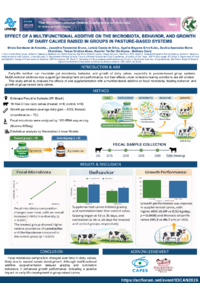
This study aimed to evaluate the effects of oral supplementation of a multifunctional additive on the fecal microbiota, feeding behavior, and growth of calves raised in groups in pasture-based systems. The study was carried out at Embrapa Pecuária Sudeste, Brazil. Sixteen Kiwi-Cross dairy calves were randomly assigned to two groups: treated (n=8): animals (3 g/animal/day) that received a compound of probiotics, prebiotics, essential fatty acids, organic minerals, and amino acids; and control (n=8): animals (3 g/animal/day) that received a placebo. From birth to weaning (0-66 days), the calves' fecal samples (D0, D15, D30, D60, and D66), feeding behavior (grazing and rumination), and growth parameters (average daily gain—ADG and thoracic circumference—TC) were taken. Fecal microbiota were analyzed by 16S rRNA sequencing (Illumina MiSeq), while behavior and growth were analyzed by Generalized Linear Models. Regardless of treatment, there was an increase (~16%) in α-diversity over time (p<0.001). The treated group presented a greater (p = 0.001) relative abundance of the families Lactobacillus and Muribaculaceae than the control group. The treated group (grazing: 43 d; rumination: 36 d) began grazing and rumination behaviors later than the control group (grazing: 35 d; rumination: 28 d). The ADG (p = 0.008) and TC (p = 0.003) were higher in the treated group (ADG: 0.69 kg/day; TC: 90.3 cm) than control group (ADG: 0.52 kg/day; TC: 86.7 cm). In conclusion, the fecal microbiota changed over time, probably due to rumen development during the experimental period. Although supplementation with a multifunctional additive delayed grazing and ruminating behaviors in dairy calves, it improved their growth.
Keywords
behavior
functional nutrition
grazing
gut microbiota
rumination.
Poster
poster resumo iocan_MB.pdf
Effect of concentrate moistening on feed intake of dairy cows in an automatic milking system
Effect of mating rate on offspring sex ratio in Thoroughbred stallions.