Event submissions
Published
This submission belongs to the session 6. Animal Physiology, Reproduction, and Sustainable Animal Production of the event The 4th International Online Conference on Animals
Published date
12 Mar, 2026
Academic Editor
'%3e%3cpath%20d='M12.6657%2010.9104C12.4185%2010.325%2012.0599%209.79327%2011.6097%209.34482C11.1609%208.89508%2010.6293%208.5365%2010.0442%208.28888C10.0389%208.28626%2010.0337%208.28495%2010.0285%208.28233C10.8446%207.69279%2011.3752%206.73249%2011.3752%205.64904C11.3752%203.8542%209.92103%202.39999%208.1262%202.39999C6.33136%202.39999%204.87715%203.8542%204.87715%205.64904C4.87715%206.73249%205.40774%207.69279%206.22393%208.28364C6.21869%208.28626%206.21345%208.28757%206.20821%208.29019C5.62129%208.5378%205.09463%208.89284%204.64265%209.34613C4.1929%209.79493%203.83432%2010.3266%203.58671%2010.9117C3.34345%2011.4845%203.21226%2012.0987%203.20023%2012.7209C3.19988%2012.7349%203.20233%2012.7488%203.20744%2012.7619C3.21255%2012.7749%203.22022%2012.7867%203.22998%2012.7968C3.23975%2012.8068%203.25142%2012.8147%203.26431%2012.8202C3.2772%2012.8256%203.29105%2012.8284%203.30504%2012.8284H4.09109C4.14874%2012.8284%204.19459%2012.7825%204.1959%2012.7262C4.2221%2011.7148%204.62823%2010.7676%205.34617%2010.0497C6.08899%209.30683%207.0755%208.89808%208.1262%208.89808C9.17689%208.89808%2010.1634%209.30683%2010.9062%2010.0497C11.6242%2010.7676%2012.0303%2011.7148%2012.0565%2012.7262C12.0578%2012.7838%2012.1037%2012.8284%2012.1613%2012.8284H12.9474C12.9613%2012.8284%2012.9752%2012.8256%2012.9881%2012.8202C13.001%2012.8147%2013.0126%2012.8068%2013.0224%2012.7968C13.0322%2012.7867%2013.0398%2012.7749%2013.0449%2012.7619C13.0501%2012.7488%2013.0525%2012.7349%2013.0522%2012.7209C13.0391%2012.0947%2012.9094%2011.4855%2012.6657%2010.9104ZM8.1262%207.9024C7.52486%207.9024%206.9589%207.6679%206.53312%207.24211C6.10733%206.81633%205.87283%206.25037%205.87283%205.64904C5.87283%205.0477%206.10733%204.48174%206.53312%204.05596C6.9589%203.63018%207.52486%203.39567%208.1262%203.39567C8.72753%203.39567%209.29349%203.63018%209.71927%204.05596C10.1451%204.48174%2010.3796%205.0477%2010.3796%205.64904C10.3796%206.25037%2010.1451%206.81633%209.71927%207.24211C9.29349%207.6679%208.72753%207.9024%208.1262%207.9024Z'%20fill='%235D1EE1'/%3e%3c/g%3e%3c/svg%3e) Mohammed Gagaoua
Mohammed GagaouaCitation
Karen Daniela Ortiz-Almendarez, Daniel González-Ruiz, Laura Itzel Cañongo-Palma, Metzli Mayte Garcia Bernal, Elisa Gutierrez Hernandez, Alicia Alcantar-Rodriguez, Jose Alfredo Medrano Hernandez, The assessment of a modified protocol for rabbit semen cryopreservation, in Proceedings of The 4th International Online Conference on Animals, 17 March–19 March 2026, MDPI: Basel, Switzerland
Share
Email
Facebook
Twitter
LinkedIn
The assessment of a modified protocol for rabbit semen cryopreservation
'%3e%3cpath%20d='M12.6647%2010.9104C12.4176%2010.325%2012.0589%209.7933%2011.6088%209.34485C11.16%208.89511%2010.6283%208.53653%2010.0432%208.28891C10.038%208.28629%2010.0327%208.28498%2010.0275%208.28236C10.8437%207.69282%2011.3743%206.73252%2011.3743%205.64907C11.3743%203.85423%209.92005%202.40002%208.12522%202.40002C6.33038%202.40002%204.87618%203.85423%204.87618%205.64907C4.87618%206.73252%205.40677%207.69282%206.22296%208.28367C6.21772%208.28629%206.21248%208.2876%206.20724%208.29022C5.62031%208.53783%205.09365%208.89287%204.64167%209.34616C4.19192%209.79496%203.83334%2010.3266%203.58573%2010.9117C3.34247%2011.4846%203.21128%2012.0987%203.19925%2012.721C3.1989%2012.735%203.20135%2012.7489%203.20646%2012.7619C3.21157%2012.7749%203.21924%2012.7868%203.22901%2012.7968C3.23877%2012.8068%203.25045%2012.8148%203.26334%2012.8202C3.27623%2012.8256%203.29007%2012.8284%203.30406%2012.8284H4.09012C4.14776%2012.8284%204.19362%2012.7825%204.19493%2012.7262C4.22113%2011.7148%204.62726%2010.7676%205.34519%2010.0497C6.08802%209.30686%207.07452%208.89811%208.12522%208.89811C9.17592%208.89811%2010.1624%209.30686%2010.9052%2010.0497C11.6232%2010.7676%2012.0293%2011.7148%2012.0555%2012.7262C12.0568%2012.7839%2012.1027%2012.8284%2012.1603%2012.8284H12.9464C12.9604%2012.8284%2012.9742%2012.8256%2012.9871%2012.8202C13%2012.8148%2013.0117%2012.8068%2013.0214%2012.7968C13.0312%2012.7868%2013.0389%2012.7749%2013.044%2012.7619C13.0491%2012.7489%2013.0515%2012.735%2013.0512%2012.721C13.0381%2012.0947%2012.9084%2011.4856%2012.6647%2010.9104ZM8.12522%207.90243C7.52388%207.90243%206.95792%207.66793%206.53214%207.24215C6.10636%206.81636%205.87185%206.2504%205.87185%205.64907C5.87185%205.04773%206.10636%204.48177%206.53214%204.05599C6.95792%203.63021%207.52388%203.3957%208.12522%203.3957C8.72655%203.3957%209.29252%203.63021%209.7183%204.05599C10.1441%204.48177%2010.3786%205.04773%2010.3786%205.64907C10.3786%206.2504%2010.1441%206.81636%209.7183%207.24215C9.29252%207.66793%208.72655%207.90243%208.12522%207.90243Z'%20fill='%235D1EE1'/%3e%3c/g%3e%3c/svg%3e)
Karen Daniela Ortiz-Almendarez 1
Daniel González-Ruiz 1
Laura Itzel Cañongo-Palma 1
Metzli Mayte Garcia Bernal 1
Elisa Gutierrez Hernandez 1
Alicia Alcantar-Rodriguez 1
Jose Alfredo Medrano Hernandez 1
1. Faculty of Superior Studies Cuautitlan, National Autonomous University of Mexico, Cuautitlan Izcalli, Estado de Mexico, C.P. 54714, Mexico
Abstract
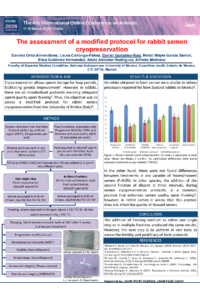
Cryopreservation allows sperm storage for long periods, facilitating genetic improvement. In rabbits, there are no standardized protocols ensuring adequate sperm quality upon thawing. The objective was to assess a modification of the rabbit semen cryopreservation protocol from the University of Molise (Italy). Semen was collected weekly from five New Zealand rabbit bucks; only ejaculates presenting ≥70% progressive motility (PM) and ≥80% viability (VB) were used to form a pool. Sperm PM, VB, normal (NS), acrosome integrity (AI), plasma membrane integrity (MI), and membrane functionality (MF) were assessed before and after cryopreservation. Each pool (n=10) was diluted, at room temperature, in a Tris–Citric Acid–Glucose (TCG) medium without cryoprotectants; sperm concentration was adjusted to 200x106 sperm/ml. Sperm were cooled to 5°C in approximately 90 minutes; then, the pool was split into two parts, into which were added TCG containing dimethyl-sulfoxide (16%) and sucrose (0.1M) as follows: one part (T1) was diluted in one step, packed in 0.25 mL straws, and equilibrated for 45 min; the other part (T2), was diluted in three fractions with a 10-min interval between them, packed in 0.25 mL straws, and equilibrated for 15 min. Then, straws were exposed to nitrogen vapors for 10 min and plunged into liquid nitrogen. For thawing, straws were immersed in water at 50°C for 10 seconds. A T-test was performed between treatments. After thawing, sperm variables for T1 vs. T2 were PM 35±5.77 vs. 35±4.21%, VB 50.9±5.2 vs. 59.2±3.72%, AI 57.6±6.00 vs. 56.4±4.69%, NS 82.2±02.27 vs. 84.7±0.96%, MF 35.5±5.94 vs. 39.6±3.46%, and MI 43.6±5.53 vs. 53.9±6.50%; there were no significant differences between treatments. In conclusion, the addition of freezing medium as either one step or in multiple fractions produced the same results. However, the next step is to perform in vivo tests to assess the fertility and prolificacy of both protocols. This study is supported by UNAM PAPIIT IN206524/ CI2441.
Keywords
Rabbit
spermatozoa
frozen/thawed
Poster
sciforum-160748 Daniel González-Ruiz.pdf
Effects of Steam-Flaked Corn on Rumen Microbial Composition and Metabolism in Yak
Research on sustainable animal nutrition in Animal Husbandry