Event submissions
Published
This submission belongs to the session 1. Sustainable Animal Welfare, Ethics and Human–Animal Interactions of the event The 4th International Online Conference on Animals
Published date
12 Mar, 2026
Academic Editor
'%3e%3cpath%20d='M12.6657%2010.9104C12.4185%2010.325%2012.0599%209.79327%2011.6097%209.34482C11.1609%208.89508%2010.6293%208.5365%2010.0442%208.28888C10.0389%208.28626%2010.0337%208.28495%2010.0285%208.28233C10.8446%207.69279%2011.3752%206.73249%2011.3752%205.64904C11.3752%203.8542%209.92103%202.39999%208.1262%202.39999C6.33136%202.39999%204.87715%203.8542%204.87715%205.64904C4.87715%206.73249%205.40774%207.69279%206.22393%208.28364C6.21869%208.28626%206.21345%208.28757%206.20821%208.29019C5.62129%208.5378%205.09463%208.89284%204.64265%209.34613C4.1929%209.79493%203.83432%2010.3266%203.58671%2010.9117C3.34345%2011.4845%203.21226%2012.0987%203.20023%2012.7209C3.19988%2012.7349%203.20233%2012.7488%203.20744%2012.7619C3.21255%2012.7749%203.22022%2012.7867%203.22998%2012.7968C3.23975%2012.8068%203.25142%2012.8147%203.26431%2012.8202C3.2772%2012.8256%203.29105%2012.8284%203.30504%2012.8284H4.09109C4.14874%2012.8284%204.19459%2012.7825%204.1959%2012.7262C4.2221%2011.7148%204.62823%2010.7676%205.34617%2010.0497C6.08899%209.30683%207.0755%208.89808%208.1262%208.89808C9.17689%208.89808%2010.1634%209.30683%2010.9062%2010.0497C11.6242%2010.7676%2012.0303%2011.7148%2012.0565%2012.7262C12.0578%2012.7838%2012.1037%2012.8284%2012.1613%2012.8284H12.9474C12.9613%2012.8284%2012.9752%2012.8256%2012.9881%2012.8202C13.001%2012.8147%2013.0126%2012.8068%2013.0224%2012.7968C13.0322%2012.7867%2013.0398%2012.7749%2013.0449%2012.7619C13.0501%2012.7488%2013.0525%2012.7349%2013.0522%2012.7209C13.0391%2012.0947%2012.9094%2011.4855%2012.6657%2010.9104ZM8.1262%207.9024C7.52486%207.9024%206.9589%207.6679%206.53312%207.24211C6.10733%206.81633%205.87283%206.25037%205.87283%205.64904C5.87283%205.0477%206.10733%204.48174%206.53312%204.05596C6.9589%203.63018%207.52486%203.39567%208.1262%203.39567C8.72753%203.39567%209.29349%203.63018%209.71927%204.05596C10.1451%204.48174%2010.3796%205.0477%2010.3796%205.64904C10.3796%206.25037%2010.1451%206.81633%209.71927%207.24211C9.29349%207.6679%208.72753%207.9024%208.1262%207.9024Z'%20fill='%235D1EE1'/%3e%3c/g%3e%3c/svg%3e) Clive Julian Phillips
Clive Julian PhillipsCitation
IOANNIS GAITANAKIS, Animal Lovers’ Tourism as a Sustainable Development Strategy: Evidence from Crete, in Proceedings of The 4th International Online Conference on Animals, 17 March–19 March 2026, MDPI: Basel, Switzerland
Share
Email
Facebook
Twitter
LinkedIn
Animal Lovers’ Tourism as a Sustainable Development Strategy: Evidence from Crete

IOANNIS GAITANAKIS 1
1. Department of Business Administration and Tourism, Hellenic Mediterranean University, P.O. Box 1939, 71004, Heraklion, Crete, Greece
Abstract
Background:
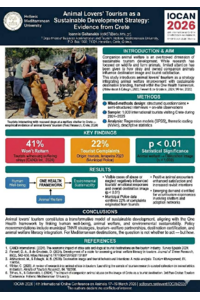
Companion animal welfare is an overlooked but crucial dimension of sustainable tourism development. While attention has often been directed towards wildlife or farm animals, little is known about how the management of stray and owned companion animals influences destination image and tourist satisfaction. This study introduces the concept of animal lovers’ tourism, proposing it as a strategy that combines animal welfare improvement with sustainable destination branding.
Methods:
A mixed-methods design was employed. Quantitative data were collected through a structured questionnaire administered to 1,000 international tourists visiting Crete in 2024–2025. Qualitative insights were derived from semi-structured interviews with stakeholders (tourists, shelter managers, municipal officers) and systematic on-site observations. Data were analyzed using descriptive statistics, regression models, and thematic coding.
Results:
Findings show that visible cases of abuse, neglect, or mismanagement of stray animals negatively affect visitors’ emotional responses and overall destination image (p < 0.01). Conversely, positive encounters with well-cared-for animals enhance satisfaction, increase revisit intentions, and promote positive word-of-mouth. The analysis also reveals an emerging demand for tourism experiences that actively involve animal welfare, such as volunteering in shelters, adoption networks, and animal-friendly accommodations.
Conclusions:
Animal lovers’ tourism can serve as a transformative model of sustainable development, aligning with the One Health framework by linking human well-being, animal welfare, and environmental sustainability. Policy recommendations include municipal strategies for stray animal management, partnerships between tourism operators and welfare organizations, and the integration of animal welfare into destination marketing. These findings provide a foundation for further research and practical implementation in Mediterranean destinations and beyond.
Keywords
Companion animals
sustainable tourism
animal welfare
One Health
destination image
Crete.
Poster
gaitanakis ioacan 2026.pdf
Gastrointestinal nematodes species in cattle: agreement between estimations based on necropsies or on larval cultures
Building Public Trust through Animal Welfare Governance: A One Health–One Welfare Case Study of the Ierapetra Municipal Police and its Impact on Tourist Perceptions