Event submissions
Published
This submission belongs to the session 2. One health: Improve Disease Manifestation and Management in Animals, Humans, and the Environment of the event The 4th International Online Conference on Animals
Published date
12 Mar, 2026
Academic Editor
'%3e%3cpath%20d='M12.6657%2010.9104C12.4185%2010.325%2012.0599%209.79327%2011.6097%209.34482C11.1609%208.89508%2010.6293%208.5365%2010.0442%208.28888C10.0389%208.28626%2010.0337%208.28495%2010.0285%208.28233C10.8446%207.69279%2011.3752%206.73249%2011.3752%205.64904C11.3752%203.8542%209.92103%202.39999%208.1262%202.39999C6.33136%202.39999%204.87715%203.8542%204.87715%205.64904C4.87715%206.73249%205.40774%207.69279%206.22393%208.28364C6.21869%208.28626%206.21345%208.28757%206.20821%208.29019C5.62129%208.5378%205.09463%208.89284%204.64265%209.34613C4.1929%209.79493%203.83432%2010.3266%203.58671%2010.9117C3.34345%2011.4845%203.21226%2012.0987%203.20023%2012.7209C3.19988%2012.7349%203.20233%2012.7488%203.20744%2012.7619C3.21255%2012.7749%203.22022%2012.7867%203.22998%2012.7968C3.23975%2012.8068%203.25142%2012.8147%203.26431%2012.8202C3.2772%2012.8256%203.29105%2012.8284%203.30504%2012.8284H4.09109C4.14874%2012.8284%204.19459%2012.7825%204.1959%2012.7262C4.2221%2011.7148%204.62823%2010.7676%205.34617%2010.0497C6.08899%209.30683%207.0755%208.89808%208.1262%208.89808C9.17689%208.89808%2010.1634%209.30683%2010.9062%2010.0497C11.6242%2010.7676%2012.0303%2011.7148%2012.0565%2012.7262C12.0578%2012.7838%2012.1037%2012.8284%2012.1613%2012.8284H12.9474C12.9613%2012.8284%2012.9752%2012.8256%2012.9881%2012.8202C13.001%2012.8147%2013.0126%2012.8068%2013.0224%2012.7968C13.0322%2012.7867%2013.0398%2012.7749%2013.0449%2012.7619C13.0501%2012.7488%2013.0525%2012.7349%2013.0522%2012.7209C13.0391%2012.0947%2012.9094%2011.4855%2012.6657%2010.9104ZM8.1262%207.9024C7.52486%207.9024%206.9589%207.6679%206.53312%207.24211C6.10733%206.81633%205.87283%206.25037%205.87283%205.64904C5.87283%205.0477%206.10733%204.48174%206.53312%204.05596C6.9589%203.63018%207.52486%203.39567%208.1262%203.39567C8.72753%203.39567%209.29349%203.63018%209.71927%204.05596C10.1451%204.48174%2010.3796%205.0477%2010.3796%205.64904C10.3796%206.25037%2010.1451%206.81633%209.71927%207.24211C9.29349%207.6679%208.72753%207.9024%208.1262%207.9024Z'%20fill='%235D1EE1'/%3e%3c/g%3e%3c/svg%3e) Levon Abrahamyan
Levon AbrahamyanCitation
Ioannis Gaitanakis, Nikolaos Trihas, Building Public Trust through Animal Welfare Governance: A One Health–One Welfare Case Study of the Ierapetra Municipal Police and its Impact on Tourist Perceptions, in Proceedings of The 4th International Online Conference on Animals, 17 March–19 March 2026, MDPI: Basel, Switzerland
Share
Email
Facebook
Twitter
LinkedIn
Building Public Trust through Animal Welfare Governance: A One Health–One Welfare Case Study of the Ierapetra Municipal Police and its Impact on Tourist Perceptions

Ioannis Gaitanakis 1

Nikolaos Trihas 1
1. Department of Business Administration and Tourism, Hellenic Mediterranean University, P.O. Box 1939, 71004, Heraklion, Crete, Greece
Abstract
Introduction:
Animal-welfare governance is increasingly recognized as an essential component of One Health and One Welfare, particularly in tourism-dependent regions where visitor wellbeing and destination image are influenced by animal-related incidents. This study examines how the Municipal Police of Ierapetra, Crete, a municipality with consistently high levels of companion-animal registration (217 per 1,000 residents), functions as an evidence-based example of municipal One Health and One Welfare implementation.
Methods:
A mixed-methods case-study design was applied. Official operational records from the Municipal Police (3,500 animal-related cases from 2010 to 2024) were analyzed to assess enforcement activity, incident types, and welfare outcomes. In addition, 32 tourist testimonies collected from May to October 2024 were examined through reflexive thematic analysis to explore emotional responses, perceived safety, and trust in local authorities. Several participants referred spontaneously to experiences in other Cretan municipalities, providing naturalistic comparative material. Quantitative and qualitative findings were integrated through triangulation.
Results:
During 2024, the Municipal Police handled 566 animal-related cases, representing 40.3 percent of its annual workload, responded to 78 percent of urgent incidents within 24 hours, and provided direct or indirect assistance to approximately 1,850 animals. Tourist testimonies revealed a consistent emotional pattern: initial distress when witnessing mistreated or suffering animals, followed by clear relief and increased trust after municipal intervention. Participants frequently associated timely and humane action with a more positive perception of Ierapetra as a destination, while insufficient responses in other municipalities were linked to ongoing distress and reduced intention to revisit.
Conclusions:
The findings show that structured municipal enforcement can implement One Health and One Welfare in practice by improving animal-welfare outcomes, reducing visitor distress, and strengthening public trust. This case offers a transferable governance model for Mediterranean and European tourist destinations seeking to integrate animal-welfare management into sustainable tourism strategies.
Keywords
One Health
One Welfare
animal welfare governance
municipal police
public trust
destination image
community policing
sustainable tourism
Greece
Poster
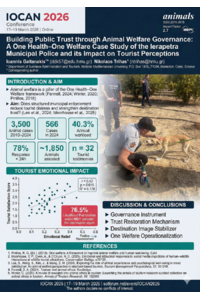
Gaitanakis_Trihas_IOCAN2026_Poster.pdf
Animal Lovers’ Tourism as a Sustainable Development Strategy: Evidence from Crete
Development of an online reporting interface to detect and reduce animal abuse cases