Event submissions
Published
This submission belongs to the session 1. Sustainable Animal Welfare, Ethics and Human–Animal Interactions of the event The 4th International Online Conference on Animals
Published date
12 Mar, 2026
Academic Editor
'%3e%3cpath%20d='M12.6657%2010.9104C12.4185%2010.325%2012.0599%209.79327%2011.6097%209.34482C11.1609%208.89508%2010.6293%208.5365%2010.0442%208.28888C10.0389%208.28626%2010.0337%208.28495%2010.0285%208.28233C10.8446%207.69279%2011.3752%206.73249%2011.3752%205.64904C11.3752%203.8542%209.92103%202.39999%208.1262%202.39999C6.33136%202.39999%204.87715%203.8542%204.87715%205.64904C4.87715%206.73249%205.40774%207.69279%206.22393%208.28364C6.21869%208.28626%206.21345%208.28757%206.20821%208.29019C5.62129%208.5378%205.09463%208.89284%204.64265%209.34613C4.1929%209.79493%203.83432%2010.3266%203.58671%2010.9117C3.34345%2011.4845%203.21226%2012.0987%203.20023%2012.7209C3.19988%2012.7349%203.20233%2012.7488%203.20744%2012.7619C3.21255%2012.7749%203.22022%2012.7867%203.22998%2012.7968C3.23975%2012.8068%203.25142%2012.8147%203.26431%2012.8202C3.2772%2012.8256%203.29105%2012.8284%203.30504%2012.8284H4.09109C4.14874%2012.8284%204.19459%2012.7825%204.1959%2012.7262C4.2221%2011.7148%204.62823%2010.7676%205.34617%2010.0497C6.08899%209.30683%207.0755%208.89808%208.1262%208.89808C9.17689%208.89808%2010.1634%209.30683%2010.9062%2010.0497C11.6242%2010.7676%2012.0303%2011.7148%2012.0565%2012.7262C12.0578%2012.7838%2012.1037%2012.8284%2012.1613%2012.8284H12.9474C12.9613%2012.8284%2012.9752%2012.8256%2012.9881%2012.8202C13.001%2012.8147%2013.0126%2012.8068%2013.0224%2012.7968C13.0322%2012.7867%2013.0398%2012.7749%2013.0449%2012.7619C13.0501%2012.7488%2013.0525%2012.7349%2013.0522%2012.7209C13.0391%2012.0947%2012.9094%2011.4855%2012.6657%2010.9104ZM8.1262%207.9024C7.52486%207.9024%206.9589%207.6679%206.53312%207.24211C6.10733%206.81633%205.87283%206.25037%205.87283%205.64904C5.87283%205.0477%206.10733%204.48174%206.53312%204.05596C6.9589%203.63018%207.52486%203.39567%208.1262%203.39567C8.72753%203.39567%209.29349%203.63018%209.71927%204.05596C10.1451%204.48174%2010.3796%205.0477%2010.3796%205.64904C10.3796%206.25037%2010.1451%206.81633%209.71927%207.24211C9.29349%207.6679%208.72753%207.9024%208.1262%207.9024Z'%20fill='%235D1EE1'/%3e%3c/g%3e%3c/svg%3e) Colin Scanes
Colin ScanesCitation
Priya Gupta Gupta, THE ETHICAL DIVIDE: A PHILOSOPHICAL EXPLORATION OF ANIMAL INDIVIDUALISM AND ECOLOGICAL HOLISM, in Proceedings of The 4th International Online Conference on Animals, 17 March–19 March 2026, MDPI: Basel, Switzerland
Share
Email
Facebook
Twitter
LinkedIn
THE ETHICAL DIVIDE: A PHILOSOPHICAL EXPLORATION OF ANIMAL INDIVIDUALISM AND ECOLOGICAL HOLISM

Priya Gupta Gupta 1
1. Department of Philosophy, University of Lucknow, Lucknow 226 007,INDIA
Abstract
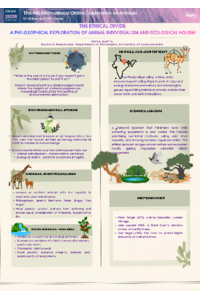
This paper intends to explore two distinct approaches in environmental ethics, namely, Individualism and Holism in the light of interconnected ethical frameworks of Animal-centrism and Eco-centrism. The unprecedented rate of material progress brought about by modernity has given rise to environmental crisis. Though the crisis urgently calls for viable solutions towards sustainable development, in the long term it urges overcoming anthropocentrism that has largely justified destruction-backed development. For most of Western philosophy, Ethics as a branch of Philosophy had remained the exclusive domain of humans. Non-human entities being relegated into categories devoid of moral worth therefore came to be viewed as a means to human ends. It was only after witnessing the 1960s environmental crisis that marked the onset of debate about humanity’s ethical obligations to nature. These intensive debates led to the birth of environmental ethics. Environmental ethics accordingly offers two contrasting approaches for understanding moral value of non-human entities in the form of Individualism and Holism. Individualism focuses on the rights and moral significance of individual beings. Animal Centrism expressed in the works of philosophers Peter Singer and Tom Regan is the systematic expression of Individualism. Animal Centrism argues that the well-being of individual animals, with their capacity for suffering, should be prioritized, over the needs of ecosystems. In contrast Holism takes the whole of nature as having ethical significance. Land Ethics appeared as an influential essay in the 1949 seminal work of American philosopher Aldo Leopold, the hallmark expression of Holism. Emphasizing interconnectedness of all components within ecosystems, it asserts that the well-being of the whole system must be prioritized over the welfare of its individual elements. This critical examination of the above two divergent perspectives offers a nuanced understanding of our moral obligations towards the environment, which is important to address the looming crisis.
Keywords
Environmental Ethics
Individualism
Animal Centrism
Animal Welfare
Animal Rights
Holism
Eco-centrism
Land Ethics
Mixed Community
Poster
sciforum-157324 Priya Gupta.pdf
Effects of Vitrification on Cumulus Expansion and Nuclear Maturation of Abattoir-Derived Cattle Oocytes
Melodious melancholia: Analysing the effect of anthropogenic sound on bird calling behaviour