Event submissions
Published
This submission belongs to the session 1. Sustainable Animal Welfare, Ethics and Human–Animal Interactions of the event The 4th International Online Conference on Animals
Published date
12 Mar, 2026
Academic Editor
'%3e%3cpath%20d='M12.6657%2010.9104C12.4185%2010.325%2012.0599%209.79327%2011.6097%209.34482C11.1609%208.89508%2010.6293%208.5365%2010.0442%208.28888C10.0389%208.28626%2010.0337%208.28495%2010.0285%208.28233C10.8446%207.69279%2011.3752%206.73249%2011.3752%205.64904C11.3752%203.8542%209.92103%202.39999%208.1262%202.39999C6.33136%202.39999%204.87715%203.8542%204.87715%205.64904C4.87715%206.73249%205.40774%207.69279%206.22393%208.28364C6.21869%208.28626%206.21345%208.28757%206.20821%208.29019C5.62129%208.5378%205.09463%208.89284%204.64265%209.34613C4.1929%209.79493%203.83432%2010.3266%203.58671%2010.9117C3.34345%2011.4845%203.21226%2012.0987%203.20023%2012.7209C3.19988%2012.7349%203.20233%2012.7488%203.20744%2012.7619C3.21255%2012.7749%203.22022%2012.7867%203.22998%2012.7968C3.23975%2012.8068%203.25142%2012.8147%203.26431%2012.8202C3.2772%2012.8256%203.29105%2012.8284%203.30504%2012.8284H4.09109C4.14874%2012.8284%204.19459%2012.7825%204.1959%2012.7262C4.2221%2011.7148%204.62823%2010.7676%205.34617%2010.0497C6.08899%209.30683%207.0755%208.89808%208.1262%208.89808C9.17689%208.89808%2010.1634%209.30683%2010.9062%2010.0497C11.6242%2010.7676%2012.0303%2011.7148%2012.0565%2012.7262C12.0578%2012.7838%2012.1037%2012.8284%2012.1613%2012.8284H12.9474C12.9613%2012.8284%2012.9752%2012.8256%2012.9881%2012.8202C13.001%2012.8147%2013.0126%2012.8068%2013.0224%2012.7968C13.0322%2012.7867%2013.0398%2012.7749%2013.0449%2012.7619C13.0501%2012.7488%2013.0525%2012.7349%2013.0522%2012.7209C13.0391%2012.0947%2012.9094%2011.4855%2012.6657%2010.9104ZM8.1262%207.9024C7.52486%207.9024%206.9589%207.6679%206.53312%207.24211C6.10733%206.81633%205.87283%206.25037%205.87283%205.64904C5.87283%205.0477%206.10733%204.48174%206.53312%204.05596C6.9589%203.63018%207.52486%203.39567%208.1262%203.39567C8.72753%203.39567%209.29349%203.63018%209.71927%204.05596C10.1451%204.48174%2010.3796%205.0477%2010.3796%205.64904C10.3796%206.25037%2010.1451%206.81633%209.71927%207.24211C9.29349%207.6679%208.72753%207.9024%208.1262%207.9024Z'%20fill='%235D1EE1'/%3e%3c/g%3e%3c/svg%3e) Michael Hässig
Michael HässigCitation
Swapnanil Mondal, Chayan Munshi, Melodious melancholia: Analysing the effect of anthropogenic sound on bird calling behaviour, in Proceedings of The 4th International Online Conference on Animals, 17 March–19 March 2026, MDPI: Basel, Switzerland
Share
Email
Facebook
Twitter
LinkedIn
Melodious melancholia: Analysing the effect of anthropogenic sound on bird calling behaviour
'%3e%3cpath%20d='M12.6647%2010.9104C12.4176%2010.325%2012.0589%209.7933%2011.6088%209.34485C11.16%208.89511%2010.6283%208.53653%2010.0432%208.28891C10.038%208.28629%2010.0327%208.28498%2010.0275%208.28236C10.8437%207.69282%2011.3743%206.73252%2011.3743%205.64907C11.3743%203.85423%209.92005%202.40002%208.12522%202.40002C6.33038%202.40002%204.87618%203.85423%204.87618%205.64907C4.87618%206.73252%205.40677%207.69282%206.22296%208.28367C6.21772%208.28629%206.21248%208.2876%206.20724%208.29022C5.62031%208.53783%205.09365%208.89287%204.64167%209.34616C4.19192%209.79496%203.83334%2010.3266%203.58573%2010.9117C3.34247%2011.4846%203.21128%2012.0987%203.19925%2012.721C3.1989%2012.735%203.20135%2012.7489%203.20646%2012.7619C3.21157%2012.7749%203.21924%2012.7868%203.22901%2012.7968C3.23877%2012.8068%203.25045%2012.8148%203.26334%2012.8202C3.27623%2012.8256%203.29007%2012.8284%203.30406%2012.8284H4.09012C4.14776%2012.8284%204.19362%2012.7825%204.19493%2012.7262C4.22113%2011.7148%204.62726%2010.7676%205.34519%2010.0497C6.08802%209.30686%207.07452%208.89811%208.12522%208.89811C9.17592%208.89811%2010.1624%209.30686%2010.9052%2010.0497C11.6232%2010.7676%2012.0293%2011.7148%2012.0555%2012.7262C12.0568%2012.7839%2012.1027%2012.8284%2012.1603%2012.8284H12.9464C12.9604%2012.8284%2012.9742%2012.8256%2012.9871%2012.8202C13%2012.8148%2013.0117%2012.8068%2013.0214%2012.7968C13.0312%2012.7868%2013.0389%2012.7749%2013.044%2012.7619C13.0491%2012.7489%2013.0515%2012.735%2013.0512%2012.721C13.0381%2012.0947%2012.9084%2011.4856%2012.6647%2010.9104ZM8.12522%207.90243C7.52388%207.90243%206.95792%207.66793%206.53214%207.24215C6.10636%206.81636%205.87185%206.2504%205.87185%205.64907C5.87185%205.04773%206.10636%204.48177%206.53214%204.05599C6.95792%203.63021%207.52388%203.3957%208.12522%203.3957C8.72655%203.3957%209.29252%203.63021%209.7183%204.05599C10.1441%204.48177%2010.3786%205.04773%2010.3786%205.64907C10.3786%206.2504%2010.1441%206.81636%209.7183%207.24215C9.29252%207.66793%208.72655%207.90243%208.12522%207.90243Z'%20fill='%235D1EE1'/%3e%3c/g%3e%3c/svg%3e)
Swapnanil Mondal 1
Chayan Munshi 1
1. Ethophilia Research Foundation, Santiniketan, 731235, India
Abstract
Introduction:
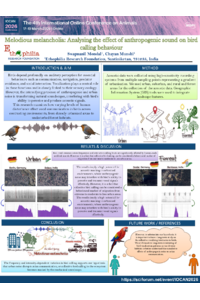
Birds depend profoundly on auditory perception for essential behaviours such as communication, navigation, predator avoidance, and social interaction. Vocalization plays a central role in these functions and is closely linked to their sensory ecology. However, the intensifying presence of anthropogenic and urban noise is transforming natural soundscapes, interfering with birds' ability to perceive and produce acoustic signals. This research examines how varying levels of human disturbance affect vocal communication in birds across contrasting environments, from densely urbanized areas to undisturbed forest habitats.
Methods:
Acoustic data (natural sound recordings) were collected using high-sensitivity recording systems from multiple sampling points representing a gradient of urbanisation. We used urban, suburban, and rural and forest areas for the collection of the acoustic data. Geographic Information System (GIS) tools were used to integrate landscape features.
Results:
Preliminary findings substantiate our fundamental hypothesis and effectively suggest that bird vocal communication frequencies and interactive calling bouts are significantly affected by human-made artificial sounds. However, it is a fact that collective bird calling can be considered a behavioural marker of migration from extreme to moderate to less urban areas. However, to substantiate this kind of hypothesis, it is important to have a long-term study on the collective vocalizing intricacies in birds. The results imply a high potential for acoustic masking in urbanized environments, where anthropogenic noise may interfere with birds' ability to perceive and transmit vocal signals effectively.
Conclusions:
The frequency- and intensity-dependent variation in bird calling supports our hypothesis that urban noise disrupts avian communication, or collective bird calling in the ecosystem becomes masked by the mechanical soundscape. In this changing soundscape, the bird’s voices echo a melodious melancholia—a poignant prelude to the possibility of a future “silent spring”.
Keywords
bird vocal communication
anthropogenic sound
bird calling
Poster
IOCAN26_SNM_CM.pdf
THE ETHICAL DIVIDE: A PHILOSOPHICAL EXPLORATION OF ANIMAL INDIVIDUALISM AND ECOLOGICAL HOLISM
PROSPECTIVE EVALUATION FOR RETRIEVABILITY AND EQUILIBRIUM DURATION ON BULL EPIDIDYMAL SPERM CRYOPRESERVATION