Event submissions
Published
This submission belongs to the session 6. Animal Physiology, Reproduction, and Sustainable Animal Production of the event The 4th International Online Conference on Animals
Published date
12 Mar, 2026
Academic Editor
'%3e%3cpath%20d='M12.6657%2010.9104C12.4185%2010.325%2012.0599%209.79327%2011.6097%209.34482C11.1609%208.89508%2010.6293%208.5365%2010.0442%208.28888C10.0389%208.28626%2010.0337%208.28495%2010.0285%208.28233C10.8446%207.69279%2011.3752%206.73249%2011.3752%205.64904C11.3752%203.8542%209.92103%202.39999%208.1262%202.39999C6.33136%202.39999%204.87715%203.8542%204.87715%205.64904C4.87715%206.73249%205.40774%207.69279%206.22393%208.28364C6.21869%208.28626%206.21345%208.28757%206.20821%208.29019C5.62129%208.5378%205.09463%208.89284%204.64265%209.34613C4.1929%209.79493%203.83432%2010.3266%203.58671%2010.9117C3.34345%2011.4845%203.21226%2012.0987%203.20023%2012.7209C3.19988%2012.7349%203.20233%2012.7488%203.20744%2012.7619C3.21255%2012.7749%203.22022%2012.7867%203.22998%2012.7968C3.23975%2012.8068%203.25142%2012.8147%203.26431%2012.8202C3.2772%2012.8256%203.29105%2012.8284%203.30504%2012.8284H4.09109C4.14874%2012.8284%204.19459%2012.7825%204.1959%2012.7262C4.2221%2011.7148%204.62823%2010.7676%205.34617%2010.0497C6.08899%209.30683%207.0755%208.89808%208.1262%208.89808C9.17689%208.89808%2010.1634%209.30683%2010.9062%2010.0497C11.6242%2010.7676%2012.0303%2011.7148%2012.0565%2012.7262C12.0578%2012.7838%2012.1037%2012.8284%2012.1613%2012.8284H12.9474C12.9613%2012.8284%2012.9752%2012.8256%2012.9881%2012.8202C13.001%2012.8147%2013.0126%2012.8068%2013.0224%2012.7968C13.0322%2012.7867%2013.0398%2012.7749%2013.0449%2012.7619C13.0501%2012.7488%2013.0525%2012.7349%2013.0522%2012.7209C13.0391%2012.0947%2012.9094%2011.4855%2012.6657%2010.9104ZM8.1262%207.9024C7.52486%207.9024%206.9589%207.6679%206.53312%207.24211C6.10733%206.81633%205.87283%206.25037%205.87283%205.64904C5.87283%205.0477%206.10733%204.48174%206.53312%204.05596C6.9589%203.63018%207.52486%203.39567%208.1262%203.39567C8.72753%203.39567%209.29349%203.63018%209.71927%204.05596C10.1451%204.48174%2010.3796%205.0477%2010.3796%205.64904C10.3796%206.25037%2010.1451%206.81633%209.71927%207.24211C9.29349%207.6679%208.72753%207.9024%208.1262%207.9024Z'%20fill='%235D1EE1'/%3e%3c/g%3e%3c/svg%3e) Mohammed Gagaoua
Mohammed GagaouaCitation
JULIANA SOUSA RIBEIRO DE LIMA E SILVA, SOLANO DANTAS MARTINS, MARIANA MORARES FROTA, VÂNIA MARILANDE CECATTO, JOSÉ HENRIQUE LEAL CARDOSO, VALDEVANE ROCHA ARAÚJO, Anethole Preserves the Viability of Epididymal Spermatozoa in Wistar Rats, in Proceedings of The 4th International Online Conference on Animals, 17 March–19 March 2026, MDPI: Basel, Switzerland
Share
Email
Facebook
Twitter
LinkedIn
Anethole Preserves the Viability of Epididymal Spermatozoa in Wistar Rats
'%3e%3cpath%20d='M12.6647%2010.9104C12.4176%2010.325%2012.0589%209.7933%2011.6088%209.34485C11.16%208.89511%2010.6283%208.53653%2010.0432%208.28891C10.038%208.28629%2010.0327%208.28498%2010.0275%208.28236C10.8437%207.69282%2011.3743%206.73252%2011.3743%205.64907C11.3743%203.85423%209.92005%202.40002%208.12522%202.40002C6.33038%202.40002%204.87618%203.85423%204.87618%205.64907C4.87618%206.73252%205.40677%207.69282%206.22296%208.28367C6.21772%208.28629%206.21248%208.2876%206.20724%208.29022C5.62031%208.53783%205.09365%208.89287%204.64167%209.34616C4.19192%209.79496%203.83334%2010.3266%203.58573%2010.9117C3.34247%2011.4846%203.21128%2012.0987%203.19925%2012.721C3.1989%2012.735%203.20135%2012.7489%203.20646%2012.7619C3.21157%2012.7749%203.21924%2012.7868%203.22901%2012.7968C3.23877%2012.8068%203.25045%2012.8148%203.26334%2012.8202C3.27623%2012.8256%203.29007%2012.8284%203.30406%2012.8284H4.09012C4.14776%2012.8284%204.19362%2012.7825%204.19493%2012.7262C4.22113%2011.7148%204.62726%2010.7676%205.34519%2010.0497C6.08802%209.30686%207.07452%208.89811%208.12522%208.89811C9.17592%208.89811%2010.1624%209.30686%2010.9052%2010.0497C11.6232%2010.7676%2012.0293%2011.7148%2012.0555%2012.7262C12.0568%2012.7839%2012.1027%2012.8284%2012.1603%2012.8284H12.9464C12.9604%2012.8284%2012.9742%2012.8256%2012.9871%2012.8202C13%2012.8148%2013.0117%2012.8068%2013.0214%2012.7968C13.0312%2012.7868%2013.0389%2012.7749%2013.044%2012.7619C13.0491%2012.7489%2013.0515%2012.735%2013.0512%2012.721C13.0381%2012.0947%2012.9084%2011.4856%2012.6647%2010.9104ZM8.12522%207.90243C7.52388%207.90243%206.95792%207.66793%206.53214%207.24215C6.10636%206.81636%205.87185%206.2504%205.87185%205.64907C5.87185%205.04773%206.10636%204.48177%206.53214%204.05599C6.95792%203.63021%207.52388%203.3957%208.12522%203.3957C8.72655%203.3957%209.29252%203.63021%209.7183%204.05599C10.1441%204.48177%2010.3786%205.04773%2010.3786%205.64907C10.3786%206.2504%2010.1441%206.81636%209.7183%207.24215C9.29252%207.66793%208.72655%207.90243%208.12522%207.90243Z'%20fill='%235D1EE1'/%3e%3c/g%3e%3c/svg%3e)
JULIANA SOUSA RIBEIRO DE LIMA E SILVA 1
SOLANO DANTAS MARTINS 1
MARIANA MORARES FROTA 2
VÂNIA MARILANDE CECATTO 2
JOSÉ HENRIQUE LEAL CARDOSO 2
VALDEVANE ROCHA ARAÚJO 1
1. Laboratory of Research in Reproductive Physiology (FisioRep Lab), Parnaíba Delta Federal University (UFDPar), Parnaíba 64202-020, Brazil
2. ISCB – Superior Institute of Biomedical Sciences, State University of Ceará (UECE), Fortaleza 60714-903, Brazil
Abstract
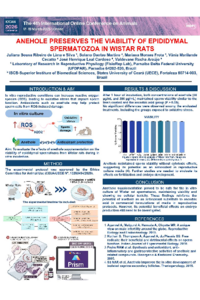
Reproductive biotechnologies, such as in vitro fertilization, are efficient alternatives in both human and animal contexts, enabling couples to achieve pregnancy and contributing to genetic improvements in animals, respectively. However, the excessive production of Reactive Oxygen Species (ROS) in the in vitro environment compromises sperm integrity and reduces fertilizing potential. In light of this challenge, anethole, a phenolic compound with recognized antioxidant activity, has been investigated as a supplement capable of attenuating oxidative stress. Therefore, the aim of the present study was to evaluate the effect of anethole supplementation on sperm viability.
The experimental protocol was approved by the Ethics Committee for Animal Use (CEUA/UECE). Epididymal spermatozoa from Wistar rats (N = 6) were collected by diffusion and incubated for 1 hour in α-MEM medium supplemented with 1.25 mg of BSA in the presence of ascorbic acid (50 µg/mL; positive control) and anethole at concentrations of 30 µg/mL and 300 µg/mL. Both antioxidants were used individually or combined with H₂O₂ (negative control). Sperm viability was assessed using eosin–nigrosin staining and was expressed as the percentage of live cells. The results were analyzed using one-way ANOVA in the GraphPad Prism software using P<0.05%.
After 1 hour of incubation, both anethole concentrations maintained sperm viability similar to the fresh control and the other treatments, including ascorbic acid (P>0.05). No differences were observed among the other groups tested (P>0.05).
Anethole supplementation proved to be safe for the in vitro culture of Wistar rat spermatozoa, maintaining viability and showing no cellular toxicity. These findings reinforce the potential of anethole as an antioxidant substitute to ascorbic acid in commercial formulations of media in reproductive protocols. However, its potential beneficial effects on embryo production still need to be investigated.
Keywords
Anethole
antioxidants
sperm viability
Poster
95 Sem Título_20260306183159.pdf
Fetal Losses in Embryo-Recipient Goats Supplemented with Progestogens
Comparing Patrol-Based and Camera Trap Mark–Resight Methods for Monitoring Population Size and Welfare in Free-Roaming Domestic Cats