Event submissions
Published
This submission belongs to the session 6. Animal Physiology, Reproduction, and Sustainable Animal Production of the event The 4th International Online Conference on Animals
Published date
12 Mar, 2026
Academic Editor
'%3e%3cpath%20d='M12.6657%2010.9104C12.4185%2010.325%2012.0599%209.79327%2011.6097%209.34482C11.1609%208.89508%2010.6293%208.5365%2010.0442%208.28888C10.0389%208.28626%2010.0337%208.28495%2010.0285%208.28233C10.8446%207.69279%2011.3752%206.73249%2011.3752%205.64904C11.3752%203.8542%209.92103%202.39999%208.1262%202.39999C6.33136%202.39999%204.87715%203.8542%204.87715%205.64904C4.87715%206.73249%205.40774%207.69279%206.22393%208.28364C6.21869%208.28626%206.21345%208.28757%206.20821%208.29019C5.62129%208.5378%205.09463%208.89284%204.64265%209.34613C4.1929%209.79493%203.83432%2010.3266%203.58671%2010.9117C3.34345%2011.4845%203.21226%2012.0987%203.20023%2012.7209C3.19988%2012.7349%203.20233%2012.7488%203.20744%2012.7619C3.21255%2012.7749%203.22022%2012.7867%203.22998%2012.7968C3.23975%2012.8068%203.25142%2012.8147%203.26431%2012.8202C3.2772%2012.8256%203.29105%2012.8284%203.30504%2012.8284H4.09109C4.14874%2012.8284%204.19459%2012.7825%204.1959%2012.7262C4.2221%2011.7148%204.62823%2010.7676%205.34617%2010.0497C6.08899%209.30683%207.0755%208.89808%208.1262%208.89808C9.17689%208.89808%2010.1634%209.30683%2010.9062%2010.0497C11.6242%2010.7676%2012.0303%2011.7148%2012.0565%2012.7262C12.0578%2012.7838%2012.1037%2012.8284%2012.1613%2012.8284H12.9474C12.9613%2012.8284%2012.9752%2012.8256%2012.9881%2012.8202C13.001%2012.8147%2013.0126%2012.8068%2013.0224%2012.7968C13.0322%2012.7867%2013.0398%2012.7749%2013.0449%2012.7619C13.0501%2012.7488%2013.0525%2012.7349%2013.0522%2012.7209C13.0391%2012.0947%2012.9094%2011.4855%2012.6657%2010.9104ZM8.1262%207.9024C7.52486%207.9024%206.9589%207.6679%206.53312%207.24211C6.10733%206.81633%205.87283%206.25037%205.87283%205.64904C5.87283%205.0477%206.10733%204.48174%206.53312%204.05596C6.9589%203.63018%207.52486%203.39567%208.1262%203.39567C8.72753%203.39567%209.29349%203.63018%209.71927%204.05596C10.1451%204.48174%2010.3796%205.0477%2010.3796%205.64904C10.3796%206.25037%2010.1451%206.81633%209.71927%207.24211C9.29349%207.6679%208.72753%207.9024%208.1262%207.9024Z'%20fill='%235D1EE1'/%3e%3c/g%3e%3c/svg%3e) Chris Rogers
Chris RogersCitation
Cristina Martínez López, Maria Scaringi, Carlos Manuel Martínez Cáceres, María José Izquierdo Rico, Francisco Alberto García Vázquez, Influence of short-term storage at 4 °C, -20 °C or -80 °C on the quality of decellularized porcine oviductal scaffolds, in Proceedings of The 4th International Online Conference on Animals, 17 March–19 March 2026, MDPI: Basel, Switzerland
Share
Email
Facebook
Twitter
LinkedIn
Influence of short-term storage at 4 °C, -20 °C or -80 °C on the quality of decellularized porcine oviductal scaffolds
'%3e%3cpath%20d='M12.6647%2010.9104C12.4176%2010.325%2012.0589%209.7933%2011.6088%209.34485C11.16%208.89511%2010.6283%208.53653%2010.0432%208.28891C10.038%208.28629%2010.0327%208.28498%2010.0275%208.28236C10.8437%207.69282%2011.3743%206.73252%2011.3743%205.64907C11.3743%203.85423%209.92005%202.40002%208.12522%202.40002C6.33038%202.40002%204.87618%203.85423%204.87618%205.64907C4.87618%206.73252%205.40677%207.69282%206.22296%208.28367C6.21772%208.28629%206.21248%208.2876%206.20724%208.29022C5.62031%208.53783%205.09365%208.89287%204.64167%209.34616C4.19192%209.79496%203.83334%2010.3266%203.58573%2010.9117C3.34247%2011.4846%203.21128%2012.0987%203.19925%2012.721C3.1989%2012.735%203.20135%2012.7489%203.20646%2012.7619C3.21157%2012.7749%203.21924%2012.7868%203.22901%2012.7968C3.23877%2012.8068%203.25045%2012.8148%203.26334%2012.8202C3.27623%2012.8256%203.29007%2012.8284%203.30406%2012.8284H4.09012C4.14776%2012.8284%204.19362%2012.7825%204.19493%2012.7262C4.22113%2011.7148%204.62726%2010.7676%205.34519%2010.0497C6.08802%209.30686%207.07452%208.89811%208.12522%208.89811C9.17592%208.89811%2010.1624%209.30686%2010.9052%2010.0497C11.6232%2010.7676%2012.0293%2011.7148%2012.0555%2012.7262C12.0568%2012.7839%2012.1027%2012.8284%2012.1603%2012.8284H12.9464C12.9604%2012.8284%2012.9742%2012.8256%2012.9871%2012.8202C13%2012.8148%2013.0117%2012.8068%2013.0214%2012.7968C13.0312%2012.7868%2013.0389%2012.7749%2013.044%2012.7619C13.0491%2012.7489%2013.0515%2012.735%2013.0512%2012.721C13.0381%2012.0947%2012.9084%2011.4856%2012.6647%2010.9104ZM8.12522%207.90243C7.52388%207.90243%206.95792%207.66793%206.53214%207.24215C6.10636%206.81636%205.87185%206.2504%205.87185%205.64907C5.87185%205.04773%206.10636%204.48177%206.53214%204.05599C6.95792%203.63021%207.52388%203.3957%208.12522%203.3957C8.72655%203.3957%209.29252%203.63021%209.7183%204.05599C10.1441%204.48177%2010.3786%205.04773%2010.3786%205.64907C10.3786%206.2504%2010.1441%206.81636%209.7183%207.24215C9.29252%207.66793%208.72655%207.90243%208.12522%207.90243Z'%20fill='%235D1EE1'/%3e%3c/g%3e%3c/svg%3e)
Cristina Martínez López 1,2
Maria Scaringi 3
Carlos Manuel Martínez Cáceres 4
María José Izquierdo Rico 2,4
Francisco Alberto García Vázquez 1,4
1. Department of Physiology, Faculty of Veterinary Medicine, University of Murcia, Murcia, Spain
2. Department of Cell Biology and Histology, Faculty of Medicine, University of Murcia, Murcia, Spain
3. Department of Veterinary Sciences, Faculty of Agrobiology, Food and Natural Resources, Czech University of Life Sciences Prague, Prague, Czech Republic
4. Murcian Institute for Biosanitary Research Pascual Parrilla (IMIB), Health Sciences Campus, Murcia, Spain
Abstract
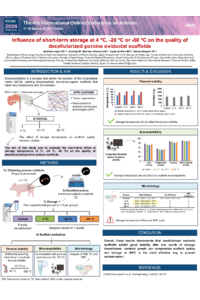
In reproductive medicine, decellularized scaffolds offer new opportunities for treating reproductive tract pathologies and improving assisted reproductive technologies. After obtaining them through decellularization procedures, these scaffolds are usually stored at 4°C, -20°C, or -80°C, although the effect of these temperatures on their quality is unknown. The objective of this study was to evaluate the short-term influence of these storage temperatures on the quality of the decellularized oviduct scaffolds derived from porcine species. Complete oviducts were obtained from prepubertal animals (Large White × Landrace) and decellularized following a previously described immersion–agitation protocol [1]. Subsequently, the scaffolds were stored at 4°C, -20°C, or -80°C for one month. Freshly decellularized oviducts were used as the control (n=4 per group). After storage, samples from each group underwent differential scanning calorimetry (DSC) and were tested for cytotoxicity by co-incubating them with porcine spermatozoa for 3 h at 38°C. Cytotoxicity analysis included the evaluation of sperm motility, kinematic parameters, viability, acrosomal integrity, and mitochondrial activity. The samples were also analyzed microbiologically, including counts of total aerobic bacteria (TAB), total coliforms (TC), and sulfite-reducing clostridia (SRC). The DSC results show no significant differences between the control group and the stored groups, indicating that storage temperature did not affect the thermal stability of the proteins (p > 0.05). No changes were observed in any sperm parameter evaluated after incubation of scaffolds with porcine spermatozoa (p > 0.05). However, storage temperature influenced TAB counts, which were significantly higher in oviducts stored at 4°C and -20°C compared to the control group (p < 0.05). Overall, these results demonstrate that decellularized oviductal scaffolds exhibit good stability after one month of storage. Nevertheless, bacterial growth can compromise scaffold quality, and storage at -80°C is the most effective way to prevent contamination.
[1] Martínez-López C et al. Theriogenology. 2025;231:36–51.
Keywords
Cold storage
Decellularization
Extracellular matrix
Oviduct
Pig
Reproductive biotechnology
Poster
Martínez-López et al., IOCAN 2026.pdf
Habituation to visual barriers in big felids under professional care for behavioural research purposes
A descriptive study of social behaviour when mixing a new goat group: how gentle can it be?