Event submissions
Published
This submission belongs to the session 1. Sustainable Animal Welfare, Ethics and Human–Animal Interactions of the event The 4th International Online Conference on Animals
Published date
12 Mar, 2026
Academic Editor
'%3e%3cpath%20d='M12.6657%2010.9104C12.4185%2010.325%2012.0599%209.79327%2011.6097%209.34482C11.1609%208.89508%2010.6293%208.5365%2010.0442%208.28888C10.0389%208.28626%2010.0337%208.28495%2010.0285%208.28233C10.8446%207.69279%2011.3752%206.73249%2011.3752%205.64904C11.3752%203.8542%209.92103%202.39999%208.1262%202.39999C6.33136%202.39999%204.87715%203.8542%204.87715%205.64904C4.87715%206.73249%205.40774%207.69279%206.22393%208.28364C6.21869%208.28626%206.21345%208.28757%206.20821%208.29019C5.62129%208.5378%205.09463%208.89284%204.64265%209.34613C4.1929%209.79493%203.83432%2010.3266%203.58671%2010.9117C3.34345%2011.4845%203.21226%2012.0987%203.20023%2012.7209C3.19988%2012.7349%203.20233%2012.7488%203.20744%2012.7619C3.21255%2012.7749%203.22022%2012.7867%203.22998%2012.7968C3.23975%2012.8068%203.25142%2012.8147%203.26431%2012.8202C3.2772%2012.8256%203.29105%2012.8284%203.30504%2012.8284H4.09109C4.14874%2012.8284%204.19459%2012.7825%204.1959%2012.7262C4.2221%2011.7148%204.62823%2010.7676%205.34617%2010.0497C6.08899%209.30683%207.0755%208.89808%208.1262%208.89808C9.17689%208.89808%2010.1634%209.30683%2010.9062%2010.0497C11.6242%2010.7676%2012.0303%2011.7148%2012.0565%2012.7262C12.0578%2012.7838%2012.1037%2012.8284%2012.1613%2012.8284H12.9474C12.9613%2012.8284%2012.9752%2012.8256%2012.9881%2012.8202C13.001%2012.8147%2013.0126%2012.8068%2013.0224%2012.7968C13.0322%2012.7867%2013.0398%2012.7749%2013.0449%2012.7619C13.0501%2012.7488%2013.0525%2012.7349%2013.0522%2012.7209C13.0391%2012.0947%2012.9094%2011.4855%2012.6657%2010.9104ZM8.1262%207.9024C7.52486%207.9024%206.9589%207.6679%206.53312%207.24211C6.10733%206.81633%205.87283%206.25037%205.87283%205.64904C5.87283%205.0477%206.10733%204.48174%206.53312%204.05596C6.9589%203.63018%207.52486%203.39567%208.1262%203.39567C8.72753%203.39567%209.29349%203.63018%209.71927%204.05596C10.1451%204.48174%2010.3796%205.0477%2010.3796%205.64904C10.3796%206.25037%2010.1451%206.81633%209.71927%207.24211C9.29349%207.6679%208.72753%207.9024%208.1262%207.9024Z'%20fill='%235D1EE1'/%3e%3c/g%3e%3c/svg%3e) Michael Hässig
Michael HässigCitation
Oluwakayode Michael Coker, Diversity and distribution of amphibians and reptiles in Omo Forest Reserve, Southwestern Nigeria, in Proceedings of The 4th International Online Conference on Animals, 17 March–19 March 2026, MDPI: Basel, Switzerland
Share
Email
Facebook
Twitter
LinkedIn
Diversity and distribution of amphibians and reptiles in Omo Forest Reserve, Southwestern Nigeria
'%3e%3cpath%20d='M12.6647%2010.9104C12.4176%2010.325%2012.0589%209.7933%2011.6088%209.34485C11.16%208.89511%2010.6283%208.53653%2010.0432%208.28891C10.038%208.28629%2010.0327%208.28498%2010.0275%208.28236C10.8437%207.69282%2011.3743%206.73252%2011.3743%205.64907C11.3743%203.85423%209.92005%202.40002%208.12522%202.40002C6.33038%202.40002%204.87618%203.85423%204.87618%205.64907C4.87618%206.73252%205.40677%207.69282%206.22296%208.28367C6.21772%208.28629%206.21248%208.2876%206.20724%208.29022C5.62031%208.53783%205.09365%208.89287%204.64167%209.34616C4.19192%209.79496%203.83334%2010.3266%203.58573%2010.9117C3.34247%2011.4846%203.21128%2012.0987%203.19925%2012.721C3.1989%2012.735%203.20135%2012.7489%203.20646%2012.7619C3.21157%2012.7749%203.21924%2012.7868%203.22901%2012.7968C3.23877%2012.8068%203.25045%2012.8148%203.26334%2012.8202C3.27623%2012.8256%203.29007%2012.8284%203.30406%2012.8284H4.09012C4.14776%2012.8284%204.19362%2012.7825%204.19493%2012.7262C4.22113%2011.7148%204.62726%2010.7676%205.34519%2010.0497C6.08802%209.30686%207.07452%208.89811%208.12522%208.89811C9.17592%208.89811%2010.1624%209.30686%2010.9052%2010.0497C11.6232%2010.7676%2012.0293%2011.7148%2012.0555%2012.7262C12.0568%2012.7839%2012.1027%2012.8284%2012.1603%2012.8284H12.9464C12.9604%2012.8284%2012.9742%2012.8256%2012.9871%2012.8202C13%2012.8148%2013.0117%2012.8068%2013.0214%2012.7968C13.0312%2012.7868%2013.0389%2012.7749%2013.044%2012.7619C13.0491%2012.7489%2013.0515%2012.735%2013.0512%2012.721C13.0381%2012.0947%2012.9084%2011.4856%2012.6647%2010.9104ZM8.12522%207.90243C7.52388%207.90243%206.95792%207.66793%206.53214%207.24215C6.10636%206.81636%205.87185%206.2504%205.87185%205.64907C5.87185%205.04773%206.10636%204.48177%206.53214%204.05599C6.95792%203.63021%207.52388%203.3957%208.12522%203.3957C8.72655%203.3957%209.29252%203.63021%209.7183%204.05599C10.1441%204.48177%2010.3786%205.04773%2010.3786%205.64907C10.3786%206.2504%2010.1441%206.81636%209.7183%207.24215C9.29252%207.66793%208.72655%207.90243%208.12522%207.90243Z'%20fill='%235D1EE1'/%3e%3c/g%3e%3c/svg%3e)
Oluwakayode Michael Coker 1
1. Department of Wildlife and Ecotourism Management, University of Ibadan, Nigeria
Abstract
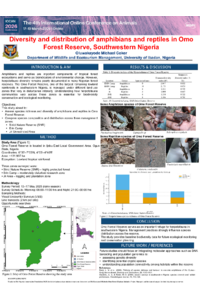
Biodiversity assessments provide critical baselines for conservation planning, particularly in tropical forest ecosystems facing rapid habitat degradation. This study assesses the species richness and diversity of amphibians and reptiles across the three main management units of Omo Forest Reserve, Strict Nature Reserve (strictly managed for flora species), Erin Camp (strictly managed for fauna species), and the J4 area (unrestricted area managed for timber plantation), and compares species composition and distribution patterns among the surveyed sections. Standard visual encounter surveys, pitfall traps, and opportunistic searches were conducted across multiple habitat types, and all individuals were identified to species level. The dataset was analyzed to estimate species richness, and distribution patterns.
A total of 59 individuals representing seven reptile (Agamidae, Boidae, Gekkonidae, Elapidae, Crocodylidae, Pythonidae, and Scincidae) and six amphibian (Hyperoliidae, Arthroleptidae, Dicroglossidae, Phrynobatrachidae, Ptychadenidae, and Bufonidae) families were recorded. There were eleven species of reptiles and 16 species of amphibian. The Erin Camp recorded the highest number of individuals encountered [39 (23 reptiles and 16 amphibian)], followed by the Unrestricted Area (J4) [10 (three reptiles and seven amphibians)], while the Strict Nature Reserve (SNR) recorded 10 individuals (four reptiles and six amphibians). For reptiles, Shannon diversity (H′) ranged from 1.099 (J4) to 2.175 (Erin Camp), while Simpson’s index (1 – D) ranged from 0.667 (J4) to 0.873 (Erin Camp), indicating moderate to high diversity within the study area. For amphibians, Shannon diversity (H′) ranged from 1.330 (SNR) to 2.047 (Erin Camp), while Simpson’s index (1 – D) ranged from 0.722 (SNR) to 0.852 (Erin Camp). The findings highlight Omo Forest Reserve as a key refuge for herpetofaunal diversity in southwestern Nigeria, despite increasing habitat modification. This study provides an essential baseline for future monitoring, habitat restoration planning, and potential genetic diversity assessments.
Keywords
Biodiversity
Conservation
Herpetofauna
Forest reserve
Poster
sciforum-157547 Oluwakayode Michael Coker.pdf
Maternal high-protein diet impairs fetal growth via placental oxidative stress and reduced amino acid transport in mice
ANIMAL CRUELTY AND WELFARE CONDITIONS AT THE AKINYELE ABATTOIR IN IBADAN