Event submissions
Published
This submission belongs to the session 3. Sustainable Animal Nutrition of the event The 4th International Online Conference on Animals
Published date
12 Mar, 2026
Academic Editor
'%3e%3cpath%20d='M12.6657%2010.9104C12.4185%2010.325%2012.0599%209.79327%2011.6097%209.34482C11.1609%208.89508%2010.6293%208.5365%2010.0442%208.28888C10.0389%208.28626%2010.0337%208.28495%2010.0285%208.28233C10.8446%207.69279%2011.3752%206.73249%2011.3752%205.64904C11.3752%203.8542%209.92103%202.39999%208.1262%202.39999C6.33136%202.39999%204.87715%203.8542%204.87715%205.64904C4.87715%206.73249%205.40774%207.69279%206.22393%208.28364C6.21869%208.28626%206.21345%208.28757%206.20821%208.29019C5.62129%208.5378%205.09463%208.89284%204.64265%209.34613C4.1929%209.79493%203.83432%2010.3266%203.58671%2010.9117C3.34345%2011.4845%203.21226%2012.0987%203.20023%2012.7209C3.19988%2012.7349%203.20233%2012.7488%203.20744%2012.7619C3.21255%2012.7749%203.22022%2012.7867%203.22998%2012.7968C3.23975%2012.8068%203.25142%2012.8147%203.26431%2012.8202C3.2772%2012.8256%203.29105%2012.8284%203.30504%2012.8284H4.09109C4.14874%2012.8284%204.19459%2012.7825%204.1959%2012.7262C4.2221%2011.7148%204.62823%2010.7676%205.34617%2010.0497C6.08899%209.30683%207.0755%208.89808%208.1262%208.89808C9.17689%208.89808%2010.1634%209.30683%2010.9062%2010.0497C11.6242%2010.7676%2012.0303%2011.7148%2012.0565%2012.7262C12.0578%2012.7838%2012.1037%2012.8284%2012.1613%2012.8284H12.9474C12.9613%2012.8284%2012.9752%2012.8256%2012.9881%2012.8202C13.001%2012.8147%2013.0126%2012.8068%2013.0224%2012.7968C13.0322%2012.7867%2013.0398%2012.7749%2013.0449%2012.7619C13.0501%2012.7488%2013.0525%2012.7349%2013.0522%2012.7209C13.0391%2012.0947%2012.9094%2011.4855%2012.6657%2010.9104ZM8.1262%207.9024C7.52486%207.9024%206.9589%207.6679%206.53312%207.24211C6.10733%206.81633%205.87283%206.25037%205.87283%205.64904C5.87283%205.0477%206.10733%204.48174%206.53312%204.05596C6.9589%203.63018%207.52486%203.39567%208.1262%203.39567C8.72753%203.39567%209.29349%203.63018%209.71927%204.05596C10.1451%204.48174%2010.3796%205.0477%2010.3796%205.64904C10.3796%206.25037%2010.1451%206.81633%209.71927%207.24211C9.29349%207.6679%208.72753%207.9024%208.1262%207.9024Z'%20fill='%235D1EE1'/%3e%3c/g%3e%3c/svg%3e) Elisabete Matos
Elisabete MatosCitation
Oluwadamilola Victoria OJO, Kehinde Abiodun ADEKOLA, Oluwaseyi TAIWO, Adebisi Favour AGBOOLA, Growth Performance and Visceral Histopathological Assessment of Broiler Chickens fed processed senna seed (Senna occidentalis (L.) meal-based diets, in Proceedings of The 4th International Online Conference on Animals, 17 March–19 March 2026, MDPI: Basel, Switzerland
Share
Email
Facebook
Twitter
LinkedIn
Growth Performance and Visceral Histopathological Assessment of Broiler Chickens fed processed senna seed (Senna occidentalis (L.) meal-based diets
'%3e%3cpath%20d='M12.6647%2010.9104C12.4176%2010.325%2012.0589%209.7933%2011.6088%209.34485C11.16%208.89511%2010.6283%208.53653%2010.0432%208.28891C10.038%208.28629%2010.0327%208.28498%2010.0275%208.28236C10.8437%207.69282%2011.3743%206.73252%2011.3743%205.64907C11.3743%203.85423%209.92005%202.40002%208.12522%202.40002C6.33038%202.40002%204.87618%203.85423%204.87618%205.64907C4.87618%206.73252%205.40677%207.69282%206.22296%208.28367C6.21772%208.28629%206.21248%208.2876%206.20724%208.29022C5.62031%208.53783%205.09365%208.89287%204.64167%209.34616C4.19192%209.79496%203.83334%2010.3266%203.58573%2010.9117C3.34247%2011.4846%203.21128%2012.0987%203.19925%2012.721C3.1989%2012.735%203.20135%2012.7489%203.20646%2012.7619C3.21157%2012.7749%203.21924%2012.7868%203.22901%2012.7968C3.23877%2012.8068%203.25045%2012.8148%203.26334%2012.8202C3.27623%2012.8256%203.29007%2012.8284%203.30406%2012.8284H4.09012C4.14776%2012.8284%204.19362%2012.7825%204.19493%2012.7262C4.22113%2011.7148%204.62726%2010.7676%205.34519%2010.0497C6.08802%209.30686%207.07452%208.89811%208.12522%208.89811C9.17592%208.89811%2010.1624%209.30686%2010.9052%2010.0497C11.6232%2010.7676%2012.0293%2011.7148%2012.0555%2012.7262C12.0568%2012.7839%2012.1027%2012.8284%2012.1603%2012.8284H12.9464C12.9604%2012.8284%2012.9742%2012.8256%2012.9871%2012.8202C13%2012.8148%2013.0117%2012.8068%2013.0214%2012.7968C13.0312%2012.7868%2013.0389%2012.7749%2013.044%2012.7619C13.0491%2012.7489%2013.0515%2012.735%2013.0512%2012.721C13.0381%2012.0947%2012.9084%2011.4856%2012.6647%2010.9104ZM8.12522%207.90243C7.52388%207.90243%206.95792%207.66793%206.53214%207.24215C6.10636%206.81636%205.87185%206.2504%205.87185%205.64907C5.87185%205.04773%206.10636%204.48177%206.53214%204.05599C6.95792%203.63021%207.52388%203.3957%208.12522%203.3957C8.72655%203.3957%209.29252%203.63021%209.7183%204.05599C10.1441%204.48177%2010.3786%205.04773%2010.3786%205.64907C10.3786%206.2504%2010.1441%206.81636%209.7183%207.24215C9.29252%207.66793%208.72655%207.90243%208.12522%207.90243Z'%20fill='%235D1EE1'/%3e%3c/g%3e%3c/svg%3e)
Oluwadamilola Victoria OJO 1
Kehinde Abiodun ADEKOLA 1
Oluwaseyi TAIWO 1
Adebisi Favour AGBOOLA 1
1. Department of Animal Science, University of Ibadan, Ibadan, Oyo State, Nigeria
Abstract
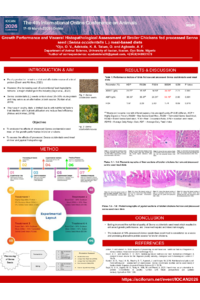
Senna occidentalis (L.) seed is a nutrient dense plant protein ingredient for poultry diets. However, its utilisation is constrained by the presence of anti-nutritional factors which may elicit metabolic disorder and poor performance in birds. Processing techniques have been shown to alleviate these limitations. This study therefore evaluated the effects of Senna occidentalis seed meal-based diets on growth performance and liver-jejunal histopathology of broiler chickens.
One hundred and sixty 17-day old Ross 308 broiler chicks were randomly allotted into four dietary treatments with five replicates of eight birds each in a completely randomised design. Diet 1 was a highly digestible protein (HDP); a control and diets 2, 3 and 4 contained Raw Senna Seed Meal (RSSM), Fermented Senna Seed Meal (FSSM), and Boiled Senna Seed Meal (BSSM) supplemented diets. Performance indices were measured. On day 21, liver and jejunal samples were harvested and examined for histopathological evaluations following standard procedures. Data were analysed using ANOVA at P = α0.05.
Birds fed BSSM diet recorded the highest (P < 0.05) average daily weight gain (34.80 g/b) and average daily feed intake (58.19 g/b) compared with the other diets. Liver of birds fed BSSM diet showed normal architecture with intact hepatocytes, with no observable necrosis while birds fed RSSM diet exhibited periportal fibrosis, sinusoidal dilation, and inflammatory infiltration, indicating hepatic stress. Jejunal sections of the birds fed the raw and processed SSM displayed intact villi and mild crypt hyperplasia without vascular changes, fibrosis or necrosis.
In conclusion, boiling improved the nutritional quality of Senna occidentalis seed meal which resulted in enhanced growth performance, and preserved hepatic and intestinal integrity. Therefore, the inclusion of 10% processed Senna occidentalis seed meal is considered as a viable and promising alternative protein source for broiler chickens.
Keywords
Senna seeds
Processing techniques
Growth response
Organ histopathology
Poster
OJO et al.,POSTER.pdf
Sawdust Utilization in WAD Goat Diets: A Comparative Analysis of Wood Ash, Hot Water, Caustic Soda, and Molasses Pre-treatments
Short-term cold storage of Caspian shemaya (Alburnus chalcoides) sperm