Event submissions
Published
This submission belongs to the session 3. Sustainable Animal Nutrition of the event The 4th International Online Conference on Animals
Published date
12 Mar, 2026
Academic Editor
'%3e%3cpath%20d='M12.6657%2010.9104C12.4185%2010.325%2012.0599%209.79327%2011.6097%209.34482C11.1609%208.89508%2010.6293%208.5365%2010.0442%208.28888C10.0389%208.28626%2010.0337%208.28495%2010.0285%208.28233C10.8446%207.69279%2011.3752%206.73249%2011.3752%205.64904C11.3752%203.8542%209.92103%202.39999%208.1262%202.39999C6.33136%202.39999%204.87715%203.8542%204.87715%205.64904C4.87715%206.73249%205.40774%207.69279%206.22393%208.28364C6.21869%208.28626%206.21345%208.28757%206.20821%208.29019C5.62129%208.5378%205.09463%208.89284%204.64265%209.34613C4.1929%209.79493%203.83432%2010.3266%203.58671%2010.9117C3.34345%2011.4845%203.21226%2012.0987%203.20023%2012.7209C3.19988%2012.7349%203.20233%2012.7488%203.20744%2012.7619C3.21255%2012.7749%203.22022%2012.7867%203.22998%2012.7968C3.23975%2012.8068%203.25142%2012.8147%203.26431%2012.8202C3.2772%2012.8256%203.29105%2012.8284%203.30504%2012.8284H4.09109C4.14874%2012.8284%204.19459%2012.7825%204.1959%2012.7262C4.2221%2011.7148%204.62823%2010.7676%205.34617%2010.0497C6.08899%209.30683%207.0755%208.89808%208.1262%208.89808C9.17689%208.89808%2010.1634%209.30683%2010.9062%2010.0497C11.6242%2010.7676%2012.0303%2011.7148%2012.0565%2012.7262C12.0578%2012.7838%2012.1037%2012.8284%2012.1613%2012.8284H12.9474C12.9613%2012.8284%2012.9752%2012.8256%2012.9881%2012.8202C13.001%2012.8147%2013.0126%2012.8068%2013.0224%2012.7968C13.0322%2012.7867%2013.0398%2012.7749%2013.0449%2012.7619C13.0501%2012.7488%2013.0525%2012.7349%2013.0522%2012.7209C13.0391%2012.0947%2012.9094%2011.4855%2012.6657%2010.9104ZM8.1262%207.9024C7.52486%207.9024%206.9589%207.6679%206.53312%207.24211C6.10733%206.81633%205.87283%206.25037%205.87283%205.64904C5.87283%205.0477%206.10733%204.48174%206.53312%204.05596C6.9589%203.63018%207.52486%203.39567%208.1262%203.39567C8.72753%203.39567%209.29349%203.63018%209.71927%204.05596C10.1451%204.48174%2010.3796%205.0477%2010.3796%205.64904C10.3796%206.25037%2010.1451%206.81633%209.71927%207.24211C9.29349%207.6679%208.72753%207.9024%208.1262%207.9024Z'%20fill='%235D1EE1'/%3e%3c/g%3e%3c/svg%3e) Elisabete Matos
Elisabete MatosCitation
Akorede Feranmi Adediji, Oluwaseyi Taiwo, Kehinde Abiodun Adekola, Adebisi Favour Agboola, Phytochemical Properties of Processed Senna Seed (Senna occidentalis L.) and its Influence on Serum Biochemical Indices in Broiler Chickens, in Proceedings of The 4th International Online Conference on Animals, 17 March–19 March 2026, MDPI: Basel, Switzerland
Share
Email
Facebook
Twitter
LinkedIn
Phytochemical Properties of Processed Senna Seed (Senna occidentalis L.) and its Influence on Serum Biochemical Indices in Broiler Chickens
'%3e%3cpath%20d='M12.6647%2010.9104C12.4176%2010.325%2012.0589%209.7933%2011.6088%209.34485C11.16%208.89511%2010.6283%208.53653%2010.0432%208.28891C10.038%208.28629%2010.0327%208.28498%2010.0275%208.28236C10.8437%207.69282%2011.3743%206.73252%2011.3743%205.64907C11.3743%203.85423%209.92005%202.40002%208.12522%202.40002C6.33038%202.40002%204.87618%203.85423%204.87618%205.64907C4.87618%206.73252%205.40677%207.69282%206.22296%208.28367C6.21772%208.28629%206.21248%208.2876%206.20724%208.29022C5.62031%208.53783%205.09365%208.89287%204.64167%209.34616C4.19192%209.79496%203.83334%2010.3266%203.58573%2010.9117C3.34247%2011.4846%203.21128%2012.0987%203.19925%2012.721C3.1989%2012.735%203.20135%2012.7489%203.20646%2012.7619C3.21157%2012.7749%203.21924%2012.7868%203.22901%2012.7968C3.23877%2012.8068%203.25045%2012.8148%203.26334%2012.8202C3.27623%2012.8256%203.29007%2012.8284%203.30406%2012.8284H4.09012C4.14776%2012.8284%204.19362%2012.7825%204.19493%2012.7262C4.22113%2011.7148%204.62726%2010.7676%205.34519%2010.0497C6.08802%209.30686%207.07452%208.89811%208.12522%208.89811C9.17592%208.89811%2010.1624%209.30686%2010.9052%2010.0497C11.6232%2010.7676%2012.0293%2011.7148%2012.0555%2012.7262C12.0568%2012.7839%2012.1027%2012.8284%2012.1603%2012.8284H12.9464C12.9604%2012.8284%2012.9742%2012.8256%2012.9871%2012.8202C13%2012.8148%2013.0117%2012.8068%2013.0214%2012.7968C13.0312%2012.7868%2013.0389%2012.7749%2013.044%2012.7619C13.0491%2012.7489%2013.0515%2012.735%2013.0512%2012.721C13.0381%2012.0947%2012.9084%2011.4856%2012.6647%2010.9104ZM8.12522%207.90243C7.52388%207.90243%206.95792%207.66793%206.53214%207.24215C6.10636%206.81636%205.87185%206.2504%205.87185%205.64907C5.87185%205.04773%206.10636%204.48177%206.53214%204.05599C6.95792%203.63021%207.52388%203.3957%208.12522%203.3957C8.72655%203.3957%209.29252%203.63021%209.7183%204.05599C10.1441%204.48177%2010.3786%205.04773%2010.3786%205.64907C10.3786%206.2504%2010.1441%206.81636%209.7183%207.24215C9.29252%207.66793%208.72655%207.90243%208.12522%207.90243Z'%20fill='%235D1EE1'/%3e%3c/g%3e%3c/svg%3e)
Akorede Feranmi Adediji 1
Oluwaseyi Taiwo 1
Kehinde Abiodun Adekola 1
Adebisi Favour Agboola 1
1. Department of Animal Science, University of Ibadan, Ibadan, Oyo State, Nigeria
Abstract
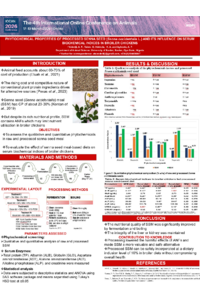
Senna occidentalis (L.) is a tropical legume with promising nutritional value for poultry feeding. However, its utlisation in broiler diets is limited by the presence of anti-nutritional factors that impair overall performance. Processing techniques have been reported to mitigate these constraints and enhance its nutritional quality. This study evaluates the phytochemical properties of processed Senna occidentalis seed and its effect on the serum biochemical profile of broiler chickens.
One hundred and sixty (160) 17-day old Ross 308 broiler chicks were randomly assigned to four dietary treatments with five replicates of eight birds each in a completely randomised design. Diet 1 was a highly digestible protein (HDP), diets 2, 3 and 4 contained 10% Raw Senna Seed Meal (RSSM), 10% Fermented (FSSM), and 10% Boiled (BSSM) supplemented diets. Phytochemical screening of the processed seed meals was determined using standard procedures. On day 21, 2mL of blood samples were collected from three birds per treatment for serum biochemical assay. Data were analysed using ANOVA at P = α0.05.
Flavonoids and alkaloids were abundantly present (++ve) across treatments. Saponins and tannins were more pronounced (++ve) in FSSM and RSSM while anthraquinones were abundantly present (++ve) in BSSM. Alkaloids content was highest in the RSSM (2.70%) and BSSM (2.40%), while FSSM had increased flavonoids (2.23%) and terpenoids (2.25%) contents. BSSM showed moderate levels of phytochemicals across compounds. Serum biochemical indices revealed elevated total protein (3.77g/dL) and albumin (1.03g/dL) in birds fed BSSM diet, while birds fed RSSM (3.83mg/dL) and FSSM (3.43mg/dL) diets had higher urea levels. Other parameters showed no significant differences.
In conclusion, fermentation and boiling enhanced the nutritional value of Senna occidentalis seed meal and improved the serum biochemical profile of broiler chickens, suggesting its potential as a safe and effective alternative protein ingredient in broiler diets.
Keywords
Senna occidentalis
fermentation
boiling
phytochemicals
broiler chickens
Poster
SSM STUDY POSTER IOCAN TEMPLATE.pdf
Short-term cold storage of Caspian shemaya (Alburnus chalcoides) sperm
Effects of Dietary Inclusion of Piper guineense Leaf and Seed on Gut Development and Organ (Liver and Kidney) Histology in Broiler Chickens