Event submissions
Published
This submission belongs to the session 6. Animal Physiology, Reproduction, and Sustainable Animal Production of the event The 4th International Online Conference on Animals
Published date
12 Mar, 2026
Academic Editor
'%3e%3cpath%20d='M12.6657%2010.9104C12.4185%2010.325%2012.0599%209.79327%2011.6097%209.34482C11.1609%208.89508%2010.6293%208.5365%2010.0442%208.28888C10.0389%208.28626%2010.0337%208.28495%2010.0285%208.28233C10.8446%207.69279%2011.3752%206.73249%2011.3752%205.64904C11.3752%203.8542%209.92103%202.39999%208.1262%202.39999C6.33136%202.39999%204.87715%203.8542%204.87715%205.64904C4.87715%206.73249%205.40774%207.69279%206.22393%208.28364C6.21869%208.28626%206.21345%208.28757%206.20821%208.29019C5.62129%208.5378%205.09463%208.89284%204.64265%209.34613C4.1929%209.79493%203.83432%2010.3266%203.58671%2010.9117C3.34345%2011.4845%203.21226%2012.0987%203.20023%2012.7209C3.19988%2012.7349%203.20233%2012.7488%203.20744%2012.7619C3.21255%2012.7749%203.22022%2012.7867%203.22998%2012.7968C3.23975%2012.8068%203.25142%2012.8147%203.26431%2012.8202C3.2772%2012.8256%203.29105%2012.8284%203.30504%2012.8284H4.09109C4.14874%2012.8284%204.19459%2012.7825%204.1959%2012.7262C4.2221%2011.7148%204.62823%2010.7676%205.34617%2010.0497C6.08899%209.30683%207.0755%208.89808%208.1262%208.89808C9.17689%208.89808%2010.1634%209.30683%2010.9062%2010.0497C11.6242%2010.7676%2012.0303%2011.7148%2012.0565%2012.7262C12.0578%2012.7838%2012.1037%2012.8284%2012.1613%2012.8284H12.9474C12.9613%2012.8284%2012.9752%2012.8256%2012.9881%2012.8202C13.001%2012.8147%2013.0126%2012.8068%2013.0224%2012.7968C13.0322%2012.7867%2013.0398%2012.7749%2013.0449%2012.7619C13.0501%2012.7488%2013.0525%2012.7349%2013.0522%2012.7209C13.0391%2012.0947%2012.9094%2011.4855%2012.6657%2010.9104ZM8.1262%207.9024C7.52486%207.9024%206.9589%207.6679%206.53312%207.24211C6.10733%206.81633%205.87283%206.25037%205.87283%205.64904C5.87283%205.0477%206.10733%204.48174%206.53312%204.05596C6.9589%203.63018%207.52486%203.39567%208.1262%203.39567C8.72753%203.39567%209.29349%203.63018%209.71927%204.05596C10.1451%204.48174%2010.3796%205.0477%2010.3796%205.64904C10.3796%206.25037%2010.1451%206.81633%209.71927%207.24211C9.29349%207.6679%208.72753%207.9024%208.1262%207.9024Z'%20fill='%235D1EE1'/%3e%3c/g%3e%3c/svg%3e) Chris Rogers
Chris RogersCitation
Nkechi Lydia Okocha, Herbert Udo, Scholarstica Urom, HORMONAL DYNAMICS AND REPRODUCTIVE EFFICIENCY IN RABBIT DOES FED CLOVE (SYZYGIUM AROMATICUM), in Proceedings of The 4th International Online Conference on Animals, 17 March–19 March 2026, MDPI: Basel, Switzerland
Share
Email
Facebook
Twitter
LinkedIn
HORMONAL DYNAMICS AND REPRODUCTIVE EFFICIENCY IN RABBIT DOES FED CLOVE (SYZYGIUM AROMATICUM)
'%3e%3cpath%20d='M12.6647%2010.9104C12.4176%2010.325%2012.0589%209.7933%2011.6088%209.34485C11.16%208.89511%2010.6283%208.53653%2010.0432%208.28891C10.038%208.28629%2010.0327%208.28498%2010.0275%208.28236C10.8437%207.69282%2011.3743%206.73252%2011.3743%205.64907C11.3743%203.85423%209.92005%202.40002%208.12522%202.40002C6.33038%202.40002%204.87618%203.85423%204.87618%205.64907C4.87618%206.73252%205.40677%207.69282%206.22296%208.28367C6.21772%208.28629%206.21248%208.2876%206.20724%208.29022C5.62031%208.53783%205.09365%208.89287%204.64167%209.34616C4.19192%209.79496%203.83334%2010.3266%203.58573%2010.9117C3.34247%2011.4846%203.21128%2012.0987%203.19925%2012.721C3.1989%2012.735%203.20135%2012.7489%203.20646%2012.7619C3.21157%2012.7749%203.21924%2012.7868%203.22901%2012.7968C3.23877%2012.8068%203.25045%2012.8148%203.26334%2012.8202C3.27623%2012.8256%203.29007%2012.8284%203.30406%2012.8284H4.09012C4.14776%2012.8284%204.19362%2012.7825%204.19493%2012.7262C4.22113%2011.7148%204.62726%2010.7676%205.34519%2010.0497C6.08802%209.30686%207.07452%208.89811%208.12522%208.89811C9.17592%208.89811%2010.1624%209.30686%2010.9052%2010.0497C11.6232%2010.7676%2012.0293%2011.7148%2012.0555%2012.7262C12.0568%2012.7839%2012.1027%2012.8284%2012.1603%2012.8284H12.9464C12.9604%2012.8284%2012.9742%2012.8256%2012.9871%2012.8202C13%2012.8148%2013.0117%2012.8068%2013.0214%2012.7968C13.0312%2012.7868%2013.0389%2012.7749%2013.044%2012.7619C13.0491%2012.7489%2013.0515%2012.735%2013.0512%2012.721C13.0381%2012.0947%2012.9084%2011.4856%2012.6647%2010.9104ZM8.12522%207.90243C7.52388%207.90243%206.95792%207.66793%206.53214%207.24215C6.10636%206.81636%205.87185%206.2504%205.87185%205.64907C5.87185%205.04773%206.10636%204.48177%206.53214%204.05599C6.95792%203.63021%207.52388%203.3957%208.12522%203.3957C8.72655%203.3957%209.29252%203.63021%209.7183%204.05599C10.1441%204.48177%2010.3786%205.04773%2010.3786%205.64907C10.3786%206.2504%2010.1441%206.81636%209.7183%207.24215C9.29252%207.66793%208.72655%207.90243%208.12522%207.90243Z'%20fill='%235D1EE1'/%3e%3c/g%3e%3c/svg%3e)
Nkechi Lydia Okocha 1
Herbert Udo 1
Scholarstica Urom 1
1. DEPARTMENT OF ANIMAL BREEDING AND PHYSIOLOGY, MICHAEL OKPARA UNIVERSITY OF AGRICULTURE UMUDIKE, UMUDIKE, NIGERIA
Abstract
Abstract
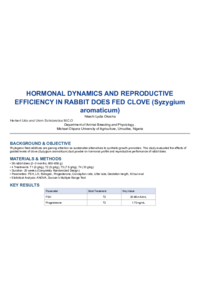
This study assessed the effects of dietary inclusion of Syzygium aromaticum (clove) bud powder on hormonal profiles and reproductive efficiency in rabbit does. Thirty-six does (2–3 months old; 600–650 g) were randomly allocated to four treatment groups—T1 (0 g/kg), T2 (5 g/kg), T3 (7.5 g/kg), and T4 (10 g/kg)—for 20 weeks in a completely randomized design. Data were analyzed using ANOVA and Duncan’s test. Several hormonal parameters (FSH, LH, estrogen, and progesterone) were measured, alongside reproductive indices such as conception rate, gestation length, litter size, litter weight, and pre-weaning survival. The moderate inclusion of clove significantly increased FSH and progesterone levels, with peak values in the T2 (20.88 mIU/mL and 1.70 ng/mL) and T3 (18.23 mIU/mL FSH) groups, indicating enhanced follicular and luteal functions. LH rose with increasing clove levels, highest in T4 (15.87 mIU/mL), though these were associated with reduced FSH and progesterone, suggesting possible hormonal dysregulation at higher doses. Estradiol showed a non-significant increase. Maternal weights at mating and conception rose with clove inclusion, highest in T3 and T4 (1850.11 g and 1950.89 g), respectively. Gestation length was significantly reduced in T2 and T4 (~28.5 days). T2 recorded the highest litter size (4.44 kits), lowest pre-weaning mortality (2.22%), and highest kit survivability (93.29%). These findings suggest that moderate clove inclusion (5–7.5 g/kg) can improve reproductive traits and hormonal balance in rabbit does, promoting sustainable production. However, there is a suggestion that higher doses may disrupt endocrine regulation.
Keywords
Keywords: Clove(Syzygium aromaticum)
rabbit does
reproductive physiology
hormonal profile
phytogenic additive
sustainable production.
Poster
IOCAN 2026.pdf
The State of Dairy and Farm Animal Welfare in Pakistan: A Call to Action for Sustainable Livestock Production
MOLECULAR IDENTIFICATION AND ANTIBIOTIC RESISTANCE PROFILING OF STAPHYLOCOCCUS AURUES AND ESCHERICHIA COLI ISOLATED FROM MASTITIC MILK SAMPLES OF LARGE RUMINANTS