Event submissions
Published
This submission belongs to the session 2. One health: Improve Disease Manifestation and Management in Animals, Humans, and the Environment of the event The 4th International Online Conference on Animals
Published date
12 Mar, 2026
Academic Editor
'%3e%3cpath%20d='M12.6657%2010.9104C12.4185%2010.325%2012.0599%209.79327%2011.6097%209.34482C11.1609%208.89508%2010.6293%208.5365%2010.0442%208.28888C10.0389%208.28626%2010.0337%208.28495%2010.0285%208.28233C10.8446%207.69279%2011.3752%206.73249%2011.3752%205.64904C11.3752%203.8542%209.92103%202.39999%208.1262%202.39999C6.33136%202.39999%204.87715%203.8542%204.87715%205.64904C4.87715%206.73249%205.40774%207.69279%206.22393%208.28364C6.21869%208.28626%206.21345%208.28757%206.20821%208.29019C5.62129%208.5378%205.09463%208.89284%204.64265%209.34613C4.1929%209.79493%203.83432%2010.3266%203.58671%2010.9117C3.34345%2011.4845%203.21226%2012.0987%203.20023%2012.7209C3.19988%2012.7349%203.20233%2012.7488%203.20744%2012.7619C3.21255%2012.7749%203.22022%2012.7867%203.22998%2012.7968C3.23975%2012.8068%203.25142%2012.8147%203.26431%2012.8202C3.2772%2012.8256%203.29105%2012.8284%203.30504%2012.8284H4.09109C4.14874%2012.8284%204.19459%2012.7825%204.1959%2012.7262C4.2221%2011.7148%204.62823%2010.7676%205.34617%2010.0497C6.08899%209.30683%207.0755%208.89808%208.1262%208.89808C9.17689%208.89808%2010.1634%209.30683%2010.9062%2010.0497C11.6242%2010.7676%2012.0303%2011.7148%2012.0565%2012.7262C12.0578%2012.7838%2012.1037%2012.8284%2012.1613%2012.8284H12.9474C12.9613%2012.8284%2012.9752%2012.8256%2012.9881%2012.8202C13.001%2012.8147%2013.0126%2012.8068%2013.0224%2012.7968C13.0322%2012.7867%2013.0398%2012.7749%2013.0449%2012.7619C13.0501%2012.7488%2013.0525%2012.7349%2013.0522%2012.7209C13.0391%2012.0947%2012.9094%2011.4855%2012.6657%2010.9104ZM8.1262%207.9024C7.52486%207.9024%206.9589%207.6679%206.53312%207.24211C6.10733%206.81633%205.87283%206.25037%205.87283%205.64904C5.87283%205.0477%206.10733%204.48174%206.53312%204.05596C6.9589%203.63018%207.52486%203.39567%208.1262%203.39567C8.72753%203.39567%209.29349%203.63018%209.71927%204.05596C10.1451%204.48174%2010.3796%205.0477%2010.3796%205.64904C10.3796%206.25037%2010.1451%206.81633%209.71927%207.24211C9.29349%207.6679%208.72753%207.9024%208.1262%207.9024Z'%20fill='%235D1EE1'/%3e%3c/g%3e%3c/svg%3e) Levon Abrahamyan
Levon AbrahamyanCitation
Aayesha Riaz, Dr. Arfan Yousaf, Evelyn Saba, MOLECULAR IDENTIFICATION AND ANTIBIOTIC RESISTANCE PROFILING OF STAPHYLOCOCCUS AURUES AND ESCHERICHIA COLI ISOLATED FROM MASTITIC MILK SAMPLES OF LARGE RUMINANTS, in Proceedings of The 4th International Online Conference on Animals, 17 March–19 March 2026, MDPI: Basel, Switzerland
Share
Email
Facebook
Twitter
LinkedIn
MOLECULAR IDENTIFICATION AND ANTIBIOTIC RESISTANCE PROFILING OF STAPHYLOCOCCUS AURUES AND ESCHERICHIA COLI ISOLATED FROM MASTITIC MILK SAMPLES OF LARGE RUMINANTS
'%3e%3cpath%20d='M12.6647%2010.9104C12.4176%2010.325%2012.0589%209.7933%2011.6088%209.34485C11.16%208.89511%2010.6283%208.53653%2010.0432%208.28891C10.038%208.28629%2010.0327%208.28498%2010.0275%208.28236C10.8437%207.69282%2011.3743%206.73252%2011.3743%205.64907C11.3743%203.85423%209.92005%202.40002%208.12522%202.40002C6.33038%202.40002%204.87618%203.85423%204.87618%205.64907C4.87618%206.73252%205.40677%207.69282%206.22296%208.28367C6.21772%208.28629%206.21248%208.2876%206.20724%208.29022C5.62031%208.53783%205.09365%208.89287%204.64167%209.34616C4.19192%209.79496%203.83334%2010.3266%203.58573%2010.9117C3.34247%2011.4846%203.21128%2012.0987%203.19925%2012.721C3.1989%2012.735%203.20135%2012.7489%203.20646%2012.7619C3.21157%2012.7749%203.21924%2012.7868%203.22901%2012.7968C3.23877%2012.8068%203.25045%2012.8148%203.26334%2012.8202C3.27623%2012.8256%203.29007%2012.8284%203.30406%2012.8284H4.09012C4.14776%2012.8284%204.19362%2012.7825%204.19493%2012.7262C4.22113%2011.7148%204.62726%2010.7676%205.34519%2010.0497C6.08802%209.30686%207.07452%208.89811%208.12522%208.89811C9.17592%208.89811%2010.1624%209.30686%2010.9052%2010.0497C11.6232%2010.7676%2012.0293%2011.7148%2012.0555%2012.7262C12.0568%2012.7839%2012.1027%2012.8284%2012.1603%2012.8284H12.9464C12.9604%2012.8284%2012.9742%2012.8256%2012.9871%2012.8202C13%2012.8148%2013.0117%2012.8068%2013.0214%2012.7968C13.0312%2012.7868%2013.0389%2012.7749%2013.044%2012.7619C13.0491%2012.7489%2013.0515%2012.735%2013.0512%2012.721C13.0381%2012.0947%2012.9084%2011.4856%2012.6647%2010.9104ZM8.12522%207.90243C7.52388%207.90243%206.95792%207.66793%206.53214%207.24215C6.10636%206.81636%205.87185%206.2504%205.87185%205.64907C5.87185%205.04773%206.10636%204.48177%206.53214%204.05599C6.95792%203.63021%207.52388%203.3957%208.12522%203.3957C8.72655%203.3957%209.29252%203.63021%209.7183%204.05599C10.1441%204.48177%2010.3786%205.04773%2010.3786%205.64907C10.3786%206.2504%2010.1441%206.81636%209.7183%207.24215C9.29252%207.66793%208.72655%207.90243%208.12522%207.90243Z'%20fill='%235D1EE1'/%3e%3c/g%3e%3c/svg%3e)
Aayesha Riaz 1
Dr. Arfan Yousaf 2

Evelyn Saba 3
1. Department of Parasitology and Microbiology, Faculty of Veterinary and Animal Sciences, PMAS-Arid Agriculture University, Rawalpindi, 46000, Pakistan
2. Department of Clinical Studies, Faculty of Veterinary and Animal Sciences, PMAS-Arid Agriculture University, Rawalpindi, 46000, Pakistan
3. Department of Veterinary Biomedical Science, Faculty of Veterinary and Animal Sciences, PMAS-Arid Agriculture University, Rawalpindi, 46000, Pakistan
Abstract
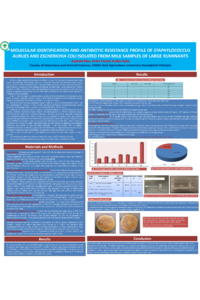
Staphylococcus aureus and Escherichia coli are main infection causing microbes. Both of the microorganisms also have great ability to develop resistant against antibiotics. Strains that have antibiotic resistance can cause infections in the form of epidemics. The objective of the present study was to identify and detect Escherichia coli and Staphylococcus aureus from samples of milk from mastitis positive buffaloes and cows and to assess the patterns of antimicrobial resistance profile. A total of 30 milk samples (buffalo: n= 15, Cows: n=15) were collected randomly from apparently healthy animals. Samples were collected from different dairy farms in the region of Rawalpindi. Samples were first checked for subclinical mastitis using surf field mastitis test (SFMT). Mastitis positive samples were analyzed in the laboratory by biochemical tests. Polymerase chain reaction (PCR) was used to for the molecular identification of Escherichia coli and Staphylococcus aureus utilizing the 16SrRNA gene. Antibiotic sensitivity test (AST) was performed to check antimicrobial resistance patterns of different antibiotics by using disk diffusion method. Out of 30 samples, 18 samples were found mastitis positive using SFMT (60%). For identification of Escherichia coli and Staphylococcus aureus API E20 and API Staph Kit was used respectively. Biochemical tests and PCR confirmed the presence of that out of 18 samples, 4 samples found for Staphylococcus. aureus and 6 samples were found positive for Escherichia coli. AST was performed to check antibiotic resistance patterns of isolated organisms and results have shown that both organisms were resistance against penicillin whereas Staphylococcus aureus was also found resistant against Oxytetracycline. Both organisms were also found highly sensitive to Ciprofloxacin and Erythromycin. The results of this study have shown that Escherichia coli and Staphylococcus aureus are present in selected dairy farms in Rawalpindi which can lead to their spread to other farms and cause a larger scale milk production loss.
Keywords
Antimicrobial sensitivity
Mastitis
Raw Milk
E. coli
S. aureus
Poster
sciforum-160807 Aayesha Riaz.pdf
HORMONAL DYNAMICS AND REPRODUCTIVE EFFICIENCY IN RABBIT DOES FED CLOVE (SYZYGIUM AROMATICUM)
Evaluating the Agronomic and Nutritional Variability of White Lupin Accessions and Their In-situ Rumen Degradation Kinetics in Buffaloes