Event submissions
Published
This submission belongs to the session 3. Sustainable Animal Nutrition of the event The 4th International Online Conference on Animals
Published date
12 Mar, 2026
Academic Editor
'%3e%3cpath%20d='M12.6657%2010.9104C12.4185%2010.325%2012.0599%209.79327%2011.6097%209.34482C11.1609%208.89508%2010.6293%208.5365%2010.0442%208.28888C10.0389%208.28626%2010.0337%208.28495%2010.0285%208.28233C10.8446%207.69279%2011.3752%206.73249%2011.3752%205.64904C11.3752%203.8542%209.92103%202.39999%208.1262%202.39999C6.33136%202.39999%204.87715%203.8542%204.87715%205.64904C4.87715%206.73249%205.40774%207.69279%206.22393%208.28364C6.21869%208.28626%206.21345%208.28757%206.20821%208.29019C5.62129%208.5378%205.09463%208.89284%204.64265%209.34613C4.1929%209.79493%203.83432%2010.3266%203.58671%2010.9117C3.34345%2011.4845%203.21226%2012.0987%203.20023%2012.7209C3.19988%2012.7349%203.20233%2012.7488%203.20744%2012.7619C3.21255%2012.7749%203.22022%2012.7867%203.22998%2012.7968C3.23975%2012.8068%203.25142%2012.8147%203.26431%2012.8202C3.2772%2012.8256%203.29105%2012.8284%203.30504%2012.8284H4.09109C4.14874%2012.8284%204.19459%2012.7825%204.1959%2012.7262C4.2221%2011.7148%204.62823%2010.7676%205.34617%2010.0497C6.08899%209.30683%207.0755%208.89808%208.1262%208.89808C9.17689%208.89808%2010.1634%209.30683%2010.9062%2010.0497C11.6242%2010.7676%2012.0303%2011.7148%2012.0565%2012.7262C12.0578%2012.7838%2012.1037%2012.8284%2012.1613%2012.8284H12.9474C12.9613%2012.8284%2012.9752%2012.8256%2012.9881%2012.8202C13.001%2012.8147%2013.0126%2012.8068%2013.0224%2012.7968C13.0322%2012.7867%2013.0398%2012.7749%2013.0449%2012.7619C13.0501%2012.7488%2013.0525%2012.7349%2013.0522%2012.7209C13.0391%2012.0947%2012.9094%2011.4855%2012.6657%2010.9104ZM8.1262%207.9024C7.52486%207.9024%206.9589%207.6679%206.53312%207.24211C6.10733%206.81633%205.87283%206.25037%205.87283%205.64904C5.87283%205.0477%206.10733%204.48174%206.53312%204.05596C6.9589%203.63018%207.52486%203.39567%208.1262%203.39567C8.72753%203.39567%209.29349%203.63018%209.71927%204.05596C10.1451%204.48174%2010.3796%205.0477%2010.3796%205.64904C10.3796%206.25037%2010.1451%206.81633%209.71927%207.24211C9.29349%207.6679%208.72753%207.9024%208.1262%207.9024Z'%20fill='%235D1EE1'/%3e%3c/g%3e%3c/svg%3e) Elisabete Matos
Elisabete MatosCitation
Muhammad Uzair Akhtar, Faiz-ul Hassan, Abdur Rahman, Muhammad Naveed-ul Haque, Effects of prepartum dietary protein-to-energy ratio on postpartum lactation performance of dairy cows: a meta-analysis, in Proceedings of The 4th International Online Conference on Animals, 17 March–19 March 2026, MDPI: Basel, Switzerland
Share
Email
Facebook
Twitter
LinkedIn
Effects of prepartum dietary protein-to-energy ratio on postpartum lactation performance of dairy cows: a meta-analysis

Muhammad Uzair Akhtar 1

Faiz-ul Hassan 2

Abdur Rahman 3
'%3e%3cpath%20d='M12.6647%2010.9104C12.4176%2010.325%2012.0589%209.7933%2011.6088%209.34485C11.16%208.89511%2010.6283%208.53653%2010.0432%208.28891C10.038%208.28629%2010.0327%208.28498%2010.0275%208.28236C10.8437%207.69282%2011.3743%206.73252%2011.3743%205.64907C11.3743%203.85423%209.92005%202.40002%208.12522%202.40002C6.33038%202.40002%204.87618%203.85423%204.87618%205.64907C4.87618%206.73252%205.40677%207.69282%206.22296%208.28367C6.21772%208.28629%206.21248%208.2876%206.20724%208.29022C5.62031%208.53783%205.09365%208.89287%204.64167%209.34616C4.19192%209.79496%203.83334%2010.3266%203.58573%2010.9117C3.34247%2011.4846%203.21128%2012.0987%203.19925%2012.721C3.1989%2012.735%203.20135%2012.7489%203.20646%2012.7619C3.21157%2012.7749%203.21924%2012.7868%203.22901%2012.7968C3.23877%2012.8068%203.25045%2012.8148%203.26334%2012.8202C3.27623%2012.8256%203.29007%2012.8284%203.30406%2012.8284H4.09012C4.14776%2012.8284%204.19362%2012.7825%204.19493%2012.7262C4.22113%2011.7148%204.62726%2010.7676%205.34519%2010.0497C6.08802%209.30686%207.07452%208.89811%208.12522%208.89811C9.17592%208.89811%2010.1624%209.30686%2010.9052%2010.0497C11.6232%2010.7676%2012.0293%2011.7148%2012.0555%2012.7262C12.0568%2012.7839%2012.1027%2012.8284%2012.1603%2012.8284H12.9464C12.9604%2012.8284%2012.9742%2012.8256%2012.9871%2012.8202C13%2012.8148%2013.0117%2012.8068%2013.0214%2012.7968C13.0312%2012.7868%2013.0389%2012.7749%2013.044%2012.7619C13.0491%2012.7489%2013.0515%2012.735%2013.0512%2012.721C13.0381%2012.0947%2012.9084%2011.4856%2012.6647%2010.9104ZM8.12522%207.90243C7.52388%207.90243%206.95792%207.66793%206.53214%207.24215C6.10636%206.81636%205.87185%206.2504%205.87185%205.64907C5.87185%205.04773%206.10636%204.48177%206.53214%204.05599C6.95792%203.63021%207.52388%203.3957%208.12522%203.3957C8.72655%203.3957%209.29252%203.63021%209.7183%204.05599C10.1441%204.48177%2010.3786%205.04773%2010.3786%205.64907C10.3786%206.2504%2010.1441%206.81636%209.7183%207.24215C9.29252%207.66793%208.72655%207.90243%208.12522%207.90243Z'%20fill='%235D1EE1'/%3e%3c/g%3e%3c/svg%3e)
Muhammad Naveed-ul Haque 4
1. Department of Animal Nutrition, Cholistan University of Veterinary and Animal Sciences, Bahawalpur 63100, Pakistan
2. Faculty of Animal Production and Technology, Cholistan University of Veterinary and Animal Sciences, Bahawalpur 63100, Pakistan
3. Department of Animal Sciences, Jhang Campus, University of Veterinary and Animal Sciences, Lahore, Pakistan
4. Department of Animal Nutrition, University of Veterinary and Animal Sciences, Lahore 54000, Pakistan
Abstract
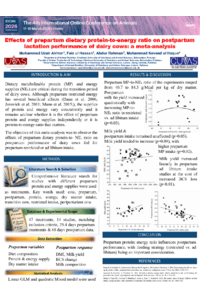
Introduction: Dietary protein and energy supplies are critical during the transition period of dairy cows. Although prepartum restricted energy has several benefits, supplies of protein and energy vary concurrently, and it remains unclear whether it is the effect of prepartum protein and energy supplies independently or it is the protein-to-energy ratio that matters. Therefore, the objective of this meta-analysis was to observe the effects of the prepartum dietary protein-to-energy ratio on the postpartum performance of dairy cows fed for prepartum restricted or ad libitum intake.
Methods: Studies conducted on the manipulation of prepartum dietary protein or energy were included in the analysis. A total of 16 experiments were included with 47 dietary treatments. To distinguish linear trends from non-linear responses, a linear GLM model was used to assess the overall direction of the response, whereas a quadratic MIXED model was applied to test curvilinear responses while accounting for between-study heterogeneity.
Results: The prepartum protein-to-energy ratio of the experiments ranged from 40.7 to 84.3 g/Mcal per kg of dry matter. Postpartum milk fat yield increased quadratically with an increase in the protein-to-energy ratio only in those studies where restricted energy intake was compared with ad libitum/high-energy intake (p=0.03). Milk yield and postpartum feed intake remained unaffected (p>0.05). However, milk yield tended to increase (p=0.09), while the milk yield/kg of dry matter linearly increased with increasing prepartum metabolizable protein intake (p=0.02). In prepartum ad libitum intake experiments, milk fat content and postpartum body condition score decreased with increasing prepartum metabolizable protein intake (p<0.05). Milk yield increased linearly in those studies where prepartum feed was offered for ad libitum/high-energy intake but at the cost of increased body condition loss (p<0.01).
Conclusions: Overall, beyond their individual effects, the ratio of prepartum dietary protein to energy influences the postpartum performance of dairy cows. Nevertheless, feeding strategies (restricted vs. ad libitum) should be considered while balancing prepartum dietary protein and energy contents.
Keywords
Transition cow
metabolizable protein
net energy for lactation
BCS
milk yield
periparturient cow
Poster
sciforum-156831 Muhammad Uzair Akhtar.pdf
Evaluating the Agronomic and Nutritional Variability of White Lupin Accessions and Their In-situ Rumen Degradation Kinetics in Buffaloes
In vitro evaluation of digestibility and methane gas production of Urochloa brizantha and Inga edulis as forage alternatives for tropical livestock systems