Event submissions
Published
This submission belongs to the session 1. Sustainable Animal Welfare, Ethics and Human–Animal Interactions of the event The 4th International Online Conference on Animals
Published date
12 Mar, 2026
Academic Editor
'%3e%3cpath%20d='M12.6657%2010.9104C12.4185%2010.325%2012.0599%209.79327%2011.6097%209.34482C11.1609%208.89508%2010.6293%208.5365%2010.0442%208.28888C10.0389%208.28626%2010.0337%208.28495%2010.0285%208.28233C10.8446%207.69279%2011.3752%206.73249%2011.3752%205.64904C11.3752%203.8542%209.92103%202.39999%208.1262%202.39999C6.33136%202.39999%204.87715%203.8542%204.87715%205.64904C4.87715%206.73249%205.40774%207.69279%206.22393%208.28364C6.21869%208.28626%206.21345%208.28757%206.20821%208.29019C5.62129%208.5378%205.09463%208.89284%204.64265%209.34613C4.1929%209.79493%203.83432%2010.3266%203.58671%2010.9117C3.34345%2011.4845%203.21226%2012.0987%203.20023%2012.7209C3.19988%2012.7349%203.20233%2012.7488%203.20744%2012.7619C3.21255%2012.7749%203.22022%2012.7867%203.22998%2012.7968C3.23975%2012.8068%203.25142%2012.8147%203.26431%2012.8202C3.2772%2012.8256%203.29105%2012.8284%203.30504%2012.8284H4.09109C4.14874%2012.8284%204.19459%2012.7825%204.1959%2012.7262C4.2221%2011.7148%204.62823%2010.7676%205.34617%2010.0497C6.08899%209.30683%207.0755%208.89808%208.1262%208.89808C9.17689%208.89808%2010.1634%209.30683%2010.9062%2010.0497C11.6242%2010.7676%2012.0303%2011.7148%2012.0565%2012.7262C12.0578%2012.7838%2012.1037%2012.8284%2012.1613%2012.8284H12.9474C12.9613%2012.8284%2012.9752%2012.8256%2012.9881%2012.8202C13.001%2012.8147%2013.0126%2012.8068%2013.0224%2012.7968C13.0322%2012.7867%2013.0398%2012.7749%2013.0449%2012.7619C13.0501%2012.7488%2013.0525%2012.7349%2013.0522%2012.7209C13.0391%2012.0947%2012.9094%2011.4855%2012.6657%2010.9104ZM8.1262%207.9024C7.52486%207.9024%206.9589%207.6679%206.53312%207.24211C6.10733%206.81633%205.87283%206.25037%205.87283%205.64904C5.87283%205.0477%206.10733%204.48174%206.53312%204.05596C6.9589%203.63018%207.52486%203.39567%208.1262%203.39567C8.72753%203.39567%209.29349%203.63018%209.71927%204.05596C10.1451%204.48174%2010.3796%205.0477%2010.3796%205.64904C10.3796%206.25037%2010.1451%206.81633%209.71927%207.24211C9.29349%207.6679%208.72753%207.9024%208.1262%207.9024Z'%20fill='%235D1EE1'/%3e%3c/g%3e%3c/svg%3e) Colin Scanes
Colin ScanesCitation
Tiago Lourenço, Maria João Rocha, Eduardo Rocha, Tânia Vieira Madureira, Hypolipidemic Pharmaceuticals Atorvastatin and Ezetimibe Shake Up Brown Trout Lipid Metabolism, in Proceedings of The 4th International Online Conference on Animals, 17 March–19 March 2026, MDPI: Basel, Switzerland
Share
Email
Facebook
Twitter
LinkedIn
Hypolipidemic Pharmaceuticals Atorvastatin and Ezetimibe Shake Up Brown Trout Lipid Metabolism
'%3e%3cpath%20d='M12.6647%2010.9104C12.4176%2010.325%2012.0589%209.7933%2011.6088%209.34485C11.16%208.89511%2010.6283%208.53653%2010.0432%208.28891C10.038%208.28629%2010.0327%208.28498%2010.0275%208.28236C10.8437%207.69282%2011.3743%206.73252%2011.3743%205.64907C11.3743%203.85423%209.92005%202.40002%208.12522%202.40002C6.33038%202.40002%204.87618%203.85423%204.87618%205.64907C4.87618%206.73252%205.40677%207.69282%206.22296%208.28367C6.21772%208.28629%206.21248%208.2876%206.20724%208.29022C5.62031%208.53783%205.09365%208.89287%204.64167%209.34616C4.19192%209.79496%203.83334%2010.3266%203.58573%2010.9117C3.34247%2011.4846%203.21128%2012.0987%203.19925%2012.721C3.1989%2012.735%203.20135%2012.7489%203.20646%2012.7619C3.21157%2012.7749%203.21924%2012.7868%203.22901%2012.7968C3.23877%2012.8068%203.25045%2012.8148%203.26334%2012.8202C3.27623%2012.8256%203.29007%2012.8284%203.30406%2012.8284H4.09012C4.14776%2012.8284%204.19362%2012.7825%204.19493%2012.7262C4.22113%2011.7148%204.62726%2010.7676%205.34519%2010.0497C6.08802%209.30686%207.07452%208.89811%208.12522%208.89811C9.17592%208.89811%2010.1624%209.30686%2010.9052%2010.0497C11.6232%2010.7676%2012.0293%2011.7148%2012.0555%2012.7262C12.0568%2012.7839%2012.1027%2012.8284%2012.1603%2012.8284H12.9464C12.9604%2012.8284%2012.9742%2012.8256%2012.9871%2012.8202C13%2012.8148%2013.0117%2012.8068%2013.0214%2012.7968C13.0312%2012.7868%2013.0389%2012.7749%2013.044%2012.7619C13.0491%2012.7489%2013.0515%2012.735%2013.0512%2012.721C13.0381%2012.0947%2012.9084%2011.4856%2012.6647%2010.9104ZM8.12522%207.90243C7.52388%207.90243%206.95792%207.66793%206.53214%207.24215C6.10636%206.81636%205.87185%206.2504%205.87185%205.64907C5.87185%205.04773%206.10636%204.48177%206.53214%204.05599C6.95792%203.63021%207.52388%203.3957%208.12522%203.3957C8.72655%203.3957%209.29252%203.63021%209.7183%204.05599C10.1441%204.48177%2010.3786%205.04773%2010.3786%205.64907C10.3786%206.2504%2010.1441%206.81636%209.7183%207.24215C9.29252%207.66793%208.72655%207.90243%208.12522%207.90243Z'%20fill='%235D1EE1'/%3e%3c/g%3e%3c/svg%3e)
Tiago Lourenço 1,2

Maria João Rocha 1,2

Eduardo Rocha 1,2

Tânia Vieira Madureira 1,2
1. ICBAS – School of Medicine and Biomedical Sciences, U.Porto – University of Porto, Porto, Portugal
2. CIIMAR/CIMAR – Interdisciplinary Centre of Marine and Environmental Research, U.Porto – University of Porto, Matosinhos, Portugal
Abstract
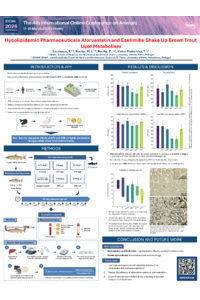
The incidence of dyslipidaemia is growing worldwide. As a result, the use of hypolipidemic pharmaceuticals has steadily increased, particularly statins, which are the most prescribed class. Consequently, hypolipidemics have become recognised as emerging environmental contaminants, reaching aquatic environments where they can cause lipid disruption in fish. These disruptions could have deep impacts, since lipids play vital roles in a wide array of physiological and homeostatic processes. In this context, this study investigated the effects of atorvastatin (ATV; a popular statin) and ezetimibe (EZB; a cholesterol-absorption inhibitor commonly co-administered with ATV) on lipid parameters in juvenile brown trout (Salmo trutta). The fish (N=12/condition) were assigned to one of six conditions — Control (C), Solvent Control (SC), ATV High (ATV-H; 0.3g.g-1), ATV Low (ATV-L; 0.03g.g-1), EZB High (EZB-H; 0.3g.g-1) and EZB Low (EZB-L; 0.03g.g-1) — and received intramuscular injections every three days for 28 days. The C group received an intramuscular injection of 0.7% saline solution, whereas SC received 0.7% saline solution supplemented with 0.9% ethanol and 0.1% DMSO. Experimental endpoints included biometric parameters measured both during exposure and after 28 days, plasma biochemistry of blood lipids, glucose, albumin and total bilirubin, gonadal development, and mRNA expression of hepatic lipid-related genes. Fish biometric parameters were not altered. Biochemical results showed evidence of lipid disruption, with ATV-H significantly lowering blood cholesterol, triglycerides, and low-density lipoproteins. EZB-L caused a significant drop in HDL levels. LDL levels seemed clearly lowered in ATV-H and EZB-L groups, although these reductions were not statistically significant. Together with the biochemical findings, additional data from ongoing histological and molecular endpoints will provide further insight into the mechanisms underlying lipid disruption triggered by hypolipidemics in trout. Such data will be essential for establishing a robust hypolipidemic fish model and understanding and predicting the environmental impacts of hypolipidemics.
Keywords
Atorvastatin
ezetimibe
hypolipidemics
brown trout
lipid metabolism
Poster
Hypolipidemic Pharmaceuticals Atorvastatin and Ezetimibe Shake Up Brown Trout Lipid Metabolism - Lourenço et al..pdf
Occurrence of Anisakis sp. Infection in Mackerel (Rastrelliger sp.) from Traditional Markets in Bogor, Indonesia
An Unusual Case of Feline Polycystic Liver Disease in a Non-Predisposed Breed