Event submissions
Published
This submission belongs to the session 2. One health: Improve Disease Manifestation and Management in Animals, Humans, and the Environment of the event The 4th International Online Conference on Animals
Published date
12 Mar, 2026
Academic Editor
'%3e%3cpath%20d='M12.6657%2010.9104C12.4185%2010.325%2012.0599%209.79327%2011.6097%209.34482C11.1609%208.89508%2010.6293%208.5365%2010.0442%208.28888C10.0389%208.28626%2010.0337%208.28495%2010.0285%208.28233C10.8446%207.69279%2011.3752%206.73249%2011.3752%205.64904C11.3752%203.8542%209.92103%202.39999%208.1262%202.39999C6.33136%202.39999%204.87715%203.8542%204.87715%205.64904C4.87715%206.73249%205.40774%207.69279%206.22393%208.28364C6.21869%208.28626%206.21345%208.28757%206.20821%208.29019C5.62129%208.5378%205.09463%208.89284%204.64265%209.34613C4.1929%209.79493%203.83432%2010.3266%203.58671%2010.9117C3.34345%2011.4845%203.21226%2012.0987%203.20023%2012.7209C3.19988%2012.7349%203.20233%2012.7488%203.20744%2012.7619C3.21255%2012.7749%203.22022%2012.7867%203.22998%2012.7968C3.23975%2012.8068%203.25142%2012.8147%203.26431%2012.8202C3.2772%2012.8256%203.29105%2012.8284%203.30504%2012.8284H4.09109C4.14874%2012.8284%204.19459%2012.7825%204.1959%2012.7262C4.2221%2011.7148%204.62823%2010.7676%205.34617%2010.0497C6.08899%209.30683%207.0755%208.89808%208.1262%208.89808C9.17689%208.89808%2010.1634%209.30683%2010.9062%2010.0497C11.6242%2010.7676%2012.0303%2011.7148%2012.0565%2012.7262C12.0578%2012.7838%2012.1037%2012.8284%2012.1613%2012.8284H12.9474C12.9613%2012.8284%2012.9752%2012.8256%2012.9881%2012.8202C13.001%2012.8147%2013.0126%2012.8068%2013.0224%2012.7968C13.0322%2012.7867%2013.0398%2012.7749%2013.0449%2012.7619C13.0501%2012.7488%2013.0525%2012.7349%2013.0522%2012.7209C13.0391%2012.0947%2012.9094%2011.4855%2012.6657%2010.9104ZM8.1262%207.9024C7.52486%207.9024%206.9589%207.6679%206.53312%207.24211C6.10733%206.81633%205.87283%206.25037%205.87283%205.64904C5.87283%205.0477%206.10733%204.48174%206.53312%204.05596C6.9589%203.63018%207.52486%203.39567%208.1262%203.39567C8.72753%203.39567%209.29349%203.63018%209.71927%204.05596C10.1451%204.48174%2010.3796%205.0477%2010.3796%205.64904C10.3796%206.25037%2010.1451%206.81633%209.71927%207.24211C9.29349%207.6679%208.72753%207.9024%208.1262%207.9024Z'%20fill='%235D1EE1'/%3e%3c/g%3e%3c/svg%3e) Michael Hässig
Michael HässigCitation
Nélida Fernández Pato, Victor Manuel Cacho Amaya, Tania Ayllón Santiago, Nerea García Benzaquén, Raquel Gómez Lucas, Lydia Calleja Bueno, Isabel Rodríguez Hurtado, Fátima Cruz López, Molecular Characterization of Piroplasms and Identification of Tick Vectors in Central Spain, in Proceedings of The 4th International Online Conference on Animals, 17 March–19 March 2026, MDPI: Basel, Switzerland
Share
Email
Facebook
Twitter
LinkedIn
Molecular Characterization of Piroplasms and Identification of Tick Vectors in Central Spain

Nélida Fernández Pato 1
'%3e%3cpath%20d='M12.6647%2010.9104C12.4176%2010.325%2012.0589%209.7933%2011.6088%209.34485C11.16%208.89511%2010.6283%208.53653%2010.0432%208.28891C10.038%208.28629%2010.0327%208.28498%2010.0275%208.28236C10.8437%207.69282%2011.3743%206.73252%2011.3743%205.64907C11.3743%203.85423%209.92005%202.40002%208.12522%202.40002C6.33038%202.40002%204.87618%203.85423%204.87618%205.64907C4.87618%206.73252%205.40677%207.69282%206.22296%208.28367C6.21772%208.28629%206.21248%208.2876%206.20724%208.29022C5.62031%208.53783%205.09365%208.89287%204.64167%209.34616C4.19192%209.79496%203.83334%2010.3266%203.58573%2010.9117C3.34247%2011.4846%203.21128%2012.0987%203.19925%2012.721C3.1989%2012.735%203.20135%2012.7489%203.20646%2012.7619C3.21157%2012.7749%203.21924%2012.7868%203.22901%2012.7968C3.23877%2012.8068%203.25045%2012.8148%203.26334%2012.8202C3.27623%2012.8256%203.29007%2012.8284%203.30406%2012.8284H4.09012C4.14776%2012.8284%204.19362%2012.7825%204.19493%2012.7262C4.22113%2011.7148%204.62726%2010.7676%205.34519%2010.0497C6.08802%209.30686%207.07452%208.89811%208.12522%208.89811C9.17592%208.89811%2010.1624%209.30686%2010.9052%2010.0497C11.6232%2010.7676%2012.0293%2011.7148%2012.0555%2012.7262C12.0568%2012.7839%2012.1027%2012.8284%2012.1603%2012.8284H12.9464C12.9604%2012.8284%2012.9742%2012.8256%2012.9871%2012.8202C13%2012.8148%2013.0117%2012.8068%2013.0214%2012.7968C13.0312%2012.7868%2013.0389%2012.7749%2013.044%2012.7619C13.0491%2012.7489%2013.0515%2012.735%2013.0512%2012.721C13.0381%2012.0947%2012.9084%2011.4856%2012.6647%2010.9104ZM8.12522%207.90243C7.52388%207.90243%206.95792%207.66793%206.53214%207.24215C6.10636%206.81636%205.87185%206.2504%205.87185%205.64907C5.87185%205.04773%206.10636%204.48177%206.53214%204.05599C6.95792%203.63021%207.52388%203.3957%208.12522%203.3957C8.72655%203.3957%209.29252%203.63021%209.7183%204.05599C10.1441%204.48177%2010.3786%205.04773%2010.3786%205.64907C10.3786%206.2504%2010.1441%206.81636%209.7183%207.24215C9.29252%207.66793%208.72655%207.90243%208.12522%207.90243Z'%20fill='%235D1EE1'/%3e%3c/g%3e%3c/svg%3e)
Victor Manuel Cacho Amaya 1
Tania Ayllón Santiago 1,2
Nerea García Benzaquén 1,2
Raquel Gómez Lucas 1
Lydia Calleja Bueno 1
Isabel Rodríguez Hurtado 1
Fátima Cruz López 1,2
1. Faculty of Veterinary Medicine, Alfonso X El Sabio University, Madrid, 28691, Spain
2. VISAVET Health Surveillance Center – Animal Health Department, Faculty of Veterinary Medicine, Complutense University of Madrid, Madrid, 28040, Spain
Abstract
Introduction and objectives
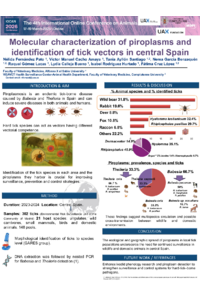
Piroplasmosis is an endemic tick-borne disease in Spain caused by protozoa of the genera Babesia and Theileria, transmitted by hard ticks (Ixodidae). These hemoprotozoa can induce severe diseases in both animals and humans. Since not all tick species or individuals are infected or competent vectors, identifying the tick fauna present in each area and the piroplasms they harbor is crucial for improving surveillance, prevention, and control strategies.
Methodology
Between 2023 and 2024, the Environmental Risk Surveillance Unit of the Community of Madrid collected 302 ticks, grouped into 148 pools, from 21 host species in central Spain. Hosts included ungulates, wild carnivores, small mammals, birds, and domestic animals. Ticks were morphologically identified to species level. DNA extraction was followed by nested PCR for Babesia and Theileria detection according to Jefferies et al. (2007).
Results and discussion
Wild boar (31.8%), rabbit (19.6%), fox (10.8%), deer (8.8%), and raccoon (6.8%) were the most frequent hosts. The spatial distribution of samples reflects an extensive surveillance effort encompassing both wildlife management areas and urban–periurban environments. The predominant tick species were Hyalomma lusitanicum (32.4%) and Rhipicephalus pusillus (29.7%). Five piroplasm species were identified: Babesia pecorum, Babesia ovis, Babesia sp. (tavsan2/occultans), Theileria ovis, and Theileria capreoli.
The overall infection rate was 6.08% (9/148). Positive samples included B. pecorum (2.7%) in wild boar (Dermacentor marginatus), goat (Rhipicephalus sanguineus), and rabbit (R. pusillus); B. ovis (0,68%) in wild boar (H. lusitanicum); Babesia sp. tavsan2/occultans (0.68%) in Iberian Ibex (Rhipicephalus bursa); T. ovis (1.35%) in rabbit (R. pusillus) and cat (R. sanguineus); and T. capreoli (0.68%) in mouflon (H. lusitanicum). These findings suggest multispecies circulation and possible cross-transmission between wildlife and domestic environments.
Conclusions
The ecological and geographic spread of piroplasms in local tick populations underscores the need for continued surveillance in wildlife and domestic animals in central Spain.
Keywords
piroplasmosis
ticks
prevalence
vertebrate hosts
diagnosis
Poster
p. Fernández Pato Nélida Molecular characterization of piroplasms POSTER IOCAN 26.pdf
Insects, Horses, and One Health: Lessons from an Extensive System in Central Spain
I Rule in Favour of the Elephants: Granting Rights to Elephants in Sri Lanka