Event submissions
Published
This submission belongs to the session 1. Sustainable Animal Welfare, Ethics and Human–Animal Interactions of the event The 4th International Online Conference on Animals
Published date
12 Mar, 2026
Academic Editor
'%3e%3cpath%20d='M12.6657%2010.9104C12.4185%2010.325%2012.0599%209.79327%2011.6097%209.34482C11.1609%208.89508%2010.6293%208.5365%2010.0442%208.28888C10.0389%208.28626%2010.0337%208.28495%2010.0285%208.28233C10.8446%207.69279%2011.3752%206.73249%2011.3752%205.64904C11.3752%203.8542%209.92103%202.39999%208.1262%202.39999C6.33136%202.39999%204.87715%203.8542%204.87715%205.64904C4.87715%206.73249%205.40774%207.69279%206.22393%208.28364C6.21869%208.28626%206.21345%208.28757%206.20821%208.29019C5.62129%208.5378%205.09463%208.89284%204.64265%209.34613C4.1929%209.79493%203.83432%2010.3266%203.58671%2010.9117C3.34345%2011.4845%203.21226%2012.0987%203.20023%2012.7209C3.19988%2012.7349%203.20233%2012.7488%203.20744%2012.7619C3.21255%2012.7749%203.22022%2012.7867%203.22998%2012.7968C3.23975%2012.8068%203.25142%2012.8147%203.26431%2012.8202C3.2772%2012.8256%203.29105%2012.8284%203.30504%2012.8284H4.09109C4.14874%2012.8284%204.19459%2012.7825%204.1959%2012.7262C4.2221%2011.7148%204.62823%2010.7676%205.34617%2010.0497C6.08899%209.30683%207.0755%208.89808%208.1262%208.89808C9.17689%208.89808%2010.1634%209.30683%2010.9062%2010.0497C11.6242%2010.7676%2012.0303%2011.7148%2012.0565%2012.7262C12.0578%2012.7838%2012.1037%2012.8284%2012.1613%2012.8284H12.9474C12.9613%2012.8284%2012.9752%2012.8256%2012.9881%2012.8202C13.001%2012.8147%2013.0126%2012.8068%2013.0224%2012.7968C13.0322%2012.7867%2013.0398%2012.7749%2013.0449%2012.7619C13.0501%2012.7488%2013.0525%2012.7349%2013.0522%2012.7209C13.0391%2012.0947%2012.9094%2011.4855%2012.6657%2010.9104ZM8.1262%207.9024C7.52486%207.9024%206.9589%207.6679%206.53312%207.24211C6.10733%206.81633%205.87283%206.25037%205.87283%205.64904C5.87283%205.0477%206.10733%204.48174%206.53312%204.05596C6.9589%203.63018%207.52486%203.39567%208.1262%203.39567C8.72753%203.39567%209.29349%203.63018%209.71927%204.05596C10.1451%204.48174%2010.3796%205.0477%2010.3796%205.64904C10.3796%206.25037%2010.1451%206.81633%209.71927%207.24211C9.29349%207.6679%208.72753%207.9024%208.1262%207.9024Z'%20fill='%235D1EE1'/%3e%3c/g%3e%3c/svg%3e) Colin Scanes
Colin ScanesCitation
S. Kyle Travis, Tannisha Duncan, Vanessa Rosete, Will Bohuslavizki, Switching Off: Autonomic Modulation with a Fast-Acting Nootropic Alters Arousal and Cognitive Engagement in Working Dogs, in Proceedings of The 4th International Online Conference on Animals, 17 March–19 March 2026, MDPI: Basel, Switzerland
Share
Email
Facebook
Twitter
LinkedIn
Switching Off: Autonomic Modulation with a Fast-Acting Nootropic Alters Arousal and Cognitive Engagement in Working Dogs
'%3e%3cpath%20d='M12.6647%2010.9104C12.4176%2010.325%2012.0589%209.7933%2011.6088%209.34485C11.16%208.89511%2010.6283%208.53653%2010.0432%208.28891C10.038%208.28629%2010.0327%208.28498%2010.0275%208.28236C10.8437%207.69282%2011.3743%206.73252%2011.3743%205.64907C11.3743%203.85423%209.92005%202.40002%208.12522%202.40002C6.33038%202.40002%204.87618%203.85423%204.87618%205.64907C4.87618%206.73252%205.40677%207.69282%206.22296%208.28367C6.21772%208.28629%206.21248%208.2876%206.20724%208.29022C5.62031%208.53783%205.09365%208.89287%204.64167%209.34616C4.19192%209.79496%203.83334%2010.3266%203.58573%2010.9117C3.34247%2011.4846%203.21128%2012.0987%203.19925%2012.721C3.1989%2012.735%203.20135%2012.7489%203.20646%2012.7619C3.21157%2012.7749%203.21924%2012.7868%203.22901%2012.7968C3.23877%2012.8068%203.25045%2012.8148%203.26334%2012.8202C3.27623%2012.8256%203.29007%2012.8284%203.30406%2012.8284H4.09012C4.14776%2012.8284%204.19362%2012.7825%204.19493%2012.7262C4.22113%2011.7148%204.62726%2010.7676%205.34519%2010.0497C6.08802%209.30686%207.07452%208.89811%208.12522%208.89811C9.17592%208.89811%2010.1624%209.30686%2010.9052%2010.0497C11.6232%2010.7676%2012.0293%2011.7148%2012.0555%2012.7262C12.0568%2012.7839%2012.1027%2012.8284%2012.1603%2012.8284H12.9464C12.9604%2012.8284%2012.9742%2012.8256%2012.9871%2012.8202C13%2012.8148%2013.0117%2012.8068%2013.0214%2012.7968C13.0312%2012.7868%2013.0389%2012.7749%2013.044%2012.7619C13.0491%2012.7489%2013.0515%2012.735%2013.0512%2012.721C13.0381%2012.0947%2012.9084%2011.4856%2012.6647%2010.9104ZM8.12522%207.90243C7.52388%207.90243%206.95792%207.66793%206.53214%207.24215C6.10636%206.81636%205.87185%206.2504%205.87185%205.64907C5.87185%205.04773%206.10636%204.48177%206.53214%204.05599C6.95792%203.63021%207.52388%203.3957%208.12522%203.3957C8.72655%203.3957%209.29252%203.63021%209.7183%204.05599C10.1441%204.48177%2010.3786%205.04773%2010.3786%205.64907C10.3786%206.2504%2010.1441%206.81636%209.7183%207.24215C9.29252%207.66793%208.72655%207.90243%208.12522%207.90243Z'%20fill='%235D1EE1'/%3e%3c/g%3e%3c/svg%3e)
S. Kyle Travis 1,2
Tannisha Duncan 1
Vanessa Rosete 1
Will Bohuslavizki 1
1. BioPerformance & Nutrition Sciences Lab, Pet MatRx, Santa Monica, CA, 90292, USA
2. Beaux & Co. K9 Foundation, Elizabethton, TN, 37643, USA
Abstract
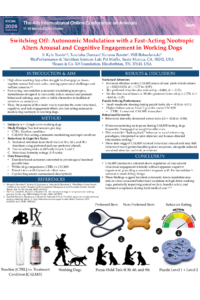
Introduction: High-drive working dogs often struggle to disengage or down-regulate arousal between tasks, creating operational challenges and welfare concerns. Fast-acting, non-sedative autonomic-modulating nootropics, formulations designed to transiently reduce arousal and promote behavioral calming, may offer a viable alternative to traditional sedatives or anxiolytics. Thus, this study examined the acute behavioral, cognitive, and task-engagement effects of a fast-acting autonomic-modulating nootropic in working dogs. Methods: Ten high-drive working dogs completed two test sessions: baseline (CTRL) and a day receiving a fast-acting autonomic-modulating nootropic (CALM®). Dogs performed (1) sustained-attention focus-hold trials at 30, 60, and 90 s with preferred and non-preferred stimuli; (2) puzzle-solving tasks (Levels 1–2); and (3) behavioral intensity ratings (1–5 scale). All duration-based outcomes were converted to percentage of maximal possible time. Within-dog differences between CTRL and CALM® were analyzed using paired t-tests with Cohen’s dz effect sizes, and cap-hit frequencies were summarized descriptively. Results: CALM® significantly reduced sustained attention across all non-preferred durations (p = 0.023–0.038; dz = –0.77 to –0.87) and at the 90 s preferred interval (p = 0.004; dz = –1.22), with similar nonsignificant trends at 30–60 s (p ≥ 0.070; dz = –0.63 to –0.65). Puzzle-solving times showed small-to-moderate nonsignificant slowing (dz = –0.36 to –0.51), with more unsolved Level 2 puzzle items under CALM® (1 CTRL vs 4 CALM®). Dogs that encountered an impasse during CALM® testing frequently disengaged or sought handler cues. Behavioral intensity decreased across both focus-hold and puzzle tasks (dz = –0.24 to –0.80), consistent with reduced arousal. Conclusions: CALM® produced a coherent down-regulation of arousal and engagement intensity without impairing cognition, consistent with its autonomic-modulating formulation. These preliminary findings suggest utility for helping high-drive dogs disengage in overstimulating environments, and they support the need for larger controlled trials across diverse working-dog and handler populations.
Keywords
canine
nutraceuticals
nutritional supplementation
autonomic nervous system
behavioral modulation
Poster
IOCAN 2026 Travis et al. v1.2.pdf
Comparison of Qualitative Behaviour Assessment by laypersons with observed behaviour in captive white-faced saki monkeys (Pithecia pithecia) and ring-tailed lemurs (Lemur catta)
Circular biotechnologies for goat reproduction: integrating animal welfare, sustainable resource use, and in vitro embryo technologies