Event submissions
Published
This submission belongs to the session 1. Sustainable Animal Welfare, Ethics and Human–Animal Interactions of the event The 4th International Online Conference on Animals
Published date
12 Mar, 2026
Academic Editor
'%3e%3cpath%20d='M12.6657%2010.9104C12.4185%2010.325%2012.0599%209.79327%2011.6097%209.34482C11.1609%208.89508%2010.6293%208.5365%2010.0442%208.28888C10.0389%208.28626%2010.0337%208.28495%2010.0285%208.28233C10.8446%207.69279%2011.3752%206.73249%2011.3752%205.64904C11.3752%203.8542%209.92103%202.39999%208.1262%202.39999C6.33136%202.39999%204.87715%203.8542%204.87715%205.64904C4.87715%206.73249%205.40774%207.69279%206.22393%208.28364C6.21869%208.28626%206.21345%208.28757%206.20821%208.29019C5.62129%208.5378%205.09463%208.89284%204.64265%209.34613C4.1929%209.79493%203.83432%2010.3266%203.58671%2010.9117C3.34345%2011.4845%203.21226%2012.0987%203.20023%2012.7209C3.19988%2012.7349%203.20233%2012.7488%203.20744%2012.7619C3.21255%2012.7749%203.22022%2012.7867%203.22998%2012.7968C3.23975%2012.8068%203.25142%2012.8147%203.26431%2012.8202C3.2772%2012.8256%203.29105%2012.8284%203.30504%2012.8284H4.09109C4.14874%2012.8284%204.19459%2012.7825%204.1959%2012.7262C4.2221%2011.7148%204.62823%2010.7676%205.34617%2010.0497C6.08899%209.30683%207.0755%208.89808%208.1262%208.89808C9.17689%208.89808%2010.1634%209.30683%2010.9062%2010.0497C11.6242%2010.7676%2012.0303%2011.7148%2012.0565%2012.7262C12.0578%2012.7838%2012.1037%2012.8284%2012.1613%2012.8284H12.9474C12.9613%2012.8284%2012.9752%2012.8256%2012.9881%2012.8202C13.001%2012.8147%2013.0126%2012.8068%2013.0224%2012.7968C13.0322%2012.7867%2013.0398%2012.7749%2013.0449%2012.7619C13.0501%2012.7488%2013.0525%2012.7349%2013.0522%2012.7209C13.0391%2012.0947%2012.9094%2011.4855%2012.6657%2010.9104ZM8.1262%207.9024C7.52486%207.9024%206.9589%207.6679%206.53312%207.24211C6.10733%206.81633%205.87283%206.25037%205.87283%205.64904C5.87283%205.0477%206.10733%204.48174%206.53312%204.05596C6.9589%203.63018%207.52486%203.39567%208.1262%203.39567C8.72753%203.39567%209.29349%203.63018%209.71927%204.05596C10.1451%204.48174%2010.3796%205.0477%2010.3796%205.64904C10.3796%206.25037%2010.1451%206.81633%209.71927%207.24211C9.29349%207.6679%208.72753%207.9024%208.1262%207.9024Z'%20fill='%235D1EE1'/%3e%3c/g%3e%3c/svg%3e) Colin Scanes
Colin ScanesCitation
Anastasiia Bogdaniuk, Tom Otter, Jehan Ettema, Dirk-Jan van Horssen, Heleen Bruintjes, Maryna Petrushko, Circular biotechnologies for goat reproduction: integrating animal welfare, sustainable resource use, and in vitro embryo technologies, in Proceedings of The 4th International Online Conference on Animals, 17 March–19 March 2026, MDPI: Basel, Switzerland
Share
Email
Facebook
Twitter
LinkedIn
Circular biotechnologies for goat reproduction: integrating animal welfare, sustainable resource use, and in vitro embryo technologies
'%3e%3cpath%20d='M12.6647%2010.9104C12.4176%2010.325%2012.0589%209.7933%2011.6088%209.34485C11.16%208.89511%2010.6283%208.53653%2010.0432%208.28891C10.038%208.28629%2010.0327%208.28498%2010.0275%208.28236C10.8437%207.69282%2011.3743%206.73252%2011.3743%205.64907C11.3743%203.85423%209.92005%202.40002%208.12522%202.40002C6.33038%202.40002%204.87618%203.85423%204.87618%205.64907C4.87618%206.73252%205.40677%207.69282%206.22296%208.28367C6.21772%208.28629%206.21248%208.2876%206.20724%208.29022C5.62031%208.53783%205.09365%208.89287%204.64167%209.34616C4.19192%209.79496%203.83334%2010.3266%203.58573%2010.9117C3.34247%2011.4846%203.21128%2012.0987%203.19925%2012.721C3.1989%2012.735%203.20135%2012.7489%203.20646%2012.7619C3.21157%2012.7749%203.21924%2012.7868%203.22901%2012.7968C3.23877%2012.8068%203.25045%2012.8148%203.26334%2012.8202C3.27623%2012.8256%203.29007%2012.8284%203.30406%2012.8284H4.09012C4.14776%2012.8284%204.19362%2012.7825%204.19493%2012.7262C4.22113%2011.7148%204.62726%2010.7676%205.34519%2010.0497C6.08802%209.30686%207.07452%208.89811%208.12522%208.89811C9.17592%208.89811%2010.1624%209.30686%2010.9052%2010.0497C11.6232%2010.7676%2012.0293%2011.7148%2012.0555%2012.7262C12.0568%2012.7839%2012.1027%2012.8284%2012.1603%2012.8284H12.9464C12.9604%2012.8284%2012.9742%2012.8256%2012.9871%2012.8202C13%2012.8148%2013.0117%2012.8068%2013.0214%2012.7968C13.0312%2012.7868%2013.0389%2012.7749%2013.044%2012.7619C13.0491%2012.7489%2013.0515%2012.735%2013.0512%2012.721C13.0381%2012.0947%2012.9084%2011.4856%2012.6647%2010.9104ZM8.12522%207.90243C7.52388%207.90243%206.95792%207.66793%206.53214%207.24215C6.10636%206.81636%205.87185%206.2504%205.87185%205.64907C5.87185%205.04773%206.10636%204.48177%206.53214%204.05599C6.95792%203.63021%207.52388%203.3957%208.12522%203.3957C8.72655%203.3957%209.29252%203.63021%209.7183%204.05599C10.1441%204.48177%2010.3786%205.04773%2010.3786%205.64907C10.3786%206.2504%2010.1441%206.81636%209.7183%207.24215C9.29252%207.66793%208.72655%207.90243%208.12522%207.90243Z'%20fill='%235D1EE1'/%3e%3c/g%3e%3c/svg%3e)
Anastasiia Bogdaniuk 1
Tom Otter 2
Jehan Ettema 3
Dirk-Jan van Horssen 3
Heleen Bruintjes 3
Maryna Petrushko 4
1. LLC "Institute of Contemporary Veterinary Technologies", 27 Shevchenka street, Cherevky, Brovarskyi r-n, Kyivska obl., 07624, Ukraine
2. TOMO Consultancy, Warfriet 13, Haaksbergen, 7482 HS, The Netherlands
3. Goat Improvement Company, Zworrelstraat 64, Herwijnen, 4171 AK, The Netherlands
4. Institute for Problems of Cryobiology and Cryomedicine of the National Academy of Sciences of Ukraine, 23 Pereyaslavskaya str., Kharkiv, 61015, Ukraine
Abstract
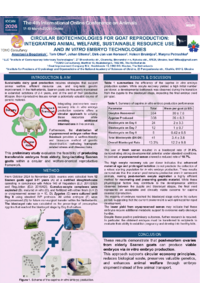
Sustainable dairy goat production requires strategies that support animal welfare, efficient resource use, and long-term genetic improvement. In the Netherlands, Saanen goats are frequently maintained in extended lactations of 2-4 years, and at the end of their productive lifespan, their reproductive tissues remain a potentially valuable source of genetic material. Integrating post-mortem ovary recovery into in vitro embryo production (IVP) systems offers a circular approach to utilizing these resources while avoiding additional interventions in live animals. Furthermore, the distribution of cryopreserved embryos rather than livestock provides a welfare-friendly and biosecure genetic dissemination, reducing transport-related stress and disease risks. This preliminary study evaluates the feasibility of producing transferable embryos from elderly, long-lactation Saanen goats within a circular and welfare-oriented reproductive framework.
From October 2024 to November 2025, ovaries were collected from 12 Saanen goats aged 8-11 years at a certified slaughterhouse operating in compliance with Article 148 of Regulation (EU) 2017/2625 and Regulation (EU) 2016/429. Cumulus-oocyte complexes were aspirated, matured in vitro, and fertilized with either fresh (n = 2) or cryopreserved semen (n = 10). Zygotes were cultured to Day 8 using standard IVP protocols. All viable embryos were cryopreserved for future non-surgical transfer within the Netherlands.
A total of 354 oocytes were recovered (30 ± 7.6 per goat). Fertilization resulted in 308 zygotes (26 ± 6.3 per goat). In total, 41 embryos developed (3 ± 1.9 per goat): 24 on Day 6, 12 on Day 7, and 5 on Day 8. Blastocyst rates were 31.8% for fresh semen and 10.7% for cryopreserved semen. All embryos were cryopreserved.
These results demonstrate that post-mortem ovaries from elderly Saanen goats can produce viable embryos via IVP. This approach supports circular economy principles, reduces biological waste, preserves valuable genetics, and enhances animal welfare through embryo shipment instead of live-animal transport.
Keywords
goat reproduction
in vitro embryo production
in vitro fertilization
animal welfare
Saanen goat
sustainable goat reproduction
Poster
A. Bogdaniuk.pdf
Switching Off: Autonomic Modulation with a Fast-Acting Nootropic Alters Arousal and Cognitive Engagement in Working Dogs
The Gut–Systemic Axis in Companion Animals: Systemic Review of the Microbiome's Role in Metabolic and Behavioral Disease