Event submissions
Published
This submission belongs to the session 7. Aquatic Animals of the event The 4th International Online Conference on Animals
Published date
12 Mar, 2026
Academic Editor
'%3e%3cpath%20d='M12.6657%2010.9104C12.4185%2010.325%2012.0599%209.79327%2011.6097%209.34482C11.1609%208.89508%2010.6293%208.5365%2010.0442%208.28888C10.0389%208.28626%2010.0337%208.28495%2010.0285%208.28233C10.8446%207.69279%2011.3752%206.73249%2011.3752%205.64904C11.3752%203.8542%209.92103%202.39999%208.1262%202.39999C6.33136%202.39999%204.87715%203.8542%204.87715%205.64904C4.87715%206.73249%205.40774%207.69279%206.22393%208.28364C6.21869%208.28626%206.21345%208.28757%206.20821%208.29019C5.62129%208.5378%205.09463%208.89284%204.64265%209.34613C4.1929%209.79493%203.83432%2010.3266%203.58671%2010.9117C3.34345%2011.4845%203.21226%2012.0987%203.20023%2012.7209C3.19988%2012.7349%203.20233%2012.7488%203.20744%2012.7619C3.21255%2012.7749%203.22022%2012.7867%203.22998%2012.7968C3.23975%2012.8068%203.25142%2012.8147%203.26431%2012.8202C3.2772%2012.8256%203.29105%2012.8284%203.30504%2012.8284H4.09109C4.14874%2012.8284%204.19459%2012.7825%204.1959%2012.7262C4.2221%2011.7148%204.62823%2010.7676%205.34617%2010.0497C6.08899%209.30683%207.0755%208.89808%208.1262%208.89808C9.17689%208.89808%2010.1634%209.30683%2010.9062%2010.0497C11.6242%2010.7676%2012.0303%2011.7148%2012.0565%2012.7262C12.0578%2012.7838%2012.1037%2012.8284%2012.1613%2012.8284H12.9474C12.9613%2012.8284%2012.9752%2012.8256%2012.9881%2012.8202C13.001%2012.8147%2013.0126%2012.8068%2013.0224%2012.7968C13.0322%2012.7867%2013.0398%2012.7749%2013.0449%2012.7619C13.0501%2012.7488%2013.0525%2012.7349%2013.0522%2012.7209C13.0391%2012.0947%2012.9094%2011.4855%2012.6657%2010.9104ZM8.1262%207.9024C7.52486%207.9024%206.9589%207.6679%206.53312%207.24211C6.10733%206.81633%205.87283%206.25037%205.87283%205.64904C5.87283%205.0477%206.10733%204.48174%206.53312%204.05596C6.9589%203.63018%207.52486%203.39567%208.1262%203.39567C8.72753%203.39567%209.29349%203.63018%209.71927%204.05596C10.1451%204.48174%2010.3796%205.0477%2010.3796%205.64904C10.3796%206.25037%2010.1451%206.81633%209.71927%207.24211C9.29349%207.6679%208.72753%207.9024%208.1262%207.9024Z'%20fill='%235D1EE1'/%3e%3c/g%3e%3c/svg%3e) Jorge Galindo-Villegas
Jorge Galindo-VillegasCitation
Alessandra Aiello, Rosaria Arena, Eleonora Curcuraci, Laura La Barbera, Concetta Maria Messina, Andrea Santulli, ENHANCING MARINE BIODIVERSITY THROUGH THE PROMOTION OF UNDERUTILIZED SPECIES USING INNOVATIVE PROCESSING METHODS, in Proceedings of The 4th International Online Conference on Animals, 17 March–19 March 2026, MDPI: Basel, Switzerland
Share
Email
Facebook
Twitter
LinkedIn
ENHANCING MARINE BIODIVERSITY THROUGH THE PROMOTION OF UNDERUTILIZED SPECIES USING INNOVATIVE PROCESSING METHODS
'%3e%3cpath%20d='M12.6647%2010.9104C12.4176%2010.325%2012.0589%209.7933%2011.6088%209.34485C11.16%208.89511%2010.6283%208.53653%2010.0432%208.28891C10.038%208.28629%2010.0327%208.28498%2010.0275%208.28236C10.8437%207.69282%2011.3743%206.73252%2011.3743%205.64907C11.3743%203.85423%209.92005%202.40002%208.12522%202.40002C6.33038%202.40002%204.87618%203.85423%204.87618%205.64907C4.87618%206.73252%205.40677%207.69282%206.22296%208.28367C6.21772%208.28629%206.21248%208.2876%206.20724%208.29022C5.62031%208.53783%205.09365%208.89287%204.64167%209.34616C4.19192%209.79496%203.83334%2010.3266%203.58573%2010.9117C3.34247%2011.4846%203.21128%2012.0987%203.19925%2012.721C3.1989%2012.735%203.20135%2012.7489%203.20646%2012.7619C3.21157%2012.7749%203.21924%2012.7868%203.22901%2012.7968C3.23877%2012.8068%203.25045%2012.8148%203.26334%2012.8202C3.27623%2012.8256%203.29007%2012.8284%203.30406%2012.8284H4.09012C4.14776%2012.8284%204.19362%2012.7825%204.19493%2012.7262C4.22113%2011.7148%204.62726%2010.7676%205.34519%2010.0497C6.08802%209.30686%207.07452%208.89811%208.12522%208.89811C9.17592%208.89811%2010.1624%209.30686%2010.9052%2010.0497C11.6232%2010.7676%2012.0293%2011.7148%2012.0555%2012.7262C12.0568%2012.7839%2012.1027%2012.8284%2012.1603%2012.8284H12.9464C12.9604%2012.8284%2012.9742%2012.8256%2012.9871%2012.8202C13%2012.8148%2013.0117%2012.8068%2013.0214%2012.7968C13.0312%2012.7868%2013.0389%2012.7749%2013.044%2012.7619C13.0491%2012.7489%2013.0515%2012.735%2013.0512%2012.721C13.0381%2012.0947%2012.9084%2011.4856%2012.6647%2010.9104ZM8.12522%207.90243C7.52388%207.90243%206.95792%207.66793%206.53214%207.24215C6.10636%206.81636%205.87185%206.2504%205.87185%205.64907C5.87185%205.04773%206.10636%204.48177%206.53214%204.05599C6.95792%203.63021%207.52388%203.3957%208.12522%203.3957C8.72655%203.3957%209.29252%203.63021%209.7183%204.05599C10.1441%204.48177%2010.3786%205.04773%2010.3786%205.64907C10.3786%206.2504%2010.1441%206.81636%209.7183%207.24215C9.29252%207.66793%208.72655%207.90243%208.12522%207.90243Z'%20fill='%235D1EE1'/%3e%3c/g%3e%3c/svg%3e)
Alessandra Aiello 1
Rosaria Arena 1
Eleonora Curcuraci 1
Laura La Barbera 2
Concetta Maria Messina 3
Andrea Santulli 3
1. Laboratory of Marine Biochemistry and Ecotoxicology, Department of Earth and Marine Sciences, DiSTeM,
University of Palermo, Via Barlotta 4, 91100 Trapani, Italy
2. Institute of Marine Biology, Trapani University Consortium, Via G. Barlotta 4, 91100 Trapani, Italy
3. Laboratory of Marine Biochemistry and Ecotoxicology, Department of Earth and Marine Sciences, DiSTeM, University of Palermo, Via Barlotta 4, 91100 Trapani, Italy
Abstract
Fish are an essential part of a balanced diet and represent the Mediterranean dietary model, which is renowned for its health benefits and nutritional value.
The high-quality proteins, omega-3 fatty acids, vitamins and essential minerals found in fish have led to increasing consumer demand for seafood. However, the continuous expansion of this market, together with sustainability challenges, highlights the need to diversify seafood production through innovative processing strategies that aim to enhance the sustainability, productivity, and quality of seafood products.
Promoting underutilized marine species, such as Spicara smaris, and seasonal species, such as Coryphaena hippurus, through innovative processing and preservation techniques has the potential to reduce pressure on target species, enhance marine biodiversity, and minimize waste. This approach is based on the principles of the circular economy and promotes the sustainable exploitation of marine ecosystems.
Recent technological advances have focused on the study of the application of traditional methods, such as salting and smoking, reinterpreted through innovative and sustainable technologies. In particular, the use of salting and cold smoking techniques using low-sodium salt mixtures and natural antioxidants has been investigated as an effective strategy to enhance the sensory quality, nutritional profile, and microbiological stability of underutilized fish species.
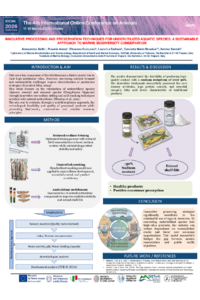
The objective of the present study was to adopt a multidisciplinary approach in order to evaluate the quality of the processed product, through sensorial, biochemical and technological analyses. The results obtained highlighted the possibility of producing a product with a sodium content reduced by more than 30% that preserves the sensory characteristics, high protein content, and omega-3 fatty acid levels of traditional products.
In conclusion, adopting innovative processing strategies can contribute significantly to the sustainable use of aquatic resources by turning underutilized species into high-quality products, reducing dependence on conventional target species, and fostering new economic opportunities in the fisheries sector.
Keywords
marine biodiversity
innovative processing
underutilized fish species
sodium reduction
Poster
Poster Aiello Alessandra - The 4th International Online Conference on Animals.pdf
Age and Sex Differences in the Prevalence of Dirofilaria immitis: Results of a Field Study in 84 Rural Dogs in Bon County, Iran
Crustaceans from the Mediterranean Sea: Possible Sentinel Species for Metal Pollution in Aquatic Environments