Event submissions
Published
This submission belongs to the session 6. Animal Physiology, Reproduction, and Sustainable Animal Production of the event The 4th International Online Conference on Animals
Published date
12 Mar, 2026
Academic Editor
'%3e%3cpath%20d='M12.6657%2010.9104C12.4185%2010.325%2012.0599%209.79327%2011.6097%209.34482C11.1609%208.89508%2010.6293%208.5365%2010.0442%208.28888C10.0389%208.28626%2010.0337%208.28495%2010.0285%208.28233C10.8446%207.69279%2011.3752%206.73249%2011.3752%205.64904C11.3752%203.8542%209.92103%202.39999%208.1262%202.39999C6.33136%202.39999%204.87715%203.8542%204.87715%205.64904C4.87715%206.73249%205.40774%207.69279%206.22393%208.28364C6.21869%208.28626%206.21345%208.28757%206.20821%208.29019C5.62129%208.5378%205.09463%208.89284%204.64265%209.34613C4.1929%209.79493%203.83432%2010.3266%203.58671%2010.9117C3.34345%2011.4845%203.21226%2012.0987%203.20023%2012.7209C3.19988%2012.7349%203.20233%2012.7488%203.20744%2012.7619C3.21255%2012.7749%203.22022%2012.7867%203.22998%2012.7968C3.23975%2012.8068%203.25142%2012.8147%203.26431%2012.8202C3.2772%2012.8256%203.29105%2012.8284%203.30504%2012.8284H4.09109C4.14874%2012.8284%204.19459%2012.7825%204.1959%2012.7262C4.2221%2011.7148%204.62823%2010.7676%205.34617%2010.0497C6.08899%209.30683%207.0755%208.89808%208.1262%208.89808C9.17689%208.89808%2010.1634%209.30683%2010.9062%2010.0497C11.6242%2010.7676%2012.0303%2011.7148%2012.0565%2012.7262C12.0578%2012.7838%2012.1037%2012.8284%2012.1613%2012.8284H12.9474C12.9613%2012.8284%2012.9752%2012.8256%2012.9881%2012.8202C13.001%2012.8147%2013.0126%2012.8068%2013.0224%2012.7968C13.0322%2012.7867%2013.0398%2012.7749%2013.0449%2012.7619C13.0501%2012.7488%2013.0525%2012.7349%2013.0522%2012.7209C13.0391%2012.0947%2012.9094%2011.4855%2012.6657%2010.9104ZM8.1262%207.9024C7.52486%207.9024%206.9589%207.6679%206.53312%207.24211C6.10733%206.81633%205.87283%206.25037%205.87283%205.64904C5.87283%205.0477%206.10733%204.48174%206.53312%204.05596C6.9589%203.63018%207.52486%203.39567%208.1262%203.39567C8.72753%203.39567%209.29349%203.63018%209.71927%204.05596C10.1451%204.48174%2010.3796%205.0477%2010.3796%205.64904C10.3796%206.25037%2010.1451%206.81633%209.71927%207.24211C9.29349%207.6679%208.72753%207.9024%208.1262%207.9024Z'%20fill='%235D1EE1'/%3e%3c/g%3e%3c/svg%3e) Mohammed Gagaoua
Mohammed GagaouaCitation
Alberto Jorge Cardenas-Padilla, Alfredo Medrano, Inter-male comparison of sperm freezability in goats using a purpose-built Sperm Quality Index, in Proceedings of The 4th International Online Conference on Animals, 17 March–19 March 2026, MDPI: Basel, Switzerland
Share
Email
Facebook
Twitter
LinkedIn
Inter-male comparison of sperm freezability in goats using a purpose-built Sperm Quality Index

Alberto Jorge Cardenas-Padilla 1
'%3e%3cpath%20d='M12.6647%2010.9104C12.4176%2010.325%2012.0589%209.7933%2011.6088%209.34485C11.16%208.89511%2010.6283%208.53653%2010.0432%208.28891C10.038%208.28629%2010.0327%208.28498%2010.0275%208.28236C10.8437%207.69282%2011.3743%206.73252%2011.3743%205.64907C11.3743%203.85423%209.92005%202.40002%208.12522%202.40002C6.33038%202.40002%204.87618%203.85423%204.87618%205.64907C4.87618%206.73252%205.40677%207.69282%206.22296%208.28367C6.21772%208.28629%206.21248%208.2876%206.20724%208.29022C5.62031%208.53783%205.09365%208.89287%204.64167%209.34616C4.19192%209.79496%203.83334%2010.3266%203.58573%2010.9117C3.34247%2011.4846%203.21128%2012.0987%203.19925%2012.721C3.1989%2012.735%203.20135%2012.7489%203.20646%2012.7619C3.21157%2012.7749%203.21924%2012.7868%203.22901%2012.7968C3.23877%2012.8068%203.25045%2012.8148%203.26334%2012.8202C3.27623%2012.8256%203.29007%2012.8284%203.30406%2012.8284H4.09012C4.14776%2012.8284%204.19362%2012.7825%204.19493%2012.7262C4.22113%2011.7148%204.62726%2010.7676%205.34519%2010.0497C6.08802%209.30686%207.07452%208.89811%208.12522%208.89811C9.17592%208.89811%2010.1624%209.30686%2010.9052%2010.0497C11.6232%2010.7676%2012.0293%2011.7148%2012.0555%2012.7262C12.0568%2012.7839%2012.1027%2012.8284%2012.1603%2012.8284H12.9464C12.9604%2012.8284%2012.9742%2012.8256%2012.9871%2012.8202C13%2012.8148%2013.0117%2012.8068%2013.0214%2012.7968C13.0312%2012.7868%2013.0389%2012.7749%2013.044%2012.7619C13.0491%2012.7489%2013.0515%2012.735%2013.0512%2012.721C13.0381%2012.0947%2012.9084%2011.4856%2012.6647%2010.9104ZM8.12522%207.90243C7.52388%207.90243%206.95792%207.66793%206.53214%207.24215C6.10636%206.81636%205.87185%206.2504%205.87185%205.64907C5.87185%205.04773%206.10636%204.48177%206.53214%204.05599C6.95792%203.63021%207.52388%203.3957%208.12522%203.3957C8.72655%203.3957%209.29252%203.63021%209.7183%204.05599C10.1441%204.48177%2010.3786%205.04773%2010.3786%205.64907C10.3786%206.2504%2010.1441%206.81636%209.7183%207.24215C9.29252%207.66793%208.72655%207.90243%208.12522%207.90243Z'%20fill='%235D1EE1'/%3e%3c/g%3e%3c/svg%3e)
Alfredo Medrano 1
1. Department of Animal Science, Faculty of Superior Studies Cuautitlan, National Autonomous University of Mexico. Cuautitlán Izcalli 54714, México
Abstract
Introduction
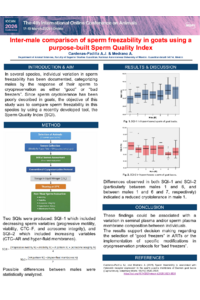
In several species, individual variation in sperm freezability has been documented, categorizing males by the response of their sperm to cryopreservation as either “good freezers” and “bad freezers”. Because sperm cryotolerance has been poorly described in goats, the objective of this study was to compare sperm freezability in this species using a recently developed tool, Sperm Quality Index (SQI).
Methods
A total of 124 ejaculates from seven Saanen goat bucks were collected weekly using an artificial vagina over one year. After semen assessment, samples were frozen using a conventional method, stored in LN2, and thawed at 37°C. Thawed sperm were assessed for motility, viability, acrosome integrity, capacitation status, and membrane fluidity. After freeze-thawing, sperm quality significantly decreases; some sperm variables, such as motility, decrease, while others increase, such as acrosome-reacted spermatozoa. Thus, two SQIs were produced, SQI–1 included decreasing variables (progressive motility, viability, CTC–F, and acrosome integrity), whereas SQI–2 included increasing variables (CTC–AR and hyper-fluid membranes). Possible differences between males were analyzed statistically.
Results
Significant differences (p<0.05) were detected between males 1 and 6 for SQI–1 (male 1: 28.1±2.16a; male 2: 32.2±1.98ab; male 3: 34.7±1.73ab; male 4: 34.7±1.64ab; male 5: 33.5±1.76ab; male 6: 39.9±1.82b; male 7: 38.3±2.26ab). Similarly, significant differences were found between male 1 and males 6 and 7 for SQI–2 (male 1: 73.0±2.28a; male 2: 66.4±2.55ab; male 3: 67.0±2.20ab; male 4: 65.7±2.22ab; male 5: 66.7±2.09ab; male 6: 60.9±1.08b; male 7: 64.4±2.22b).
Conclusion
Differences observed in both SQI–1 and SQI–2 (specifically between male 1 and male 6, and between male 1 and males 6 and 7, respectively) indicated a reduced cryotolerance in male 1. These findings could be associated with a variation in seminal plasma and/or sperm plasma membrane composition. The results support decision making regarding the selection of “good freezers” in ARTs or the implementation of specific modifications in cryopreservation protocols for “bad freezers”.
Keywords
Goat bucks
freezability
cryotolerance
Sperm Quality Index (SQI)
Poster
REV Poster IOCAN 2026.pdf
Thermoregulatory Mechanisms of Caracu Young Bulls under Tropical Climate
Effects of Vitamin C and E Supplementation on Hen Day production, Egg Quality Characteristics and Ovarian Morphometry of Improved Fulani Ecotype Hens