Event submissions
Published
This submission belongs to the session 6. Animal Physiology, Reproduction, and Sustainable Animal Production of the event The 4th International Online Conference on Animals
Published date
12 Mar, 2026
Academic Editor
'%3e%3cpath%20d='M12.6657%2010.9104C12.4185%2010.325%2012.0599%209.79327%2011.6097%209.34482C11.1609%208.89508%2010.6293%208.5365%2010.0442%208.28888C10.0389%208.28626%2010.0337%208.28495%2010.0285%208.28233C10.8446%207.69279%2011.3752%206.73249%2011.3752%205.64904C11.3752%203.8542%209.92103%202.39999%208.1262%202.39999C6.33136%202.39999%204.87715%203.8542%204.87715%205.64904C4.87715%206.73249%205.40774%207.69279%206.22393%208.28364C6.21869%208.28626%206.21345%208.28757%206.20821%208.29019C5.62129%208.5378%205.09463%208.89284%204.64265%209.34613C4.1929%209.79493%203.83432%2010.3266%203.58671%2010.9117C3.34345%2011.4845%203.21226%2012.0987%203.20023%2012.7209C3.19988%2012.7349%203.20233%2012.7488%203.20744%2012.7619C3.21255%2012.7749%203.22022%2012.7867%203.22998%2012.7968C3.23975%2012.8068%203.25142%2012.8147%203.26431%2012.8202C3.2772%2012.8256%203.29105%2012.8284%203.30504%2012.8284H4.09109C4.14874%2012.8284%204.19459%2012.7825%204.1959%2012.7262C4.2221%2011.7148%204.62823%2010.7676%205.34617%2010.0497C6.08899%209.30683%207.0755%208.89808%208.1262%208.89808C9.17689%208.89808%2010.1634%209.30683%2010.9062%2010.0497C11.6242%2010.7676%2012.0303%2011.7148%2012.0565%2012.7262C12.0578%2012.7838%2012.1037%2012.8284%2012.1613%2012.8284H12.9474C12.9613%2012.8284%2012.9752%2012.8256%2012.9881%2012.8202C13.001%2012.8147%2013.0126%2012.8068%2013.0224%2012.7968C13.0322%2012.7867%2013.0398%2012.7749%2013.0449%2012.7619C13.0501%2012.7488%2013.0525%2012.7349%2013.0522%2012.7209C13.0391%2012.0947%2012.9094%2011.4855%2012.6657%2010.9104ZM8.1262%207.9024C7.52486%207.9024%206.9589%207.6679%206.53312%207.24211C6.10733%206.81633%205.87283%206.25037%205.87283%205.64904C5.87283%205.0477%206.10733%204.48174%206.53312%204.05596C6.9589%203.63018%207.52486%203.39567%208.1262%203.39567C8.72753%203.39567%209.29349%203.63018%209.71927%204.05596C10.1451%204.48174%2010.3796%205.0477%2010.3796%205.64904C10.3796%206.25037%2010.1451%206.81633%209.71927%207.24211C9.29349%207.6679%208.72753%207.9024%208.1262%207.9024Z'%20fill='%235D1EE1'/%3e%3c/g%3e%3c/svg%3e) Mohammed Gagaoua
Mohammed GagaouaCitation
Raquel Gomez-Lucas, Angela Garrido, Nelida Fernandez-Pato, Tania Ayllon, Lydia Calleja, Nerea Garcia, Isabel Rodriguez-Hurtado, Fatima Cruz-Lopez, Seroprevalence and risk factors of equine piroplasmosis (EP) in competition horses in Spain, in Proceedings of The 4th International Online Conference on Animals, 17 March–19 March 2026, MDPI: Basel, Switzerland
Share
Email
Facebook
Twitter
LinkedIn
Seroprevalence and risk factors of equine piroplasmosis (EP) in competition horses in Spain
'%3e%3cpath%20d='M12.6647%2010.9104C12.4176%2010.325%2012.0589%209.7933%2011.6088%209.34485C11.16%208.89511%2010.6283%208.53653%2010.0432%208.28891C10.038%208.28629%2010.0327%208.28498%2010.0275%208.28236C10.8437%207.69282%2011.3743%206.73252%2011.3743%205.64907C11.3743%203.85423%209.92005%202.40002%208.12522%202.40002C6.33038%202.40002%204.87618%203.85423%204.87618%205.64907C4.87618%206.73252%205.40677%207.69282%206.22296%208.28367C6.21772%208.28629%206.21248%208.2876%206.20724%208.29022C5.62031%208.53783%205.09365%208.89287%204.64167%209.34616C4.19192%209.79496%203.83334%2010.3266%203.58573%2010.9117C3.34247%2011.4846%203.21128%2012.0987%203.19925%2012.721C3.1989%2012.735%203.20135%2012.7489%203.20646%2012.7619C3.21157%2012.7749%203.21924%2012.7868%203.22901%2012.7968C3.23877%2012.8068%203.25045%2012.8148%203.26334%2012.8202C3.27623%2012.8256%203.29007%2012.8284%203.30406%2012.8284H4.09012C4.14776%2012.8284%204.19362%2012.7825%204.19493%2012.7262C4.22113%2011.7148%204.62726%2010.7676%205.34519%2010.0497C6.08802%209.30686%207.07452%208.89811%208.12522%208.89811C9.17592%208.89811%2010.1624%209.30686%2010.9052%2010.0497C11.6232%2010.7676%2012.0293%2011.7148%2012.0555%2012.7262C12.0568%2012.7839%2012.1027%2012.8284%2012.1603%2012.8284H12.9464C12.9604%2012.8284%2012.9742%2012.8256%2012.9871%2012.8202C13%2012.8148%2013.0117%2012.8068%2013.0214%2012.7968C13.0312%2012.7868%2013.0389%2012.7749%2013.044%2012.7619C13.0491%2012.7489%2013.0515%2012.735%2013.0512%2012.721C13.0381%2012.0947%2012.9084%2011.4856%2012.6647%2010.9104ZM8.12522%207.90243C7.52388%207.90243%206.95792%207.66793%206.53214%207.24215C6.10636%206.81636%205.87185%206.2504%205.87185%205.64907C5.87185%205.04773%206.10636%204.48177%206.53214%204.05599C6.95792%203.63021%207.52388%203.3957%208.12522%203.3957C8.72655%203.3957%209.29252%203.63021%209.7183%204.05599C10.1441%204.48177%2010.3786%205.04773%2010.3786%205.64907C10.3786%206.2504%2010.1441%206.81636%209.7183%207.24215C9.29252%207.66793%208.72655%207.90243%208.12522%207.90243Z'%20fill='%235D1EE1'/%3e%3c/g%3e%3c/svg%3e)
Raquel Gomez-Lucas 1
Angela Garrido 1

Nelida Fernandez-Pato 1
Tania Ayllon 1
Lydia Calleja 1
Nerea Garcia 2,3
Isabel Rodriguez-Hurtado 1
Fatima Cruz-Lopez 1
1. Facultad de Veterinaria, Universidad Alfonso X El Sabio, Madrid, Spain.
2. Departamento de Sanidad Animal, Facultad de Veterinaria, Universidad Complutense de Madrid, Madrid, Spain
3. VISAVET Centre, Universidad Complutense de Madrid, Madrid, Spain
Abstract
Introduction and objectives:
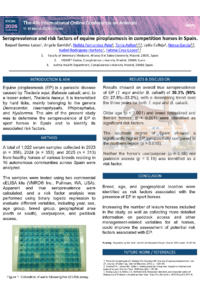
Equine piroplasmosis (EP) is a parasitic disease caused by Theileria equi, Babesia caballi, and, to a lesser extent, Theileria haneyi. It is transmitted by hard ticks, mainly belonging to the genera Dermacentor, Haemaphysalis, Rhipicephalus, and Hyalomma. The aim of the present study was to determine the seroprevalence of EP in sport horses in Spain and to identify its associated risk factors.
Methodology:
A total of 1,022 serum samples collected in 2023 (n = 356), 2024 (n = 353), and 2025 (n = 313) from healthy horses of various breeds residing in 16 autonomous communities across Spain were analyzed. The samples were tested using two commercial cELISA kits (VMRD® Inc., Pullman, WA, USA). Apparent and true seroprevalence were calculated, and a risk factor analysis was performed using binary logistic regression to evaluate different variables, including year, sex, age group, breed group, geographical area (north or south), use/purpose, and paddock access.
Results and discussion:
Results showed an overall true seroprevalence of EP (T. equi and/or B. caballi) of 30.3% (95% CI: 27.5%–33.2%), with a decreasing trend over the three years for both T. equi and B. caballi. Older age (p < 0.001) and breed (crossbred and Iberian horses, p < 0.001) were identified as significant risk factors. The southern region of Spain showed a significantly higher EP seropositivity compared to the northern region (p = 0.018). Neither the horse’s use/purpose (p = 0.66) nor paddock access (p = 0.19) was identified as a risk factor.
Conclusions: Breed, age, and geographical location were identified as risk factors associated with the presence of EP in sport horses. Increasing the number of leisure horses included in the study, as well as collecting more detailed information on paddock access and other
management-related variables for all horses, could improve the assessment of potential risk factors associated with EP.
Keywords
piroplasmosis
equine
sport
risk factors
Spain.
Poster
Poster IOCAN 2026 EP seroprevalence.pdf
Effects of Vitamin C and E Supplementation on Hen Day production, Egg Quality Characteristics and Ovarian Morphometry of Improved Fulani Ecotype Hens
Water Quality and Welfare Awareness as Pillars of Sustainable Tilapia Culture in Egypt