Event submissions
Published
This submission belongs to the session 5. Environmental Challenges to Animals and Precision Livestock Farming of the event The 4th International Online Conference on Animals
Published date
12 Mar, 2026
Academic Editor
'%3e%3cpath%20d='M12.6657%2010.9104C12.4185%2010.325%2012.0599%209.79327%2011.6097%209.34482C11.1609%208.89508%2010.6293%208.5365%2010.0442%208.28888C10.0389%208.28626%2010.0337%208.28495%2010.0285%208.28233C10.8446%207.69279%2011.3752%206.73249%2011.3752%205.64904C11.3752%203.8542%209.92103%202.39999%208.1262%202.39999C6.33136%202.39999%204.87715%203.8542%204.87715%205.64904C4.87715%206.73249%205.40774%207.69279%206.22393%208.28364C6.21869%208.28626%206.21345%208.28757%206.20821%208.29019C5.62129%208.5378%205.09463%208.89284%204.64265%209.34613C4.1929%209.79493%203.83432%2010.3266%203.58671%2010.9117C3.34345%2011.4845%203.21226%2012.0987%203.20023%2012.7209C3.19988%2012.7349%203.20233%2012.7488%203.20744%2012.7619C3.21255%2012.7749%203.22022%2012.7867%203.22998%2012.7968C3.23975%2012.8068%203.25142%2012.8147%203.26431%2012.8202C3.2772%2012.8256%203.29105%2012.8284%203.30504%2012.8284H4.09109C4.14874%2012.8284%204.19459%2012.7825%204.1959%2012.7262C4.2221%2011.7148%204.62823%2010.7676%205.34617%2010.0497C6.08899%209.30683%207.0755%208.89808%208.1262%208.89808C9.17689%208.89808%2010.1634%209.30683%2010.9062%2010.0497C11.6242%2010.7676%2012.0303%2011.7148%2012.0565%2012.7262C12.0578%2012.7838%2012.1037%2012.8284%2012.1613%2012.8284H12.9474C12.9613%2012.8284%2012.9752%2012.8256%2012.9881%2012.8202C13.001%2012.8147%2013.0126%2012.8068%2013.0224%2012.7968C13.0322%2012.7867%2013.0398%2012.7749%2013.0449%2012.7619C13.0501%2012.7488%2013.0525%2012.7349%2013.0522%2012.7209C13.0391%2012.0947%2012.9094%2011.4855%2012.6657%2010.9104ZM8.1262%207.9024C7.52486%207.9024%206.9589%207.6679%206.53312%207.24211C6.10733%206.81633%205.87283%206.25037%205.87283%205.64904C5.87283%205.0477%206.10733%204.48174%206.53312%204.05596C6.9589%203.63018%207.52486%203.39567%208.1262%203.39567C8.72753%203.39567%209.29349%203.63018%209.71927%204.05596C10.1451%204.48174%2010.3796%205.0477%2010.3796%205.64904C10.3796%206.25037%2010.1451%206.81633%209.71927%207.24211C9.29349%207.6679%208.72753%207.9024%208.1262%207.9024Z'%20fill='%235D1EE1'/%3e%3c/g%3e%3c/svg%3e) Andrea Pezzuolo
Andrea PezzuoloCitation
Ana Vitória Magalhães de Almeida, Solano Dantas Martins, Sara Jayane Abreu de Souza, Valdevane Rocha Araújo, EFFECTS OF HEAT STRESS ON TESTICULAR PHYSIOLOGY IN CATTLE: A REVIEW, in Proceedings of The 4th International Online Conference on Animals, 17 March–19 March 2026, MDPI: Basel, Switzerland
Share
Email
Facebook
Twitter
LinkedIn
EFFECTS OF HEAT STRESS ON TESTICULAR PHYSIOLOGY IN CATTLE: A REVIEW
'%3e%3cpath%20d='M12.6647%2010.9104C12.4176%2010.325%2012.0589%209.7933%2011.6088%209.34485C11.16%208.89511%2010.6283%208.53653%2010.0432%208.28891C10.038%208.28629%2010.0327%208.28498%2010.0275%208.28236C10.8437%207.69282%2011.3743%206.73252%2011.3743%205.64907C11.3743%203.85423%209.92005%202.40002%208.12522%202.40002C6.33038%202.40002%204.87618%203.85423%204.87618%205.64907C4.87618%206.73252%205.40677%207.69282%206.22296%208.28367C6.21772%208.28629%206.21248%208.2876%206.20724%208.29022C5.62031%208.53783%205.09365%208.89287%204.64167%209.34616C4.19192%209.79496%203.83334%2010.3266%203.58573%2010.9117C3.34247%2011.4846%203.21128%2012.0987%203.19925%2012.721C3.1989%2012.735%203.20135%2012.7489%203.20646%2012.7619C3.21157%2012.7749%203.21924%2012.7868%203.22901%2012.7968C3.23877%2012.8068%203.25045%2012.8148%203.26334%2012.8202C3.27623%2012.8256%203.29007%2012.8284%203.30406%2012.8284H4.09012C4.14776%2012.8284%204.19362%2012.7825%204.19493%2012.7262C4.22113%2011.7148%204.62726%2010.7676%205.34519%2010.0497C6.08802%209.30686%207.07452%208.89811%208.12522%208.89811C9.17592%208.89811%2010.1624%209.30686%2010.9052%2010.0497C11.6232%2010.7676%2012.0293%2011.7148%2012.0555%2012.7262C12.0568%2012.7839%2012.1027%2012.8284%2012.1603%2012.8284H12.9464C12.9604%2012.8284%2012.9742%2012.8256%2012.9871%2012.8202C13%2012.8148%2013.0117%2012.8068%2013.0214%2012.7968C13.0312%2012.7868%2013.0389%2012.7749%2013.044%2012.7619C13.0491%2012.7489%2013.0515%2012.735%2013.0512%2012.721C13.0381%2012.0947%2012.9084%2011.4856%2012.6647%2010.9104ZM8.12522%207.90243C7.52388%207.90243%206.95792%207.66793%206.53214%207.24215C6.10636%206.81636%205.87185%206.2504%205.87185%205.64907C5.87185%205.04773%206.10636%204.48177%206.53214%204.05599C6.95792%203.63021%207.52388%203.3957%208.12522%203.3957C8.72655%203.3957%209.29252%203.63021%209.7183%204.05599C10.1441%204.48177%2010.3786%205.04773%2010.3786%205.64907C10.3786%206.2504%2010.1441%206.81636%209.7183%207.24215C9.29252%207.66793%208.72655%207.90243%208.12522%207.90243Z'%20fill='%235D1EE1'/%3e%3c/g%3e%3c/svg%3e)
Ana Vitória Magalhães de Almeida 1
Solano Dantas Martins 1
Sara Jayane Abreu de Souza 1
Valdevane Rocha Araújo 1
1. Laboratory of Research in Reproductive physiology (Fisiorep Lab), Parnaíba Delta Federal University (UFDPar), Parnaíba 64202-020, Brazil
Abstract
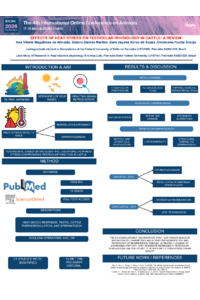
INTRODUCTION: Global warming has intensified the occurrence of heat waves, directly impacting animal reproduction, especially in cattle. Heat stress affects male reproductive efficiency. Increased body temperature compromises essential reproductive processes, particularly spermatogenesis. Understanding how heat interferes with testicular physiology and sperm quality in cattle is fundamental for the development of management strategies that minimize its negative effects on reproduction. This study aimed to evaluate, based on the scientific literature, how heat stress compromises testicular function in cattle. METHODOLOGY: The review was conducted in the PubMed and ScienceDirect databases, including original scientific articles published in English in the last 10 years, with full-text access. The descriptors used were heat-shock response, testis, cattle, thermoregulation, and spermatozoa. Initially, 21 studies were identified, of which 13 met the inclusion criteria. RESULTS: Evidence has shown that environmental heat stress promotes increased testicular temperature and alterations in blood flow, compromising scrotal thermoregulation. These alterations result in oxidative stress, sperm DNA damage, and epigenetic modifications. Significant reductions in sperm quality have been observed, including decreased motility, impaired sperm structural integrity, and Sertoli and Leydig cell dysfunction, negatively affecting spermatogenesis. Studies have also reported early diagnostic methods for heat-induced testicular changes. Furthermore, mitigation strategies, including ventilation, cooling systems, and chemical approaches, have proven effective in reducing thermal damage and preserving fertility. CONCLUSION: The studies demonstrate that heat stress reduces sperm quality parameters and alters the morphology and physiology of seminiferous tubules, ultimately leading to decreased fertility. Even moderate increases in testicular temperature are sufficient to significantly compromise sperm quality.
Keywords
thermoregulation
spermatozoa
heat-shock response
fertility
Poster
IOCAN MODELO - Copia.pptx.pdf
Water Quality and Welfare Awareness as Pillars of Sustainable Tilapia Culture in Egypt