Event submissions
EventsThe 5th International Electronic Conference on Brain Sciences & 1st International Electronic Conference on Neurosciences
Published
This submission belongs to the session S1. Neurodegenerative Diseases of the event The 5th International Electronic Conference on Brain Sciences & 1st International Electronic Conference on Neurosciences
Published date
12 Mar, 2026
Academic Editor
'%3e%3cpath%20d='M12.6657%2010.9104C12.4185%2010.325%2012.0599%209.79327%2011.6097%209.34482C11.1609%208.89508%2010.6293%208.5365%2010.0442%208.28888C10.0389%208.28626%2010.0337%208.28495%2010.0285%208.28233C10.8446%207.69279%2011.3752%206.73249%2011.3752%205.64904C11.3752%203.8542%209.92103%202.39999%208.1262%202.39999C6.33136%202.39999%204.87715%203.8542%204.87715%205.64904C4.87715%206.73249%205.40774%207.69279%206.22393%208.28364C6.21869%208.28626%206.21345%208.28757%206.20821%208.29019C5.62129%208.5378%205.09463%208.89284%204.64265%209.34613C4.1929%209.79493%203.83432%2010.3266%203.58671%2010.9117C3.34345%2011.4845%203.21226%2012.0987%203.20023%2012.7209C3.19988%2012.7349%203.20233%2012.7488%203.20744%2012.7619C3.21255%2012.7749%203.22022%2012.7867%203.22998%2012.7968C3.23975%2012.8068%203.25142%2012.8147%203.26431%2012.8202C3.2772%2012.8256%203.29105%2012.8284%203.30504%2012.8284H4.09109C4.14874%2012.8284%204.19459%2012.7825%204.1959%2012.7262C4.2221%2011.7148%204.62823%2010.7676%205.34617%2010.0497C6.08899%209.30683%207.0755%208.89808%208.1262%208.89808C9.17689%208.89808%2010.1634%209.30683%2010.9062%2010.0497C11.6242%2010.7676%2012.0303%2011.7148%2012.0565%2012.7262C12.0578%2012.7838%2012.1037%2012.8284%2012.1613%2012.8284H12.9474C12.9613%2012.8284%2012.9752%2012.8256%2012.9881%2012.8202C13.001%2012.8147%2013.0126%2012.8068%2013.0224%2012.7968C13.0322%2012.7867%2013.0398%2012.7749%2013.0449%2012.7619C13.0501%2012.7488%2013.0525%2012.7349%2013.0522%2012.7209C13.0391%2012.0947%2012.9094%2011.4855%2012.6657%2010.9104ZM8.1262%207.9024C7.52486%207.9024%206.9589%207.6679%206.53312%207.24211C6.10733%206.81633%205.87283%206.25037%205.87283%205.64904C5.87283%205.0477%206.10733%204.48174%206.53312%204.05596C6.9589%203.63018%207.52486%203.39567%208.1262%203.39567C8.72753%203.39567%209.29349%203.63018%209.71927%204.05596C10.1451%204.48174%2010.3796%205.0477%2010.3796%205.64904C10.3796%206.25037%2010.1451%206.81633%209.71927%207.24211C9.29349%207.6679%208.72753%207.9024%208.1262%207.9024Z'%20fill='%235D1EE1'/%3e%3c/g%3e%3c/svg%3e) Stephen Meriney
Stephen MerineyCitation
P. Barciela, A. Perez-Vazquez, R. Nogueira-Marques, Maria Carpena, M. Prieto, Targeting Neurotrophin Regulation by Polyphenols: Mechanistic Basis for Cognitive Resilience, in Proceedings of The 5th International Electronic Conference on Brain Sciences & 1st International Electronic Conference on Neurosciences, 9 March–11 March 2026, MDPI: Basel, Switzerland
Share
Email
Facebook
Twitter
LinkedIn
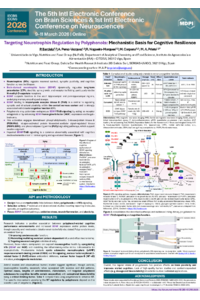
Targeting Neurotrophin Regulation by Polyphenols: Mechanistic Basis for Cognitive Resilience

P. Barciela 1
'%3e%3cpath%20d='M12.6647%2010.9104C12.4176%2010.325%2012.0589%209.7933%2011.6088%209.34485C11.16%208.89511%2010.6283%208.53653%2010.0432%208.28891C10.038%208.28629%2010.0327%208.28498%2010.0275%208.28236C10.8437%207.69282%2011.3743%206.73252%2011.3743%205.64907C11.3743%203.85423%209.92005%202.40002%208.12522%202.40002C6.33038%202.40002%204.87618%203.85423%204.87618%205.64907C4.87618%206.73252%205.40677%207.69282%206.22296%208.28367C6.21772%208.28629%206.21248%208.2876%206.20724%208.29022C5.62031%208.53783%205.09365%208.89287%204.64167%209.34616C4.19192%209.79496%203.83334%2010.3266%203.58573%2010.9117C3.34247%2011.4846%203.21128%2012.0987%203.19925%2012.721C3.1989%2012.735%203.20135%2012.7489%203.20646%2012.7619C3.21157%2012.7749%203.21924%2012.7868%203.22901%2012.7968C3.23877%2012.8068%203.25045%2012.8148%203.26334%2012.8202C3.27623%2012.8256%203.29007%2012.8284%203.30406%2012.8284H4.09012C4.14776%2012.8284%204.19362%2012.7825%204.19493%2012.7262C4.22113%2011.7148%204.62726%2010.7676%205.34519%2010.0497C6.08802%209.30686%207.07452%208.89811%208.12522%208.89811C9.17592%208.89811%2010.1624%209.30686%2010.9052%2010.0497C11.6232%2010.7676%2012.0293%2011.7148%2012.0555%2012.7262C12.0568%2012.7839%2012.1027%2012.8284%2012.1603%2012.8284H12.9464C12.9604%2012.8284%2012.9742%2012.8256%2012.9871%2012.8202C13%2012.8148%2013.0117%2012.8068%2013.0214%2012.7968C13.0312%2012.7868%2013.0389%2012.7749%2013.044%2012.7619C13.0491%2012.7489%2013.0515%2012.735%2013.0512%2012.721C13.0381%2012.0947%2012.9084%2011.4856%2012.6647%2010.9104ZM8.12522%207.90243C7.52388%207.90243%206.95792%207.66793%206.53214%207.24215C6.10636%206.81636%205.87185%206.2504%205.87185%205.64907C5.87185%205.04773%206.10636%204.48177%206.53214%204.05599C6.95792%203.63021%207.52388%203.3957%208.12522%203.3957C8.72655%203.3957%209.29252%203.63021%209.7183%204.05599C10.1441%204.48177%2010.3786%205.04773%2010.3786%205.64907C10.3786%206.2504%2010.1441%206.81636%209.7183%207.24215C9.29252%207.66793%208.72655%207.90243%208.12522%207.90243Z'%20fill='%235D1EE1'/%3e%3c/g%3e%3c/svg%3e)
A. Perez-Vazquez 1
R. Nogueira-Marques 1

Maria Carpena 1

M. Prieto 1
1. Instituto de Agroecoloxía e Alimentación (IAA), Universidade de Vigo, Nutrition and Food Group (NuFoG), Campus Auga, 32004 Ourense, Spain
Abstract
Background:
Synaptic plasticity in neurodegenerative disorders (NDs), cognitive impairment, and mental health conditions is regulated by brain-derived neurotrophic factor (BDNF). Even healthy individuals have different levels, which are affected by complex epigenetic, inflammatory, and metabolic regulation. BDNF expression changes are associated with both typical and abnormal aging, as well as mental health conditions. These changes affect brain areas that are crucial for memory, such as the hippocampus and the parahippocampal cortex. Neurotrophins (NTs), including nerve growth factor (NGF) and BDNF, are essential for neuronal differentiation via tropomyosin receptor kinase (Trk) and the p75 neurotrophin receptor (p75NTR). Dysregulated NT signaling contributes to synaptic dysfunction and neuroinflammation.
Objective:
This systematic review synthesizes preclinical evidence of the potential of naturally derived compounds to modulate NTs for neuroprotection and their incorporation into novel foods.
Methodology:
A review of major databases found studies that examined the impact of dietary polyphenols and other bioactive substances on NT signaling, oxidative stress, inflammation, and neuronal plasticity.
Results:
Compounds such as epigallocatechin gallate, resveratrol, curcumin, quercetin, and flavanols can positively impact NTs, reducing reactive oxygen species (ROS)/reactive nitrogen species (RNS), enhancing cell survival, and increasing the expression of trophic factors such as Nrf2, NGF, and vascular endothelial growth factor (VEGF) in neural stem cells. However, their bioavailability, optimal dosage, and dietary interactions require further research.
Conclusions:
The consumption of BDNF-promoting foods can potentially stimulate BDNF synthesis, support optimal neurotransmission, and fortify neural plasticity. Evidence supports a polyphenol-rich diet for preventing NDs and promoting brain health. Observational studies consistently support the protective effects of polyphenols on brain health through their impact on the gut–brain axis.
Keywords
Neurotrophins
Polyphenols
Neuroprotection
Neurodegenerative Diseases
Cognitive health
Synaptic plasticity
Poster
sciforum-156148_PB.pdf
Artificial Intelligence- and Technology-Enhanced Neurorehabilitation: Innovations in Traumatic Brain Injury and HIV-Associated Cognitive Impairment
Acute physical exercise enhances semantic memory processing speed: evidence from a reaction-time lexical decision task