Event submissions
EventsThe 5th International Electronic Conference on Brain Sciences & 1st International Electronic Conference on Neurosciences
Published
This submission belongs to the session S4. Cognitive Neuroscience of the event The 5th International Electronic Conference on Brain Sciences & 1st International Electronic Conference on Neurosciences
Published date
12 Mar, 2026
Academic Editor
'%3e%3cpath%20d='M12.6657%2010.9104C12.4185%2010.325%2012.0599%209.79327%2011.6097%209.34482C11.1609%208.89508%2010.6293%208.5365%2010.0442%208.28888C10.0389%208.28626%2010.0337%208.28495%2010.0285%208.28233C10.8446%207.69279%2011.3752%206.73249%2011.3752%205.64904C11.3752%203.8542%209.92103%202.39999%208.1262%202.39999C6.33136%202.39999%204.87715%203.8542%204.87715%205.64904C4.87715%206.73249%205.40774%207.69279%206.22393%208.28364C6.21869%208.28626%206.21345%208.28757%206.20821%208.29019C5.62129%208.5378%205.09463%208.89284%204.64265%209.34613C4.1929%209.79493%203.83432%2010.3266%203.58671%2010.9117C3.34345%2011.4845%203.21226%2012.0987%203.20023%2012.7209C3.19988%2012.7349%203.20233%2012.7488%203.20744%2012.7619C3.21255%2012.7749%203.22022%2012.7867%203.22998%2012.7968C3.23975%2012.8068%203.25142%2012.8147%203.26431%2012.8202C3.2772%2012.8256%203.29105%2012.8284%203.30504%2012.8284H4.09109C4.14874%2012.8284%204.19459%2012.7825%204.1959%2012.7262C4.2221%2011.7148%204.62823%2010.7676%205.34617%2010.0497C6.08899%209.30683%207.0755%208.89808%208.1262%208.89808C9.17689%208.89808%2010.1634%209.30683%2010.9062%2010.0497C11.6242%2010.7676%2012.0303%2011.7148%2012.0565%2012.7262C12.0578%2012.7838%2012.1037%2012.8284%2012.1613%2012.8284H12.9474C12.9613%2012.8284%2012.9752%2012.8256%2012.9881%2012.8202C13.001%2012.8147%2013.0126%2012.8068%2013.0224%2012.7968C13.0322%2012.7867%2013.0398%2012.7749%2013.0449%2012.7619C13.0501%2012.7488%2013.0525%2012.7349%2013.0522%2012.7209C13.0391%2012.0947%2012.9094%2011.4855%2012.6657%2010.9104ZM8.1262%207.9024C7.52486%207.9024%206.9589%207.6679%206.53312%207.24211C6.10733%206.81633%205.87283%206.25037%205.87283%205.64904C5.87283%205.0477%206.10733%204.48174%206.53312%204.05596C6.9589%203.63018%207.52486%203.39567%208.1262%203.39567C8.72753%203.39567%209.29349%203.63018%209.71927%204.05596C10.1451%204.48174%2010.3796%205.0477%2010.3796%205.64904C10.3796%206.25037%2010.1451%206.81633%209.71927%207.24211C9.29349%207.6679%208.72753%207.9024%208.1262%207.9024Z'%20fill='%235D1EE1'/%3e%3c/g%3e%3c/svg%3e) Carla Masala
Carla MasalaCitation
Xinbi Zhang, Mingming Huang, Wangyang Xu, Rui Zhou, Yingzhe Song, Leiming Di, Effects of Different Stress States on Athletes’ Cognitive Function and the Underlying Neural Mechanisms, in Proceedings of The 5th International Electronic Conference on Brain Sciences & 1st International Electronic Conference on Neurosciences, 9 March–11 March 2026, MDPI: Basel, Switzerland
Share
Email
Facebook
Twitter
LinkedIn
Effects of Different Stress States on Athletes’ Cognitive Function and the Underlying Neural Mechanisms
'%3e%3cpath%20d='M12.6647%2010.9104C12.4176%2010.325%2012.0589%209.7933%2011.6088%209.34485C11.16%208.89511%2010.6283%208.53653%2010.0432%208.28891C10.038%208.28629%2010.0327%208.28498%2010.0275%208.28236C10.8437%207.69282%2011.3743%206.73252%2011.3743%205.64907C11.3743%203.85423%209.92005%202.40002%208.12522%202.40002C6.33038%202.40002%204.87618%203.85423%204.87618%205.64907C4.87618%206.73252%205.40677%207.69282%206.22296%208.28367C6.21772%208.28629%206.21248%208.2876%206.20724%208.29022C5.62031%208.53783%205.09365%208.89287%204.64167%209.34616C4.19192%209.79496%203.83334%2010.3266%203.58573%2010.9117C3.34247%2011.4846%203.21128%2012.0987%203.19925%2012.721C3.1989%2012.735%203.20135%2012.7489%203.20646%2012.7619C3.21157%2012.7749%203.21924%2012.7868%203.22901%2012.7968C3.23877%2012.8068%203.25045%2012.8148%203.26334%2012.8202C3.27623%2012.8256%203.29007%2012.8284%203.30406%2012.8284H4.09012C4.14776%2012.8284%204.19362%2012.7825%204.19493%2012.7262C4.22113%2011.7148%204.62726%2010.7676%205.34519%2010.0497C6.08802%209.30686%207.07452%208.89811%208.12522%208.89811C9.17592%208.89811%2010.1624%209.30686%2010.9052%2010.0497C11.6232%2010.7676%2012.0293%2011.7148%2012.0555%2012.7262C12.0568%2012.7839%2012.1027%2012.8284%2012.1603%2012.8284H12.9464C12.9604%2012.8284%2012.9742%2012.8256%2012.9871%2012.8202C13%2012.8148%2013.0117%2012.8068%2013.0214%2012.7968C13.0312%2012.7868%2013.0389%2012.7749%2013.044%2012.7619C13.0491%2012.7489%2013.0515%2012.735%2013.0512%2012.721C13.0381%2012.0947%2012.9084%2011.4856%2012.6647%2010.9104ZM8.12522%207.90243C7.52388%207.90243%206.95792%207.66793%206.53214%207.24215C6.10636%206.81636%205.87185%206.2504%205.87185%205.64907C5.87185%205.04773%206.10636%204.48177%206.53214%204.05599C6.95792%203.63021%207.52388%203.3957%208.12522%203.3957C8.72655%203.3957%209.29252%203.63021%209.7183%204.05599C10.1441%204.48177%2010.3786%205.04773%2010.3786%205.64907C10.3786%206.2504%2010.1441%206.81636%209.7183%207.24215C9.29252%207.66793%208.72655%207.90243%208.12522%207.90243Z'%20fill='%235D1EE1'/%3e%3c/g%3e%3c/svg%3e)
Xinbi Zhang 1
Mingming Huang 1
Wangyang Xu 2
Rui Zhou 1
Yingzhe Song 1
Leiming Di 1
1. School of Kinesiology and Health, Capital University of Physical Education and Sports, Beijing 100191, China
2. School of Athletic Performance, Shanghai University of Sport, Shanghai, 200438, China
Abstract
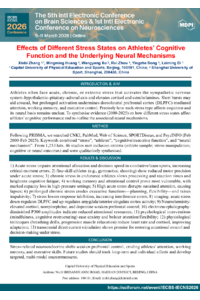
Athletes often face acute, chronic, or extreme stress that activates the sympathetic nervous system–hypothalamic–pituitary–adrenal axis and elevates cortisol and catecholamines. Short bursts may aid arousal, but prolonged activation undermines dorsolateral prefrontal cortex (DLPFC)-mediated attention, working memory, and executive control. Precisely how each stress type affects cognition and its neural basis remains unclear.
Objective
To synthesise evidence (2000-2025) on how different stress states affect athletes’ cognitive performance and to outline the associated neural mechanisms.
Methods
Following PRISMA, we searched CNKI, PubMed, Web of Science, SPORTDiscus, and PsycINFO (Feb 2000-Feb 2025). Keywords combined “stress”, “athletes”, “cognitive/executive function”, and “neural mechanism”. From 1,253 hits, 46 studies met inclusion criteria (athlete sample; stress manipulation; and cognitive or neural outcomes) and were qualitatively synthesised.
Results
1) Acute stress impairs attentional allocation and decision speed in combative/team sports, increasing critical-moment errors; 2) fine-skill athletes (e.g., gymnastics and shooting) show reduced motor precision under acute stress; 3) chronic stress in endurance athletes slows processing and reaction times and heightens cognitive fatigue; 4) working memory and attentional control prove most vulnerable, with marked capacity loss in high-pressure settings; 5) high acute stress disrupts sustained attention, causing lapses; 6) prolonged chronic stress erodes executive functions—planning and flexibility—and raises impulsivity; 7) stress lowers response inhibition, increasing interference errors; 8) imaging: acute stress down-regulates DLPFC and up-regulates amygdala/anterior cingulate cortex activity; 9) neurochemistry: elevated cortisol, norepinephrine, and dopamine weaken prefrontal control; 10) electroencephalography: diminished P300 amplitudes indicate reduced attentional resources; 11) psychological interventions (mindfulness and cognitive restructuring) ease anxiety and bolster attention/flexibility; 12) physiological techniques (breathing drills and progressive muscle relaxation) reduce heart rate and cortisol, improving adaptation; and 13) transcranial direct current stimulation shows promise for restoring attentional control and decision-making under stress.
Conclusion
Stress-related neuroendocrine shifts weaken prefrontal control, eroding athletes’ attention, working memory, and executive skills. Future studies should track long-term and individual effects and develop targeted, multi-modal countermeasures.
Keywords
Stress
Athletes
Cognitive Function
Executive Function
Neural Mechanism
Poster
Xinbi_Zhang_Poster_ID_sciforum-124738.pdf
Acute physical exercise enhances semantic memory processing speed: evidence from a reaction-time lexical decision task
Learning-Dependent Modulation of Corticospinal Excitability During TMS-Based Neurofeedback