Event submissions
Published
This submission belongs to the session S5. Studies on Cognitive Processes of the event The 1st International Online Conference on Human Intelligence
Published date
20 Mar, 2026
Academic Editor
'%3e%3cpath%20d='M12.6657%2010.9104C12.4185%2010.325%2012.0599%209.79327%2011.6097%209.34482C11.1609%208.89508%2010.6293%208.5365%2010.0442%208.28888C10.0389%208.28626%2010.0337%208.28495%2010.0285%208.28233C10.8446%207.69279%2011.3752%206.73249%2011.3752%205.64904C11.3752%203.8542%209.92103%202.39999%208.1262%202.39999C6.33136%202.39999%204.87715%203.8542%204.87715%205.64904C4.87715%206.73249%205.40774%207.69279%206.22393%208.28364C6.21869%208.28626%206.21345%208.28757%206.20821%208.29019C5.62129%208.5378%205.09463%208.89284%204.64265%209.34613C4.1929%209.79493%203.83432%2010.3266%203.58671%2010.9117C3.34345%2011.4845%203.21226%2012.0987%203.20023%2012.7209C3.19988%2012.7349%203.20233%2012.7488%203.20744%2012.7619C3.21255%2012.7749%203.22022%2012.7867%203.22998%2012.7968C3.23975%2012.8068%203.25142%2012.8147%203.26431%2012.8202C3.2772%2012.8256%203.29105%2012.8284%203.30504%2012.8284H4.09109C4.14874%2012.8284%204.19459%2012.7825%204.1959%2012.7262C4.2221%2011.7148%204.62823%2010.7676%205.34617%2010.0497C6.08899%209.30683%207.0755%208.89808%208.1262%208.89808C9.17689%208.89808%2010.1634%209.30683%2010.9062%2010.0497C11.6242%2010.7676%2012.0303%2011.7148%2012.0565%2012.7262C12.0578%2012.7838%2012.1037%2012.8284%2012.1613%2012.8284H12.9474C12.9613%2012.8284%2012.9752%2012.8256%2012.9881%2012.8202C13.001%2012.8147%2013.0126%2012.8068%2013.0224%2012.7968C13.0322%2012.7867%2013.0398%2012.7749%2013.0449%2012.7619C13.0501%2012.7488%2013.0525%2012.7349%2013.0522%2012.7209C13.0391%2012.0947%2012.9094%2011.4855%2012.6657%2010.9104ZM8.1262%207.9024C7.52486%207.9024%206.9589%207.6679%206.53312%207.24211C6.10733%206.81633%205.87283%206.25037%205.87283%205.64904C5.87283%205.0477%206.10733%204.48174%206.53312%204.05596C6.9589%203.63018%207.52486%203.39567%208.1262%203.39567C8.72753%203.39567%209.29349%203.63018%209.71927%204.05596C10.1451%204.48174%2010.3796%205.0477%2010.3796%205.64904C10.3796%206.25037%2010.1451%206.81633%209.71927%207.24211C9.29349%207.6679%208.72753%207.9024%208.1262%207.9024Z'%20fill='%235D1EE1'/%3e%3c/g%3e%3c/svg%3e) Andreas Demetriou
Andreas DemetriouCitation
Irene Ioannidou, Spiros Sirmakessis, Maria Rigou, Adaptive Performance and Cognitive Regulation in Immersive VR Vocational Training, in Proceedings of The 1st International Online Conference on Human Intelligence, 25 March–26 March 2026, MDPI: Basel, Switzerland
Share
Email
Facebook
Twitter
LinkedIn
Adaptive Performance and Cognitive Regulation in Immersive VR Vocational Training

Irene Ioannidou 1

Spiros Sirmakessis 1

Maria Rigou 2
1. Electrical and Computer Engineering Department, University of the Peloponnese, 26334 Patra, Greece
2. Department of Management Science and Technology, University of Patras, 26334 Patras, Greece
Abstract
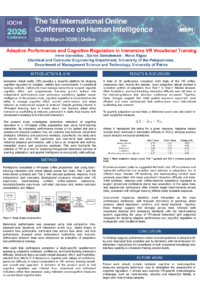
Immersive virtual reality (VR) environments offer novel opportunities to examine cognitive regulation and adaptive performance during complex, ecologically valid tasks. In vocational training contexts, learners must manage instructional support, regulate cognitive effort, and translate guidance into independent action, processes closely related to applied human intelligence. The present study examines behavioral indicators of cognitive regulation in a VR-based coffee preparation task using hand-tracking interaction.
Participants completed the same vocational procedure across two trials: an initial trial with full instructional guidance and a subsequent trial with reduced guidance. Performance was assessed using detailed temporal metrics for task segments, total completion time, interaction errors (object drops), and subjective workload and confidence ratings. Participants varied in prior VR experience and real-world coffee-machine expertise, allowing examination of expert–novice differences across both interaction and task knowledge dimensions.
Analyses focus on changes in performance and perceived workload following the removal of instructional scaffolding. Segment-level time distributions and guidance-related performance costs are examined to identify distinct performance strategies and potential bottlenecks. This study investigates how prior task expertise and VR experience relate to the regulation of cognitive effort under reduced guidance, highlighting the potential of VR-based behavioral measures for studying adaptive performance and applied intelligence in learning environments.
Keywords
cognitive regulation
adaptive performance
immersive virtual reality
vocational training
applied intelligence
task expertise
instructional scaffolding
Poster
poster- Adaptive Performance and Cognitive Regulation in Immersive VR Vocational Training.pdf
Where are we at with national IQ databases? 12 key issues and one live experiment
TEMPORAL ANCHORS AND COGNITIVE SCAFFOLDING: A CONTENT ANALYSIS OF COMPLEX NARRATIVE STRUCTURES