Event submissions
Published
This submission belongs to the session S1. Digital Health Adoption and Innovation—A Vision for the Future of Healthcare of the event The 1st International Online Conference on Healthcare
Published date
20 Mar, 2026
Academic Editor
'%3e%3cpath%20d='M12.6657%2010.9104C12.4185%2010.325%2012.0599%209.79327%2011.6097%209.34482C11.1609%208.89508%2010.6293%208.5365%2010.0442%208.28888C10.0389%208.28626%2010.0337%208.28495%2010.0285%208.28233C10.8446%207.69279%2011.3752%206.73249%2011.3752%205.64904C11.3752%203.8542%209.92103%202.39999%208.1262%202.39999C6.33136%202.39999%204.87715%203.8542%204.87715%205.64904C4.87715%206.73249%205.40774%207.69279%206.22393%208.28364C6.21869%208.28626%206.21345%208.28757%206.20821%208.29019C5.62129%208.5378%205.09463%208.89284%204.64265%209.34613C4.1929%209.79493%203.83432%2010.3266%203.58671%2010.9117C3.34345%2011.4845%203.21226%2012.0987%203.20023%2012.7209C3.19988%2012.7349%203.20233%2012.7488%203.20744%2012.7619C3.21255%2012.7749%203.22022%2012.7867%203.22998%2012.7968C3.23975%2012.8068%203.25142%2012.8147%203.26431%2012.8202C3.2772%2012.8256%203.29105%2012.8284%203.30504%2012.8284H4.09109C4.14874%2012.8284%204.19459%2012.7825%204.1959%2012.7262C4.2221%2011.7148%204.62823%2010.7676%205.34617%2010.0497C6.08899%209.30683%207.0755%208.89808%208.1262%208.89808C9.17689%208.89808%2010.1634%209.30683%2010.9062%2010.0497C11.6242%2010.7676%2012.0303%2011.7148%2012.0565%2012.7262C12.0578%2012.7838%2012.1037%2012.8284%2012.1613%2012.8284H12.9474C12.9613%2012.8284%2012.9752%2012.8256%2012.9881%2012.8202C13.001%2012.8147%2013.0126%2012.8068%2013.0224%2012.7968C13.0322%2012.7867%2013.0398%2012.7749%2013.0449%2012.7619C13.0501%2012.7488%2013.0525%2012.7349%2013.0522%2012.7209C13.0391%2012.0947%2012.9094%2011.4855%2012.6657%2010.9104ZM8.1262%207.9024C7.52486%207.9024%206.9589%207.6679%206.53312%207.24211C6.10733%206.81633%205.87283%206.25037%205.87283%205.64904C5.87283%205.0477%206.10733%204.48174%206.53312%204.05596C6.9589%203.63018%207.52486%203.39567%208.1262%203.39567C8.72753%203.39567%209.29349%203.63018%209.71927%204.05596C10.1451%204.48174%2010.3796%205.0477%2010.3796%205.64904C10.3796%206.25037%2010.1451%206.81633%209.71927%207.24211C9.29349%207.6679%208.72753%207.9024%208.1262%207.9024Z'%20fill='%235D1EE1'/%3e%3c/g%3e%3c/svg%3e) James Chow
James ChowCitation
Reut Ifrah, Avi Besser, Ayelet Goldstein, Yevgeny Beiderman, Liat Gantz, Psychological Stress Mediates the Relationship Between Personality Characteristics and Eye-Blink Rate, in Proceedings of The 1st International Online Conference on Healthcare, 25 March–26 March 2026, MDPI: Basel, Switzerland
Share
Email
Facebook
Twitter
LinkedIn
Psychological Stress Mediates the Relationship Between Personality Characteristics and Eye-Blink Rate
'%3e%3cpath%20d='M12.6647%2010.9104C12.4176%2010.325%2012.0589%209.7933%2011.6088%209.34485C11.16%208.89511%2010.6283%208.53653%2010.0432%208.28891C10.038%208.28629%2010.0327%208.28498%2010.0275%208.28236C10.8437%207.69282%2011.3743%206.73252%2011.3743%205.64907C11.3743%203.85423%209.92005%202.40002%208.12522%202.40002C6.33038%202.40002%204.87618%203.85423%204.87618%205.64907C4.87618%206.73252%205.40677%207.69282%206.22296%208.28367C6.21772%208.28629%206.21248%208.2876%206.20724%208.29022C5.62031%208.53783%205.09365%208.89287%204.64167%209.34616C4.19192%209.79496%203.83334%2010.3266%203.58573%2010.9117C3.34247%2011.4846%203.21128%2012.0987%203.19925%2012.721C3.1989%2012.735%203.20135%2012.7489%203.20646%2012.7619C3.21157%2012.7749%203.21924%2012.7868%203.22901%2012.7968C3.23877%2012.8068%203.25045%2012.8148%203.26334%2012.8202C3.27623%2012.8256%203.29007%2012.8284%203.30406%2012.8284H4.09012C4.14776%2012.8284%204.19362%2012.7825%204.19493%2012.7262C4.22113%2011.7148%204.62726%2010.7676%205.34519%2010.0497C6.08802%209.30686%207.07452%208.89811%208.12522%208.89811C9.17592%208.89811%2010.1624%209.30686%2010.9052%2010.0497C11.6232%2010.7676%2012.0293%2011.7148%2012.0555%2012.7262C12.0568%2012.7839%2012.1027%2012.8284%2012.1603%2012.8284H12.9464C12.9604%2012.8284%2012.9742%2012.8256%2012.9871%2012.8202C13%2012.8148%2013.0117%2012.8068%2013.0214%2012.7968C13.0312%2012.7868%2013.0389%2012.7749%2013.044%2012.7619C13.0491%2012.7489%2013.0515%2012.735%2013.0512%2012.721C13.0381%2012.0947%2012.9084%2011.4856%2012.6647%2010.9104ZM8.12522%207.90243C7.52388%207.90243%206.95792%207.66793%206.53214%207.24215C6.10636%206.81636%205.87185%206.2504%205.87185%205.64907C5.87185%205.04773%206.10636%204.48177%206.53214%204.05599C6.95792%203.63021%207.52388%203.3957%208.12522%203.3957C8.72655%203.3957%209.29252%203.63021%209.7183%204.05599C10.1441%204.48177%2010.3786%205.04773%2010.3786%205.64907C10.3786%206.2504%2010.1441%206.81636%209.7183%207.24215C9.29252%207.66793%208.72655%207.90243%208.12522%207.90243Z'%20fill='%235D1EE1'/%3e%3c/g%3e%3c/svg%3e)
Reut Ifrah 1

Avi Besser 2
Ayelet Goldstein 3
Yevgeny Beiderman 4
Liat Gantz 1
1. Department of Optometry and Vision Science, Jerusalem Multidisciplinary College, Jerusalem, Israel
2. Department of Communication disorders, Jerusalem Multidisciplinary College, Jerusalem, Israel
3. Department of Computer Science, Jerusalem Multidisciplinary College, Jerusalem, Israel
4. Faculty of Electric and Electronics Engineering, Holon Institute of Technology, Holon, Israel
Abstract
Introduction:
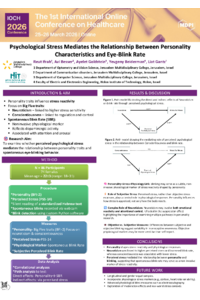
This study examined how personality traits influence physiological markers of stress, focusing on the mediating role of perceived psychological stress in the link between personality and spontaneous eye-blinking behavior. Drawing on the Big Five framework, we explored how neuroticism and conscientiousness—traits that are closely tied to stress reactivity—relate to perceived stress and blink rate. Spontaneous blink rate (SBR), a dopaminergic and attentional marker, was used as a noninvasive physiological indicator of stress-related arousal.
Methods:
Eighty-six adults (74 females; M = 21.9 ± 2.5 years, range = 18–31) silently read a standardized Hebrew text while their blinks were recorded via webcam using custom Python-based software. Personality (BFI-2) and perceived stress (PSS-14) were assessed online approximately five months later to minimize reactivity. Correlational and path analyses tested direct and indirect associations between personality, perceived stress, and blink rate.
Results:
Neuroticism was positively related to perceived stress (β = 0.35; p < .001), which predicted a higher blink rate (β = 0.38; p < .001), supporting the mediation hypothesis. When modeled together, neuroticism showed a negative direct effect on blink rate (β = –0.30; p < .005), revealing a suppression effect. Conscientiousness indirectly predicted a lower blink rate through reduced stress (β = –0.26, p < .05; stress → blink rate, β = 0.29, p < .01). The model explained 12% of the variance in stress and 15% of the variance in blink rate.
Conclusions:
Perceived stress mediates the relationship between personality and blink dynamics, revealing dual pathways: neuroticism increases blinking via stress but directly reduces it through attentional mechanisms. Blink rate thus emerges as a sensitive psychophysiological marker linking personality and stress, with implications for noninvasive stress monitoring and personalized assessment in clinical and occupational contexts.
Keywords
Personality
Big-Five
Perceived Stress
Blinking Behavior
Poster
Psychological Stress Mediates the Relationship Between Personality Characteristics and Eye-Blink Rate IOCH 2026 POSTER .pdf
Evaluating the Scalability of SNOMED CT for Jurisdictional Level Semantic Interoperability
Healthcare Professionals’ Intentions to Adopt Holoportation Technology