Event submissions
Published
This submission belongs to the session S1. Digital Health Adoption and Innovation—A Vision for the Future of Healthcare of the event The 1st International Online Conference on Healthcare
Published date
20 Mar, 2026
Academic Editor
'%3e%3cpath%20d='M12.6657%2010.9104C12.4185%2010.325%2012.0599%209.79327%2011.6097%209.34482C11.1609%208.89508%2010.6293%208.5365%2010.0442%208.28888C10.0389%208.28626%2010.0337%208.28495%2010.0285%208.28233C10.8446%207.69279%2011.3752%206.73249%2011.3752%205.64904C11.3752%203.8542%209.92103%202.39999%208.1262%202.39999C6.33136%202.39999%204.87715%203.8542%204.87715%205.64904C4.87715%206.73249%205.40774%207.69279%206.22393%208.28364C6.21869%208.28626%206.21345%208.28757%206.20821%208.29019C5.62129%208.5378%205.09463%208.89284%204.64265%209.34613C4.1929%209.79493%203.83432%2010.3266%203.58671%2010.9117C3.34345%2011.4845%203.21226%2012.0987%203.20023%2012.7209C3.19988%2012.7349%203.20233%2012.7488%203.20744%2012.7619C3.21255%2012.7749%203.22022%2012.7867%203.22998%2012.7968C3.23975%2012.8068%203.25142%2012.8147%203.26431%2012.8202C3.2772%2012.8256%203.29105%2012.8284%203.30504%2012.8284H4.09109C4.14874%2012.8284%204.19459%2012.7825%204.1959%2012.7262C4.2221%2011.7148%204.62823%2010.7676%205.34617%2010.0497C6.08899%209.30683%207.0755%208.89808%208.1262%208.89808C9.17689%208.89808%2010.1634%209.30683%2010.9062%2010.0497C11.6242%2010.7676%2012.0303%2011.7148%2012.0565%2012.7262C12.0578%2012.7838%2012.1037%2012.8284%2012.1613%2012.8284H12.9474C12.9613%2012.8284%2012.9752%2012.8256%2012.9881%2012.8202C13.001%2012.8147%2013.0126%2012.8068%2013.0224%2012.7968C13.0322%2012.7867%2013.0398%2012.7749%2013.0449%2012.7619C13.0501%2012.7488%2013.0525%2012.7349%2013.0522%2012.7209C13.0391%2012.0947%2012.9094%2011.4855%2012.6657%2010.9104ZM8.1262%207.9024C7.52486%207.9024%206.9589%207.6679%206.53312%207.24211C6.10733%206.81633%205.87283%206.25037%205.87283%205.64904C5.87283%205.0477%206.10733%204.48174%206.53312%204.05596C6.9589%203.63018%207.52486%203.39567%208.1262%203.39567C8.72753%203.39567%209.29349%203.63018%209.71927%204.05596C10.1451%204.48174%2010.3796%205.0477%2010.3796%205.64904C10.3796%206.25037%2010.1451%206.81633%209.71927%207.24211C9.29349%207.6679%208.72753%207.9024%208.1262%207.9024Z'%20fill='%235D1EE1'/%3e%3c/g%3e%3c/svg%3e) James Chow
James ChowCitation
Aishwarya Joshi, Cynthia Williams, Edwin Nassiff, Digital Health Strategies for Florida’s Emerging Chronic Disease Burden, in Proceedings of The 1st International Online Conference on Healthcare, 25 March–26 March 2026, MDPI: Basel, Switzerland
Share
Email
Facebook
Twitter
LinkedIn
Digital Health Strategies for Florida’s Emerging Chronic Disease Burden
'%3e%3cpath%20d='M12.6647%2010.9104C12.4176%2010.325%2012.0589%209.7933%2011.6088%209.34485C11.16%208.89511%2010.6283%208.53653%2010.0432%208.28891C10.038%208.28629%2010.0327%208.28498%2010.0275%208.28236C10.8437%207.69282%2011.3743%206.73252%2011.3743%205.64907C11.3743%203.85423%209.92005%202.40002%208.12522%202.40002C6.33038%202.40002%204.87618%203.85423%204.87618%205.64907C4.87618%206.73252%205.40677%207.69282%206.22296%208.28367C6.21772%208.28629%206.21248%208.2876%206.20724%208.29022C5.62031%208.53783%205.09365%208.89287%204.64167%209.34616C4.19192%209.79496%203.83334%2010.3266%203.58573%2010.9117C3.34247%2011.4846%203.21128%2012.0987%203.19925%2012.721C3.1989%2012.735%203.20135%2012.7489%203.20646%2012.7619C3.21157%2012.7749%203.21924%2012.7868%203.22901%2012.7968C3.23877%2012.8068%203.25045%2012.8148%203.26334%2012.8202C3.27623%2012.8256%203.29007%2012.8284%203.30406%2012.8284H4.09012C4.14776%2012.8284%204.19362%2012.7825%204.19493%2012.7262C4.22113%2011.7148%204.62726%2010.7676%205.34519%2010.0497C6.08802%209.30686%207.07452%208.89811%208.12522%208.89811C9.17592%208.89811%2010.1624%209.30686%2010.9052%2010.0497C11.6232%2010.7676%2012.0293%2011.7148%2012.0555%2012.7262C12.0568%2012.7839%2012.1027%2012.8284%2012.1603%2012.8284H12.9464C12.9604%2012.8284%2012.9742%2012.8256%2012.9871%2012.8202C13%2012.8148%2013.0117%2012.8068%2013.0214%2012.7968C13.0312%2012.7868%2013.0389%2012.7749%2013.044%2012.7619C13.0491%2012.7489%2013.0515%2012.735%2013.0512%2012.721C13.0381%2012.0947%2012.9084%2011.4856%2012.6647%2010.9104ZM8.12522%207.90243C7.52388%207.90243%206.95792%207.66793%206.53214%207.24215C6.10636%206.81636%205.87185%206.2504%205.87185%205.64907C5.87185%205.04773%206.10636%204.48177%206.53214%204.05599C6.95792%203.63021%207.52388%203.3957%208.12522%203.3957C8.72655%203.3957%209.29252%203.63021%209.7183%204.05599C10.1441%204.48177%2010.3786%205.04773%2010.3786%205.64907C10.3786%206.2504%2010.1441%206.81636%209.7183%207.24215C9.29252%207.66793%208.72655%207.90243%208.12522%207.90243Z'%20fill='%235D1EE1'/%3e%3c/g%3e%3c/svg%3e)
Aishwarya Joshi 1
Cynthia Williams 1
Edwin Nassiff 2
1. School of Global Health and Informatics, University of Central Florida, Orlando, FL, USA
2. College of Engineering and Computer Science, University of Central Florida, Orlando, FL, USA
Abstract
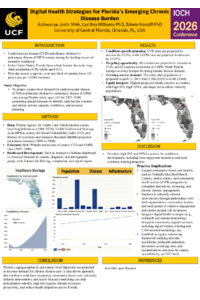
Background: Digital health technologies have the potential to reduce the burden of chronic diseases by improving prevention, early detection, and continuous management. This study projects county-level demand from 2025 to 2040 for cardiovascular disease (CVD) and chronic obstructive pulmonary disease (COPD) among older adults in Florida and considers how digital health can alleviate the chronic disease burden in high-risk counties.
Methods: County-level hospitalization data from the Florida Agency for Health Care Administration (2000–2024) were analyzed using the Holt–Winters exponential smoothing method to forecast CVD and COPD prevalence. Forecasts were integrated with Health Professional Shortage Area (HPSA) and Social Vulnerability Index (SVI) data.
Results: The statewide trends suggest a general increase in CVD by 8.13% and a decline in COPD by 13.47%, but a closer examination at the county level reveals a more uneven distribution, with twenty-one counties projected to experience an increase in both diseases. The projected burden is greatest in counties with higher social vulnerability, limited provider availability, and higher proportions of racial/ethnic minorities. The Internet of Things (IoT) can enhance prevention and long-term management through remote monitoring, activity tracking, and behavior-based feedback systems.
Conclusion: Strategic planning and targeted investments are essential to address regional disparities and meet future healthcare demands. Forecasting models informed by digital health innovation have the potential to improve chronic disease management and expand equitable healthcare access. Counties with high SVI and HPSA scores should prioritize digital health interventions, including telehealth, mobile health units, teleradiology, wearable monitoring, and e-pharmacy services, to improve access and continuity of care. IoT implementation must include community-based training to improve digital literacy, ensure cultural competence, and address infrastructure barriers such as connectivity and affordability. Building a digitally enabled, data-informed public health system will be critical in ensuring equitable, proactive, and sustainable chronic disease prevention across Florida’s aging population.
Keywords
Cardiovascular disease
Chronic Obstructive Pulmonary Disease
Forecasting model
Internet of Things
Aging population
Poster
Joshi, Aishwarya_Florida’s Emerging Chronic Disease Burden_presentation.pdf
Healthcare Professionals’ Intentions to Adopt Holoportation Technology
Opportunities and Challenges in Integrating Smart Healthcare into Taiwan’s Long-Term Care System: A Physicians’ Perspective