Event submissions
Published
This submission belongs to the session S2. Patient-Centered Care—Optimizing Care Pathways through Engagement and Outcome Measurement of the event The 1st International Online Conference on Healthcare
Published date
20 Mar, 2026
Academic Editor
'%3e%3cpath%20d='M12.6657%2010.9104C12.4185%2010.325%2012.0599%209.79327%2011.6097%209.34482C11.1609%208.89508%2010.6293%208.5365%2010.0442%208.28888C10.0389%208.28626%2010.0337%208.28495%2010.0285%208.28233C10.8446%207.69279%2011.3752%206.73249%2011.3752%205.64904C11.3752%203.8542%209.92103%202.39999%208.1262%202.39999C6.33136%202.39999%204.87715%203.8542%204.87715%205.64904C4.87715%206.73249%205.40774%207.69279%206.22393%208.28364C6.21869%208.28626%206.21345%208.28757%206.20821%208.29019C5.62129%208.5378%205.09463%208.89284%204.64265%209.34613C4.1929%209.79493%203.83432%2010.3266%203.58671%2010.9117C3.34345%2011.4845%203.21226%2012.0987%203.20023%2012.7209C3.19988%2012.7349%203.20233%2012.7488%203.20744%2012.7619C3.21255%2012.7749%203.22022%2012.7867%203.22998%2012.7968C3.23975%2012.8068%203.25142%2012.8147%203.26431%2012.8202C3.2772%2012.8256%203.29105%2012.8284%203.30504%2012.8284H4.09109C4.14874%2012.8284%204.19459%2012.7825%204.1959%2012.7262C4.2221%2011.7148%204.62823%2010.7676%205.34617%2010.0497C6.08899%209.30683%207.0755%208.89808%208.1262%208.89808C9.17689%208.89808%2010.1634%209.30683%2010.9062%2010.0497C11.6242%2010.7676%2012.0303%2011.7148%2012.0565%2012.7262C12.0578%2012.7838%2012.1037%2012.8284%2012.1613%2012.8284H12.9474C12.9613%2012.8284%2012.9752%2012.8256%2012.9881%2012.8202C13.001%2012.8147%2013.0126%2012.8068%2013.0224%2012.7968C13.0322%2012.7867%2013.0398%2012.7749%2013.0449%2012.7619C13.0501%2012.7488%2013.0525%2012.7349%2013.0522%2012.7209C13.0391%2012.0947%2012.9094%2011.4855%2012.6657%2010.9104ZM8.1262%207.9024C7.52486%207.9024%206.9589%207.6679%206.53312%207.24211C6.10733%206.81633%205.87283%206.25037%205.87283%205.64904C5.87283%205.0477%206.10733%204.48174%206.53312%204.05596C6.9589%203.63018%207.52486%203.39567%208.1262%203.39567C8.72753%203.39567%209.29349%203.63018%209.71927%204.05596C10.1451%204.48174%2010.3796%205.0477%2010.3796%205.64904C10.3796%206.25037%2010.1451%206.81633%209.71927%207.24211C9.29349%207.6679%208.72753%207.9024%208.1262%207.9024Z'%20fill='%235D1EE1'/%3e%3c/g%3e%3c/svg%3e) Lorraine Evangelista
Lorraine EvangelistaCitation
Zeinab El Hajj Hussein, Maria Luiza Camilo, Luciana Marchiori, Braulio Henrique Magnani Branco, EFFECTS OF A 16-WEEK INTERDISCIPLINARY INTERVENTION ON BODY WATER DISTRIBUTION AND CARDIOMETABOLIC RISK INDICATORS IN OVERWEIGHT MIDDLE-AGED WOMEN, in Proceedings of The 1st International Online Conference on Healthcare, 25 March–26 March 2026, MDPI: Basel, Switzerland
Share
Email
Facebook
Twitter
LinkedIn
EFFECTS OF A 16-WEEK INTERDISCIPLINARY INTERVENTION ON BODY WATER DISTRIBUTION AND CARDIOMETABOLIC RISK INDICATORS IN OVERWEIGHT MIDDLE-AGED WOMEN

Zeinab El Hajj Hussein 1
'%3e%3cpath%20d='M12.6647%2010.9104C12.4176%2010.325%2012.0589%209.7933%2011.6088%209.34485C11.16%208.89511%2010.6283%208.53653%2010.0432%208.28891C10.038%208.28629%2010.0327%208.28498%2010.0275%208.28236C10.8437%207.69282%2011.3743%206.73252%2011.3743%205.64907C11.3743%203.85423%209.92005%202.40002%208.12522%202.40002C6.33038%202.40002%204.87618%203.85423%204.87618%205.64907C4.87618%206.73252%205.40677%207.69282%206.22296%208.28367C6.21772%208.28629%206.21248%208.2876%206.20724%208.29022C5.62031%208.53783%205.09365%208.89287%204.64167%209.34616C4.19192%209.79496%203.83334%2010.3266%203.58573%2010.9117C3.34247%2011.4846%203.21128%2012.0987%203.19925%2012.721C3.1989%2012.735%203.20135%2012.7489%203.20646%2012.7619C3.21157%2012.7749%203.21924%2012.7868%203.22901%2012.7968C3.23877%2012.8068%203.25045%2012.8148%203.26334%2012.8202C3.27623%2012.8256%203.29007%2012.8284%203.30406%2012.8284H4.09012C4.14776%2012.8284%204.19362%2012.7825%204.19493%2012.7262C4.22113%2011.7148%204.62726%2010.7676%205.34519%2010.0497C6.08802%209.30686%207.07452%208.89811%208.12522%208.89811C9.17592%208.89811%2010.1624%209.30686%2010.9052%2010.0497C11.6232%2010.7676%2012.0293%2011.7148%2012.0555%2012.7262C12.0568%2012.7839%2012.1027%2012.8284%2012.1603%2012.8284H12.9464C12.9604%2012.8284%2012.9742%2012.8256%2012.9871%2012.8202C13%2012.8148%2013.0117%2012.8068%2013.0214%2012.7968C13.0312%2012.7868%2013.0389%2012.7749%2013.044%2012.7619C13.0491%2012.7489%2013.0515%2012.735%2013.0512%2012.721C13.0381%2012.0947%2012.9084%2011.4856%2012.6647%2010.9104ZM8.12522%207.90243C7.52388%207.90243%206.95792%207.66793%206.53214%207.24215C6.10636%206.81636%205.87185%206.2504%205.87185%205.64907C5.87185%205.04773%206.10636%204.48177%206.53214%204.05599C6.95792%203.63021%207.52388%203.3957%208.12522%203.3957C8.72655%203.3957%209.29252%203.63021%209.7183%204.05599C10.1441%204.48177%2010.3786%205.04773%2010.3786%205.64907C10.3786%206.2504%2010.1441%206.81636%209.7183%207.24215C9.29252%207.66793%208.72655%207.90243%208.12522%207.90243Z'%20fill='%235D1EE1'/%3e%3c/g%3e%3c/svg%3e)
Maria Luiza Camilo 1
Luciana Marchiori 1

Braulio Henrique Magnani Branco 1
1. Graduate Program in Health Promotion, UniCesumar – University Center of Maringa, Maringa, PR 87050-900, Brazil
Abstract
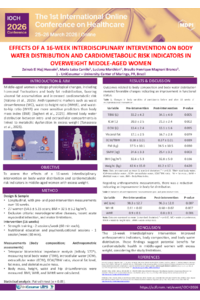
Introduction: Middle-aged women undergo significant physiological changes, including hormonal fluctuations and body fat redistribution, which favor visceral fat accumulation and elevate cardiometabolic risk. Anthropometric markers such as waist circumference (WC), waist-to-height ratio (WHtR), and waist-to-hip ratio (WHR) are more sensitive predictors of cardiometabolic risk than body mass index (BMI). Alterations in body water distribution, such as a higher extracellular water (ECW) fraction, have also been associated with systemic inflammation and insulin resistance in women with excess weight.
Objective: To assess the effects of a 16-week interdisciplinary intervention on body water distribution and cardiometabolic risk indicators in middle-aged women with excess weight.
Methods: Twenty-seven women (54.6 ± 5.3 years; BMI: 32.5 ± 5.2 kg/m²) were evaluated before and after a 16-week intervention. The program included twice-weekly physical training sessions, weekly nutritional education, and psychoeducational activities. Body composition was assessed using multifrequency tetrapolar bioelectrical impedance analysis (InBody 570®), measuring total body water (TBW), intracellular water (ICW), ECW, ECW/TBW index, visceral fat level, fat mass, and skeletal muscle mass. Waist and hip circumferences were measured, and WHR and WHtR were calculated.
Results: Significant reductions were observed in waist circumference, WHtR, and WHR (all p < 0.05), with a moderate effect size (d = 0.6). TBW and ICW significantly increased after the intervention (p < 0.05). Although ECW and visceral fat level did not show significant changes, the ECW/TBW index decreased (p = 0.04), indicating improved body water distribution. Fat mass decreased significantly (37.5 ± 10.1 to 36.5 ± 10.5 kg; p = 0.03), while skeletal muscle mass increased (24.6 ± 3.4 to 25.4 ± 3.2 kg; p = 0.003), corroborating the increase in ICW.
Conclusion: The 16-week interdisciplinary intervention resulted in improvements in anthropometric indicators, body composition, and body water distribution. These changes should be interpreted cautiously within the study context. The findings suggest that combining physical training, nutritional education, and psychoeducational strategies can support healthier body composition and hydration status among middle-aged women with excess weight.
Keywords
Obesity
Body Composition
Multidisciplinary Intervention
Poster
Pôster, Zeinab El Hajj.pdf
Understanding the Collective Mindset: A Quantitative Analysis of Nurses’ Views on Team Nursing Education
Patient-Centered Care in the Digital Era: Social Representations of Technology and Care Pathways among Nursing and Health Technology Students in ISPITS-Casablanca/Morocco