Event submissions
Published
This submission belongs to the session S3. Connected Care—Leveraging Technology to Build an Integrated Care Ecosystem of the event The 1st International Online Conference on Healthcare
Published date
20 Mar, 2026
Academic Editor
'%3e%3cpath%20d='M12.6657%2010.9104C12.4185%2010.325%2012.0599%209.79327%2011.6097%209.34482C11.1609%208.89508%2010.6293%208.5365%2010.0442%208.28888C10.0389%208.28626%2010.0337%208.28495%2010.0285%208.28233C10.8446%207.69279%2011.3752%206.73249%2011.3752%205.64904C11.3752%203.8542%209.92103%202.39999%208.1262%202.39999C6.33136%202.39999%204.87715%203.8542%204.87715%205.64904C4.87715%206.73249%205.40774%207.69279%206.22393%208.28364C6.21869%208.28626%206.21345%208.28757%206.20821%208.29019C5.62129%208.5378%205.09463%208.89284%204.64265%209.34613C4.1929%209.79493%203.83432%2010.3266%203.58671%2010.9117C3.34345%2011.4845%203.21226%2012.0987%203.20023%2012.7209C3.19988%2012.7349%203.20233%2012.7488%203.20744%2012.7619C3.21255%2012.7749%203.22022%2012.7867%203.22998%2012.7968C3.23975%2012.8068%203.25142%2012.8147%203.26431%2012.8202C3.2772%2012.8256%203.29105%2012.8284%203.30504%2012.8284H4.09109C4.14874%2012.8284%204.19459%2012.7825%204.1959%2012.7262C4.2221%2011.7148%204.62823%2010.7676%205.34617%2010.0497C6.08899%209.30683%207.0755%208.89808%208.1262%208.89808C9.17689%208.89808%2010.1634%209.30683%2010.9062%2010.0497C11.6242%2010.7676%2012.0303%2011.7148%2012.0565%2012.7262C12.0578%2012.7838%2012.1037%2012.8284%2012.1613%2012.8284H12.9474C12.9613%2012.8284%2012.9752%2012.8256%2012.9881%2012.8202C13.001%2012.8147%2013.0126%2012.8068%2013.0224%2012.7968C13.0322%2012.7867%2013.0398%2012.7749%2013.0449%2012.7619C13.0501%2012.7488%2013.0525%2012.7349%2013.0522%2012.7209C13.0391%2012.0947%2012.9094%2011.4855%2012.6657%2010.9104ZM8.1262%207.9024C7.52486%207.9024%206.9589%207.6679%206.53312%207.24211C6.10733%206.81633%205.87283%206.25037%205.87283%205.64904C5.87283%205.0477%206.10733%204.48174%206.53312%204.05596C6.9589%203.63018%207.52486%203.39567%208.1262%203.39567C8.72753%203.39567%209.29349%203.63018%209.71927%204.05596C10.1451%204.48174%2010.3796%205.0477%2010.3796%205.64904C10.3796%206.25037%2010.1451%206.81633%209.71927%207.24211C9.29349%207.6679%208.72753%207.9024%208.1262%207.9024Z'%20fill='%235D1EE1'/%3e%3c/g%3e%3c/svg%3e) Stefano Omboni
Stefano OmboniCitation
Vedansh Mehra, Implementing Digital Care Companions for Diabetes and Hypertension: An Interrelated System to facilitate Self-management and Clinician Supervision, in Proceedings of The 1st International Online Conference on Healthcare, 25 March–26 March 2026, MDPI: Basel, Switzerland
Share
Email
Facebook
Twitter
LinkedIn
Implementing Digital Care Companions for Diabetes and Hypertension: An Interrelated System to facilitate Self-management and Clinician Supervision
'%3e%3cpath%20d='M12.6647%2010.9104C12.4176%2010.325%2012.0589%209.7933%2011.6088%209.34485C11.16%208.89511%2010.6283%208.53653%2010.0432%208.28891C10.038%208.28629%2010.0327%208.28498%2010.0275%208.28236C10.8437%207.69282%2011.3743%206.73252%2011.3743%205.64907C11.3743%203.85423%209.92005%202.40002%208.12522%202.40002C6.33038%202.40002%204.87618%203.85423%204.87618%205.64907C4.87618%206.73252%205.40677%207.69282%206.22296%208.28367C6.21772%208.28629%206.21248%208.2876%206.20724%208.29022C5.62031%208.53783%205.09365%208.89287%204.64167%209.34616C4.19192%209.79496%203.83334%2010.3266%203.58573%2010.9117C3.34247%2011.4846%203.21128%2012.0987%203.19925%2012.721C3.1989%2012.735%203.20135%2012.7489%203.20646%2012.7619C3.21157%2012.7749%203.21924%2012.7868%203.22901%2012.7968C3.23877%2012.8068%203.25045%2012.8148%203.26334%2012.8202C3.27623%2012.8256%203.29007%2012.8284%203.30406%2012.8284H4.09012C4.14776%2012.8284%204.19362%2012.7825%204.19493%2012.7262C4.22113%2011.7148%204.62726%2010.7676%205.34519%2010.0497C6.08802%209.30686%207.07452%208.89811%208.12522%208.89811C9.17592%208.89811%2010.1624%209.30686%2010.9052%2010.0497C11.6232%2010.7676%2012.0293%2011.7148%2012.0555%2012.7262C12.0568%2012.7839%2012.1027%2012.8284%2012.1603%2012.8284H12.9464C12.9604%2012.8284%2012.9742%2012.8256%2012.9871%2012.8202C13%2012.8148%2013.0117%2012.8068%2013.0214%2012.7968C13.0312%2012.7868%2013.0389%2012.7749%2013.044%2012.7619C13.0491%2012.7489%2013.0515%2012.735%2013.0512%2012.721C13.0381%2012.0947%2012.9084%2011.4856%2012.6647%2010.9104ZM8.12522%207.90243C7.52388%207.90243%206.95792%207.66793%206.53214%207.24215C6.10636%206.81636%205.87185%206.2504%205.87185%205.64907C5.87185%205.04773%206.10636%204.48177%206.53214%204.05599C6.95792%203.63021%207.52388%203.3957%208.12522%203.3957C8.72655%203.3957%209.29252%203.63021%209.7183%204.05599C10.1441%204.48177%2010.3786%205.04773%2010.3786%205.64907C10.3786%206.2504%2010.1441%206.81636%209.7183%207.24215C9.29252%207.66793%208.72655%207.90243%208.12522%207.90243Z'%20fill='%235D1EE1'/%3e%3c/g%3e%3c/svg%3e)
Vedansh Mehra 1
1. Department of Medicine, Dr. V.M. Government Medical College, Solapur, 413003, India
Abstract
Introduction:
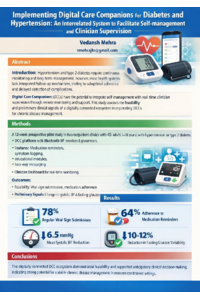
Hypertension and type 2 diabetes require continuous monitoring and long-term management; however, most health systems lack integrated follow-up mechanisms, leading to suboptimal adherence and delayed detection of complications. Digital Care Companions (DCCs) have the potential to integrate self-management with real-time clinician supervision through remote monitoring and support. This study assesses the feasibility and preliminary clinical signals of a digitally connected ecosystem incorporating DCCs for chronic disease management.
Methods:
A 12-week prospective pilot study was conducted across two outpatient clinics and included 45 adult participants (≥18 years) diagnosed with hypertension or type 2 diabetes. Participants used a DCC platform integrated with Bluetooth-enabled blood pressure monitors and glucometers. Platform features included medication reminders, symptom logging, educational modules, and secure two-way messaging. Clinicians accessed real-time patient data through a centralized dashboard. Feasibility was evaluated based on the frequency of vital sign submissions and adherence to medication reminders. Preliminary clinical signals included observed changes in mean systolic blood pressure and fasting glucose variability among participants with ≥70% data completeness. All outcomes were summarized using descriptive statistics.
Results:
Among the 45 participants, 78% submitted vital sign measurements regularly, and 64% adhered to medication reminders. Active users demonstrated an observed mean reduction in systolic blood pressure of 6.5 mmHg and a 10-12% reduction in fasting glucose variability. Clinicians reported improved visualization of longitudinal trends, fewer unplanned visits, and real-time therapeutic adjustments in 26% of users.
Conclusions:
The digitally connected DCC ecosystem demonstrated feasibility and supported anticipatory clinical decision-making, indicating strong potential for scalable chronic disease management in resource-constrained settings.
Keywords
Hypertension
type 2 diabetes
Digital Care Companions(DCCs)
Chronic disease management
Poster
Vedansh Mehra’s Poster Presentation .pdf
Optimizing Geriatric Prescribing in Secondary Care: Patterns, Polypharmacy, and Medication Appropriateness in an Outpatient Pharmacy Setting
Integrating Machine Learning into Care Coordination Pathways: A Framework for Long-Term Care Facilities