Event submissions
Published
This submission belongs to the session S2. Patient-Centered Care—Optimizing Care Pathways through Engagement and Outcome Measurement of the event The 1st International Online Conference on Healthcare
Published date
20 Mar, 2026
Academic Editor
'%3e%3cpath%20d='M12.6657%2010.9104C12.4185%2010.325%2012.0599%209.79327%2011.6097%209.34482C11.1609%208.89508%2010.6293%208.5365%2010.0442%208.28888C10.0389%208.28626%2010.0337%208.28495%2010.0285%208.28233C10.8446%207.69279%2011.3752%206.73249%2011.3752%205.64904C11.3752%203.8542%209.92103%202.39999%208.1262%202.39999C6.33136%202.39999%204.87715%203.8542%204.87715%205.64904C4.87715%206.73249%205.40774%207.69279%206.22393%208.28364C6.21869%208.28626%206.21345%208.28757%206.20821%208.29019C5.62129%208.5378%205.09463%208.89284%204.64265%209.34613C4.1929%209.79493%203.83432%2010.3266%203.58671%2010.9117C3.34345%2011.4845%203.21226%2012.0987%203.20023%2012.7209C3.19988%2012.7349%203.20233%2012.7488%203.20744%2012.7619C3.21255%2012.7749%203.22022%2012.7867%203.22998%2012.7968C3.23975%2012.8068%203.25142%2012.8147%203.26431%2012.8202C3.2772%2012.8256%203.29105%2012.8284%203.30504%2012.8284H4.09109C4.14874%2012.8284%204.19459%2012.7825%204.1959%2012.7262C4.2221%2011.7148%204.62823%2010.7676%205.34617%2010.0497C6.08899%209.30683%207.0755%208.89808%208.1262%208.89808C9.17689%208.89808%2010.1634%209.30683%2010.9062%2010.0497C11.6242%2010.7676%2012.0303%2011.7148%2012.0565%2012.7262C12.0578%2012.7838%2012.1037%2012.8284%2012.1613%2012.8284H12.9474C12.9613%2012.8284%2012.9752%2012.8256%2012.9881%2012.8202C13.001%2012.8147%2013.0126%2012.8068%2013.0224%2012.7968C13.0322%2012.7867%2013.0398%2012.7749%2013.0449%2012.7619C13.0501%2012.7488%2013.0525%2012.7349%2013.0522%2012.7209C13.0391%2012.0947%2012.9094%2011.4855%2012.6657%2010.9104ZM8.1262%207.9024C7.52486%207.9024%206.9589%207.6679%206.53312%207.24211C6.10733%206.81633%205.87283%206.25037%205.87283%205.64904C5.87283%205.0477%206.10733%204.48174%206.53312%204.05596C6.9589%203.63018%207.52486%203.39567%208.1262%203.39567C8.72753%203.39567%209.29349%203.63018%209.71927%204.05596C10.1451%204.48174%2010.3796%205.0477%2010.3796%205.64904C10.3796%206.25037%2010.1451%206.81633%209.71927%207.24211C9.29349%207.6679%208.72753%207.9024%208.1262%207.9024Z'%20fill='%235D1EE1'/%3e%3c/g%3e%3c/svg%3e) Lorraine Evangelista
Lorraine EvangelistaCitation
Olga Vasiliauskienė, Dovydas Vasiliauskas, Ausrine Kontrimiene, Holistic primary health care for patients with multimorbidity: impact on treatment burden, quality of life and urban–rural inequalities, in Proceedings of The 1st International Online Conference on Healthcare, 25 March–26 March 2026, MDPI: Basel, Switzerland
Share
Email
Facebook
Twitter
LinkedIn
Holistic primary health care for patients with multimorbidity: impact on treatment burden, quality of life and urban–rural inequalities
'%3e%3cpath%20d='M12.6647%2010.9104C12.4176%2010.325%2012.0589%209.7933%2011.6088%209.34485C11.16%208.89511%2010.6283%208.53653%2010.0432%208.28891C10.038%208.28629%2010.0327%208.28498%2010.0275%208.28236C10.8437%207.69282%2011.3743%206.73252%2011.3743%205.64907C11.3743%203.85423%209.92005%202.40002%208.12522%202.40002C6.33038%202.40002%204.87618%203.85423%204.87618%205.64907C4.87618%206.73252%205.40677%207.69282%206.22296%208.28367C6.21772%208.28629%206.21248%208.2876%206.20724%208.29022C5.62031%208.53783%205.09365%208.89287%204.64167%209.34616C4.19192%209.79496%203.83334%2010.3266%203.58573%2010.9117C3.34247%2011.4846%203.21128%2012.0987%203.19925%2012.721C3.1989%2012.735%203.20135%2012.7489%203.20646%2012.7619C3.21157%2012.7749%203.21924%2012.7868%203.22901%2012.7968C3.23877%2012.8068%203.25045%2012.8148%203.26334%2012.8202C3.27623%2012.8256%203.29007%2012.8284%203.30406%2012.8284H4.09012C4.14776%2012.8284%204.19362%2012.7825%204.19493%2012.7262C4.22113%2011.7148%204.62726%2010.7676%205.34519%2010.0497C6.08802%209.30686%207.07452%208.89811%208.12522%208.89811C9.17592%208.89811%2010.1624%209.30686%2010.9052%2010.0497C11.6232%2010.7676%2012.0293%2011.7148%2012.0555%2012.7262C12.0568%2012.7839%2012.1027%2012.8284%2012.1603%2012.8284H12.9464C12.9604%2012.8284%2012.9742%2012.8256%2012.9871%2012.8202C13%2012.8148%2013.0117%2012.8068%2013.0214%2012.7968C13.0312%2012.7868%2013.0389%2012.7749%2013.044%2012.7619C13.0491%2012.7489%2013.0515%2012.735%2013.0512%2012.721C13.0381%2012.0947%2012.9084%2011.4856%2012.6647%2010.9104ZM8.12522%207.90243C7.52388%207.90243%206.95792%207.66793%206.53214%207.24215C6.10636%206.81636%205.87185%206.2504%205.87185%205.64907C5.87185%205.04773%206.10636%204.48177%206.53214%204.05599C6.95792%203.63021%207.52388%203.3957%208.12522%203.3957C8.72655%203.3957%209.29252%203.63021%209.7183%204.05599C10.1441%204.48177%2010.3786%205.04773%2010.3786%205.64907C10.3786%206.2504%2010.1441%206.81636%209.7183%207.24215C9.29252%207.66793%208.72655%207.90243%208.12522%207.90243Z'%20fill='%235D1EE1'/%3e%3c/g%3e%3c/svg%3e)
Olga Vasiliauskienė 1
Dovydas Vasiliauskas 2
Ausrine Kontrimiene 1
1. Department of Family medicine, Faculty of Medicine, Lithuanian University of Health Sciences, Eivenių 2, Kaunas, LT – 50162, Lithuania
2. Department of Chemistry, The University of Chicago, 5735 S Ellis Avenue, Chicago, IL. 60637, USA
Abstract
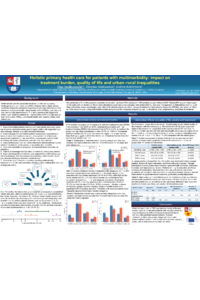
Background. Multimorbidity and the associated treatment burden are a growing challenge for primary health care (PHC). Patients with multiple chronic conditions frequently experience fragmented care, high self-management demands, and poorer health-related quality of life (HRQoL), particularly in rural and socially deprived areas. This study assessed the impact of a holistic care model for patients with multimorbidity in PHC in Lithuania on treatment burden, HRQoL, and mental health, and explored urban–rural differences.
Methods. We conducted a 15-month pragmatic controlled trial in urban and rural PHC centres (n = 796 enrolled) as part of the EUFIAP “TELELISPA” project. Adults aged 40–85 years with ≥2 chronic conditions were allocated to usual care or to a complex intervention that included case management, multidisciplinary team support (family physician, nurse, psychologist, physiotherapist, lifestyle specialist), structured use of patient-reported outcome measures (PROMs), and proactive follow-up. Data were analysed using multivariable models and pre-specified subgroup analyses by age, multimorbidity level, polypharmacy, and place of residence.
Results. Compared with usual care, the intervention produced small-to-moderate improvements in mental health (PHQ-9, GAD-7) and HRQoL (EQ-5D-5L index, EQ-VAS, selected SF-36 domains). The greatest benefits were observed among younger (<65 years) patients, those with higher multimorbidity or polypharmacy, and in urban PHC settings. In rural areas and among older adults, anxiety and depression scores improved, but logistical and organisational aspects of care increased perceived treatment burden (MTBQ), especially medication management, transport, and visit coordination.
Conclusions. A holistic care model in PHC can improve quality of life and mental health in multimorbid patients with complex needs, but may simultaneously shift or increase treatment burden in contexts with persistent access barriers. To avoid overloading vulnerable groups, integrated care should reduce logistical barriers and be tailored to patients’ capacity, particularly in rural and socially deprived areas.
Keywords
• multimorbidity • treatment burden • primary health care • quality of life • urban–rural inequalities
Poster
Poster_Vasiliauskiene_MTBQ_0318.pdf
Development and implementation of a structured emergency nursing triage training program
Assessing Patient-Centered Engagement: Provider–Patient Interaction (PPI), Trust, and Cultural Sensitivity Scales