Event submissions
Published
This submission belongs to the session S2. Patient-Centered Care—Optimizing Care Pathways through Engagement and Outcome Measurement of the event The 1st International Online Conference on Healthcare
Published date
20 Mar, 2026
Academic Editor
'%3e%3cpath%20d='M12.6657%2010.9104C12.4185%2010.325%2012.0599%209.79327%2011.6097%209.34482C11.1609%208.89508%2010.6293%208.5365%2010.0442%208.28888C10.0389%208.28626%2010.0337%208.28495%2010.0285%208.28233C10.8446%207.69279%2011.3752%206.73249%2011.3752%205.64904C11.3752%203.8542%209.92103%202.39999%208.1262%202.39999C6.33136%202.39999%204.87715%203.8542%204.87715%205.64904C4.87715%206.73249%205.40774%207.69279%206.22393%208.28364C6.21869%208.28626%206.21345%208.28757%206.20821%208.29019C5.62129%208.5378%205.09463%208.89284%204.64265%209.34613C4.1929%209.79493%203.83432%2010.3266%203.58671%2010.9117C3.34345%2011.4845%203.21226%2012.0987%203.20023%2012.7209C3.19988%2012.7349%203.20233%2012.7488%203.20744%2012.7619C3.21255%2012.7749%203.22022%2012.7867%203.22998%2012.7968C3.23975%2012.8068%203.25142%2012.8147%203.26431%2012.8202C3.2772%2012.8256%203.29105%2012.8284%203.30504%2012.8284H4.09109C4.14874%2012.8284%204.19459%2012.7825%204.1959%2012.7262C4.2221%2011.7148%204.62823%2010.7676%205.34617%2010.0497C6.08899%209.30683%207.0755%208.89808%208.1262%208.89808C9.17689%208.89808%2010.1634%209.30683%2010.9062%2010.0497C11.6242%2010.7676%2012.0303%2011.7148%2012.0565%2012.7262C12.0578%2012.7838%2012.1037%2012.8284%2012.1613%2012.8284H12.9474C12.9613%2012.8284%2012.9752%2012.8256%2012.9881%2012.8202C13.001%2012.8147%2013.0126%2012.8068%2013.0224%2012.7968C13.0322%2012.7867%2013.0398%2012.7749%2013.0449%2012.7619C13.0501%2012.7488%2013.0525%2012.7349%2013.0522%2012.7209C13.0391%2012.0947%2012.9094%2011.4855%2012.6657%2010.9104ZM8.1262%207.9024C7.52486%207.9024%206.9589%207.6679%206.53312%207.24211C6.10733%206.81633%205.87283%206.25037%205.87283%205.64904C5.87283%205.0477%206.10733%204.48174%206.53312%204.05596C6.9589%203.63018%207.52486%203.39567%208.1262%203.39567C8.72753%203.39567%209.29349%203.63018%209.71927%204.05596C10.1451%204.48174%2010.3796%205.0477%2010.3796%205.64904C10.3796%206.25037%2010.1451%206.81633%209.71927%207.24211C9.29349%207.6679%208.72753%207.9024%208.1262%207.9024Z'%20fill='%235D1EE1'/%3e%3c/g%3e%3c/svg%3e) Lorraine Evangelista
Lorraine EvangelistaCitation
Hou Su-I, Assessing Patient-Centered Engagement: Provider–Patient Interaction (PPI), Trust, and Cultural Sensitivity Scales, in Proceedings of The 1st International Online Conference on Healthcare, 25 March–26 March 2026, MDPI: Basel, Switzerland
Share
Email
Facebook
Twitter
LinkedIn
Assessing Patient-Centered Engagement: Provider–Patient Interaction (PPI), Trust, and Cultural Sensitivity Scales

Hou Su-I 1
1. School of Global Health Management & Informatics, University of Central Florida, Orlando, Florida, USA
Abstract
Introduction:
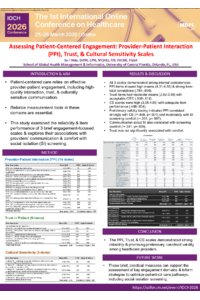
Patient-centered care relies on effective provider–patient engagement, including high-quality interaction, trust, and culturally sensitive communication. Reliable measurement tools in these domains are essential for understanding how providers approach social needs such as social isolation (SI). This study examines the reliability and item performance of three brief engagement-focused scales—Provider–Patient Interaction (PPI), Trust in Patients, and Cultural Sensitivity (CS)—and explores their associations with providers’ communication and comfort with SI screening.
Methods:
Healthcare providers who care for older adults (n = 59) completed the PPI (16 items), Trust (6 items), and CS (5 items) scales, along with measures of communication about SI and comfort with SI screening. Analyses included internal consistency reliability, descriptive item statistics, and corrected item–total correlations. Preliminary construct validity was explored through correlations between each scale and conceptually related indicators (communication about SI and comfort screening SI).
Results:
All three scales demonstrated strong internal consistency: PPI α = .987, Trust α = .906, and CS α = .832. PPI items showed high means (4.31–4.59) and strong item–total correlations (.781–.936). Trust items had moderate means (2.92–3.59) with acceptable item–total correlations (.596–.814). CS scores were high (3.95–4.56) with adequate item performance (.408–.834). Preliminary validity testing indicated that PPI correlated strongly with CS (r = .858, p < .001) and moderately with SI screening comfort (r = .391, p = .007). Communication about SI also correlated with screening comfort (r = .314, p = .026). Trust was not significantly associated with comfort.
Conclusions:
The PPI, Trust, and CS scales demonstrated strong reliability and promising preliminary construct validity among healthcare providers. These brief, practical measures can support the assessment of key engagement domains and inform strategies to optimize patient-centered care pathways, including social isolation screening.
Keywords
patient-centered engagement
provider-patient interaction (PPI)
trust
cultural sensitivity
reliabilities
Poster
Patient_CenteredCare_OptimizingCarePathwaysthroughEngagementandOutcomeMeasurement_29911_Intergenerational_Engagement_a_slides.pdf
Holistic primary health care for patients with multimorbidity: impact on treatment burden, quality of life and urban–rural inequalities
Smart Infusion Pumps and Clinical Data: Evaluating Medication Errors to Improve Patient Safety