Event submissions
Published
This submission belongs to the session S2. Patient-Centered Care—Optimizing Care Pathways through Engagement and Outcome Measurement of the event The 1st International Online Conference on Healthcare
Published date
20 Mar, 2026
Academic Editor
'%3e%3cpath%20d='M12.6657%2010.9104C12.4185%2010.325%2012.0599%209.79327%2011.6097%209.34482C11.1609%208.89508%2010.6293%208.5365%2010.0442%208.28888C10.0389%208.28626%2010.0337%208.28495%2010.0285%208.28233C10.8446%207.69279%2011.3752%206.73249%2011.3752%205.64904C11.3752%203.8542%209.92103%202.39999%208.1262%202.39999C6.33136%202.39999%204.87715%203.8542%204.87715%205.64904C4.87715%206.73249%205.40774%207.69279%206.22393%208.28364C6.21869%208.28626%206.21345%208.28757%206.20821%208.29019C5.62129%208.5378%205.09463%208.89284%204.64265%209.34613C4.1929%209.79493%203.83432%2010.3266%203.58671%2010.9117C3.34345%2011.4845%203.21226%2012.0987%203.20023%2012.7209C3.19988%2012.7349%203.20233%2012.7488%203.20744%2012.7619C3.21255%2012.7749%203.22022%2012.7867%203.22998%2012.7968C3.23975%2012.8068%203.25142%2012.8147%203.26431%2012.8202C3.2772%2012.8256%203.29105%2012.8284%203.30504%2012.8284H4.09109C4.14874%2012.8284%204.19459%2012.7825%204.1959%2012.7262C4.2221%2011.7148%204.62823%2010.7676%205.34617%2010.0497C6.08899%209.30683%207.0755%208.89808%208.1262%208.89808C9.17689%208.89808%2010.1634%209.30683%2010.9062%2010.0497C11.6242%2010.7676%2012.0303%2011.7148%2012.0565%2012.7262C12.0578%2012.7838%2012.1037%2012.8284%2012.1613%2012.8284H12.9474C12.9613%2012.8284%2012.9752%2012.8256%2012.9881%2012.8202C13.001%2012.8147%2013.0126%2012.8068%2013.0224%2012.7968C13.0322%2012.7867%2013.0398%2012.7749%2013.0449%2012.7619C13.0501%2012.7488%2013.0525%2012.7349%2013.0522%2012.7209C13.0391%2012.0947%2012.9094%2011.4855%2012.6657%2010.9104ZM8.1262%207.9024C7.52486%207.9024%206.9589%207.6679%206.53312%207.24211C6.10733%206.81633%205.87283%206.25037%205.87283%205.64904C5.87283%205.0477%206.10733%204.48174%206.53312%204.05596C6.9589%203.63018%207.52486%203.39567%208.1262%203.39567C8.72753%203.39567%209.29349%203.63018%209.71927%204.05596C10.1451%204.48174%2010.3796%205.0477%2010.3796%205.64904C10.3796%206.25037%2010.1451%206.81633%209.71927%207.24211C9.29349%207.6679%208.72753%207.9024%208.1262%207.9024Z'%20fill='%235D1EE1'/%3e%3c/g%3e%3c/svg%3e) Lorraine Evangelista
Lorraine EvangelistaCitation
Shhamvobi Nath, Empowering Healing Beyond the Clinic: Student Perspectives on Social Prescribing—A Cross-Sectional Study Among Undergraduate Health-Science students , in Proceedings of The 1st International Online Conference on Healthcare, 25 March–26 March 2026, MDPI: Basel, Switzerland
Share
Email
Facebook
Twitter
LinkedIn
Empowering Healing Beyond the Clinic: Student Perspectives on Social Prescribing—A Cross-Sectional Study Among Undergraduate Health-Science students
'%3e%3cpath%20d='M12.6647%2010.9104C12.4176%2010.325%2012.0589%209.7933%2011.6088%209.34485C11.16%208.89511%2010.6283%208.53653%2010.0432%208.28891C10.038%208.28629%2010.0327%208.28498%2010.0275%208.28236C10.8437%207.69282%2011.3743%206.73252%2011.3743%205.64907C11.3743%203.85423%209.92005%202.40002%208.12522%202.40002C6.33038%202.40002%204.87618%203.85423%204.87618%205.64907C4.87618%206.73252%205.40677%207.69282%206.22296%208.28367C6.21772%208.28629%206.21248%208.2876%206.20724%208.29022C5.62031%208.53783%205.09365%208.89287%204.64167%209.34616C4.19192%209.79496%203.83334%2010.3266%203.58573%2010.9117C3.34247%2011.4846%203.21128%2012.0987%203.19925%2012.721C3.1989%2012.735%203.20135%2012.7489%203.20646%2012.7619C3.21157%2012.7749%203.21924%2012.7868%203.22901%2012.7968C3.23877%2012.8068%203.25045%2012.8148%203.26334%2012.8202C3.27623%2012.8256%203.29007%2012.8284%203.30406%2012.8284H4.09012C4.14776%2012.8284%204.19362%2012.7825%204.19493%2012.7262C4.22113%2011.7148%204.62726%2010.7676%205.34519%2010.0497C6.08802%209.30686%207.07452%208.89811%208.12522%208.89811C9.17592%208.89811%2010.1624%209.30686%2010.9052%2010.0497C11.6232%2010.7676%2012.0293%2011.7148%2012.0555%2012.7262C12.0568%2012.7839%2012.1027%2012.8284%2012.1603%2012.8284H12.9464C12.9604%2012.8284%2012.9742%2012.8256%2012.9871%2012.8202C13%2012.8148%2013.0117%2012.8068%2013.0214%2012.7968C13.0312%2012.7868%2013.0389%2012.7749%2013.044%2012.7619C13.0491%2012.7489%2013.0515%2012.735%2013.0512%2012.721C13.0381%2012.0947%2012.9084%2011.4856%2012.6647%2010.9104ZM8.12522%207.90243C7.52388%207.90243%206.95792%207.66793%206.53214%207.24215C6.10636%206.81636%205.87185%206.2504%205.87185%205.64907C5.87185%205.04773%206.10636%204.48177%206.53214%204.05599C6.95792%203.63021%207.52388%203.3957%208.12522%203.3957C8.72655%203.3957%209.29252%203.63021%209.7183%204.05599C10.1441%204.48177%2010.3786%205.04773%2010.3786%205.64907C10.3786%206.2504%2010.1441%206.81636%209.7183%207.24215C9.29252%207.66793%208.72655%207.90243%208.12522%207.90243Z'%20fill='%235D1EE1'/%3e%3c/g%3e%3c/svg%3e)
Shhamvobi Nath 1
1. Himachal Dental College, AMRU University, Sundarnagar 175019, India
Abstract
Background: Social prescribing is an emerging, person-centered healthcare model in which individuals are connected to non-medical, community-based services to improve physical, mental, and social well-being. By addressing social determinants of health, it complements conventional clinical care and supports holistic patient management.
Aim: To assess the knowledge, attitudes, and perceived applicability of social prescribing among undergraduate health-science students, and to evaluate predictors of readiness to adopt this approach in future practice.
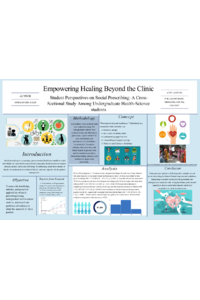
Materials and Method: A descriptive cross-sectional study was conducted among 419 undergraduate students from medical, dental, and allied health professions. A pre-validated 29-item self-administered questionnaire was distributed electronically. Descriptive statistics, chi-square tests, and binary logistic regression were used to examine associations between knowledge, attitudes, and readiness to adopt social prescribing.
Results: Of the 419 participants, 61.3% demonstrated adequate knowledge of social prescribing. Students with prior exposure to community-based health programs were 2.14 times more likely to have good knowledge (OR = 2.14, 95% CI: 1.45–3.15, p < 0.001). A favorable attitude was observed in 78.5% of respondents, and those with adequate knowledge had 3.28 times higher odds of positive attitudes (OR = 3.28, 95% CI: 2.21–4.87, p < 0.001). Only 39.6% reported confidence in explaining social prescribing to patients; receiving curricular exposure increased confidence (OR = 1.87, 95% CI: 1.21–2.89, p = 0.004). Overall readiness to adopt social prescribing in future practice was 68.4%, significantly associated with favorable attitudes (OR = 2.93, 95% CI: 1.98–4.34, p < 0.001). Dental students showed higher recognition of its relevance to lifestyle-related conditions compared to other streams (p = 0.03).
Conclusion: Undergraduate students exhibited positive attitudes toward social prescribing but limited formal exposure and confidence. Integrating structured social prescribing modules into undergraduate curricula could strengthen future professionals’ capacity to address social determinants and deliver comprehensive, patient-centered care.
Keywords
Social Prescribing
Social Support
Community Health Services.
Poster
SP study.pdf
Managing Online Breastfeeding Consultations Using LDA and BERTopic: A Topic Modeling Approach
Pioneering the Future of Healthcare: Bridging Innovation and Transparency in Clinical Data Management