Event submissions
Published
This submission belongs to the session S2. Patient-Centered Care—Optimizing Care Pathways through Engagement and Outcome Measurement of the event The 1st International Online Conference on Healthcare
Published date
20 Mar, 2026
Academic Editor
'%3e%3cpath%20d='M12.6657%2010.9104C12.4185%2010.325%2012.0599%209.79327%2011.6097%209.34482C11.1609%208.89508%2010.6293%208.5365%2010.0442%208.28888C10.0389%208.28626%2010.0337%208.28495%2010.0285%208.28233C10.8446%207.69279%2011.3752%206.73249%2011.3752%205.64904C11.3752%203.8542%209.92103%202.39999%208.1262%202.39999C6.33136%202.39999%204.87715%203.8542%204.87715%205.64904C4.87715%206.73249%205.40774%207.69279%206.22393%208.28364C6.21869%208.28626%206.21345%208.28757%206.20821%208.29019C5.62129%208.5378%205.09463%208.89284%204.64265%209.34613C4.1929%209.79493%203.83432%2010.3266%203.58671%2010.9117C3.34345%2011.4845%203.21226%2012.0987%203.20023%2012.7209C3.19988%2012.7349%203.20233%2012.7488%203.20744%2012.7619C3.21255%2012.7749%203.22022%2012.7867%203.22998%2012.7968C3.23975%2012.8068%203.25142%2012.8147%203.26431%2012.8202C3.2772%2012.8256%203.29105%2012.8284%203.30504%2012.8284H4.09109C4.14874%2012.8284%204.19459%2012.7825%204.1959%2012.7262C4.2221%2011.7148%204.62823%2010.7676%205.34617%2010.0497C6.08899%209.30683%207.0755%208.89808%208.1262%208.89808C9.17689%208.89808%2010.1634%209.30683%2010.9062%2010.0497C11.6242%2010.7676%2012.0303%2011.7148%2012.0565%2012.7262C12.0578%2012.7838%2012.1037%2012.8284%2012.1613%2012.8284H12.9474C12.9613%2012.8284%2012.9752%2012.8256%2012.9881%2012.8202C13.001%2012.8147%2013.0126%2012.8068%2013.0224%2012.7968C13.0322%2012.7867%2013.0398%2012.7749%2013.0449%2012.7619C13.0501%2012.7488%2013.0525%2012.7349%2013.0522%2012.7209C13.0391%2012.0947%2012.9094%2011.4855%2012.6657%2010.9104ZM8.1262%207.9024C7.52486%207.9024%206.9589%207.6679%206.53312%207.24211C6.10733%206.81633%205.87283%206.25037%205.87283%205.64904C5.87283%205.0477%206.10733%204.48174%206.53312%204.05596C6.9589%203.63018%207.52486%203.39567%208.1262%203.39567C8.72753%203.39567%209.29349%203.63018%209.71927%204.05596C10.1451%204.48174%2010.3796%205.0477%2010.3796%205.64904C10.3796%206.25037%2010.1451%206.81633%209.71927%207.24211C9.29349%207.6679%208.72753%207.9024%208.1262%207.9024Z'%20fill='%235D1EE1'/%3e%3c/g%3e%3c/svg%3e) Lorraine Evangelista
Lorraine EvangelistaCitation
Leonor Sol Gonçalves Costa Anjos, Ricardo Madeira, Adriana Maia, Ana Antunes, Tatiana Ferreira, Adelósio Soma, Dulce Esteves, Henrique Neiva, Resting Heart Rate Variability Profile in Women with Stage II-III Breast Cancer Enrolled in the MAMA_MOVE Program, in Proceedings of The 1st International Online Conference on Healthcare, 25 March–26 March 2026, MDPI: Basel, Switzerland
Share
Email
Facebook
Twitter
LinkedIn
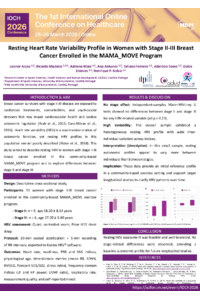
Resting Heart Rate Variability Profile in Women with Stage II-III Breast Cancer Enrolled in the MAMA_MOVE Program
'%3e%3cpath%20d='M12.6647%2010.9104C12.4176%2010.325%2012.0589%209.7933%2011.6088%209.34485C11.16%208.89511%2010.6283%208.53653%2010.0432%208.28891C10.038%208.28629%2010.0327%208.28498%2010.0275%208.28236C10.8437%207.69282%2011.3743%206.73252%2011.3743%205.64907C11.3743%203.85423%209.92005%202.40002%208.12522%202.40002C6.33038%202.40002%204.87618%203.85423%204.87618%205.64907C4.87618%206.73252%205.40677%207.69282%206.22296%208.28367C6.21772%208.28629%206.21248%208.2876%206.20724%208.29022C5.62031%208.53783%205.09365%208.89287%204.64167%209.34616C4.19192%209.79496%203.83334%2010.3266%203.58573%2010.9117C3.34247%2011.4846%203.21128%2012.0987%203.19925%2012.721C3.1989%2012.735%203.20135%2012.7489%203.20646%2012.7619C3.21157%2012.7749%203.21924%2012.7868%203.22901%2012.7968C3.23877%2012.8068%203.25045%2012.8148%203.26334%2012.8202C3.27623%2012.8256%203.29007%2012.8284%203.30406%2012.8284H4.09012C4.14776%2012.8284%204.19362%2012.7825%204.19493%2012.7262C4.22113%2011.7148%204.62726%2010.7676%205.34519%2010.0497C6.08802%209.30686%207.07452%208.89811%208.12522%208.89811C9.17592%208.89811%2010.1624%209.30686%2010.9052%2010.0497C11.6232%2010.7676%2012.0293%2011.7148%2012.0555%2012.7262C12.0568%2012.7839%2012.1027%2012.8284%2012.1603%2012.8284H12.9464C12.9604%2012.8284%2012.9742%2012.8256%2012.9871%2012.8202C13%2012.8148%2013.0117%2012.8068%2013.0214%2012.7968C13.0312%2012.7868%2013.0389%2012.7749%2013.044%2012.7619C13.0491%2012.7489%2013.0515%2012.735%2013.0512%2012.721C13.0381%2012.0947%2012.9084%2011.4856%2012.6647%2010.9104ZM8.12522%207.90243C7.52388%207.90243%206.95792%207.66793%206.53214%207.24215C6.10636%206.81636%205.87185%206.2504%205.87185%205.64907C5.87185%205.04773%206.10636%204.48177%206.53214%204.05599C6.95792%203.63021%207.52388%203.3957%208.12522%203.3957C8.72655%203.3957%209.29252%203.63021%209.7183%204.05599C10.1441%204.48177%2010.3786%205.04773%2010.3786%205.64907C10.3786%206.2504%2010.1441%206.81636%209.7183%207.24215C9.29252%207.66793%208.72655%207.90243%208.12522%207.90243Z'%20fill='%235D1EE1'/%3e%3c/g%3e%3c/svg%3e)
Leonor Sol Gonçalves Costa Anjos 1,2
Ricardo Madeira 1,2,3
Adriana Maia 1,2
Ana Antunes 1,2
Tatiana Ferreira 1,2
Adelósio Soma 1,2
Dulce Esteves 1,2

Henrique Neiva 1,2
1. Research Center in Sports Sciences, Health Sciences and Human Development (CIDESD), Covilhã, 6201-001, Portugal
2. Department of Sports Sciences, University of Beira Interior, Covilhã, 6201-001, Portugal
3. RISE-Health-UBI, University of Beira Interior, Covilhã, 6201-506, Portugal
Abstract
Introduction: Breast cancer survivors, particularly those with stage II-III disease, are exposed to a high burden of cardiotoxic treatments, comorbidities, and psychosocial stressors that may negatively affect cardiovascular health and autonomic regulation. Heart rate variability (HRV) is a non-invasive marker of cardiac autonomic function, yet descriptive data on resting HRV profiles in this population are scarce. Methods: This descriptive cross-sectional study included twelve women with stage II-III breast cancer enrolled in the community-based MAMA_MOVE exercise program. Five women had stage II disease, with a mean age of 58.20 ± 8.14 years, and seven had stage III disease, with a mean age of 58.14 ± 5.79 years. Resting HRV was assessed in a quiet, controlled room using a Polar H10 chest strap. After a 10-minute seated stabilization period, a 5-minute segment of R-R intervals was recorded and exported to Kubios HVR ® software. Outcome measures included heart rate, readiness, parasympathetic (PNS) and sympathetic (SNS) indices, physiological age, time-domain HRV parameters (mean RR, SDNN, RMSSD, Poincaré SD1 and SD2, stress index), and frequency-domain indices (LF and HF power in absolute and relative units, LF/HF ratio), respiratory rate, measurement quality, and self-reported mood. Results: Independent-samples Mann–Whitney U tests revealed no differences between stages II and III for any HRV-related variable (all p > .20). The overall sample showed a heterogeneous resting HRV profile, with wide inter-individual variation across indices. Conclusions: Resting HRV assessment was feasible and well-tolerated in this community-based exercise setting. Although no stage-related differences were identified, the present data provide an initial autonomic profile for women with stage II-III breast cancer and a baseline for future longitudinal exercise studies.
Keywords
Keywords: breast cancer
heart rate variability
cardiac autonomic regulation
exercise-based recovery
survivorship.
Poster
Patient_CenteredCare_OptimizingCarePathwaysthroughEngagementandOutcomeMeasurement_29954_Resting_Heart_Rate_Variability_slides.pdf
Optimizing Care for Infants with Colic through Probiotic Intervention
Turning Incident Reports into Insights: Leveraging Medication Error Reports in a Cardiac Care Unit