Event submissions
Published
This submission belongs to the session S4. Clinical Data Management—Balancing Transparency with Innovation for Enhanced Care Quality of the event The 1st International Online Conference on Healthcare
Published date
20 Mar, 2026
Academic Editor
'%3e%3cpath%20d='M12.6657%2010.9104C12.4185%2010.325%2012.0599%209.79327%2011.6097%209.34482C11.1609%208.89508%2010.6293%208.5365%2010.0442%208.28888C10.0389%208.28626%2010.0337%208.28495%2010.0285%208.28233C10.8446%207.69279%2011.3752%206.73249%2011.3752%205.64904C11.3752%203.8542%209.92103%202.39999%208.1262%202.39999C6.33136%202.39999%204.87715%203.8542%204.87715%205.64904C4.87715%206.73249%205.40774%207.69279%206.22393%208.28364C6.21869%208.28626%206.21345%208.28757%206.20821%208.29019C5.62129%208.5378%205.09463%208.89284%204.64265%209.34613C4.1929%209.79493%203.83432%2010.3266%203.58671%2010.9117C3.34345%2011.4845%203.21226%2012.0987%203.20023%2012.7209C3.19988%2012.7349%203.20233%2012.7488%203.20744%2012.7619C3.21255%2012.7749%203.22022%2012.7867%203.22998%2012.7968C3.23975%2012.8068%203.25142%2012.8147%203.26431%2012.8202C3.2772%2012.8256%203.29105%2012.8284%203.30504%2012.8284H4.09109C4.14874%2012.8284%204.19459%2012.7825%204.1959%2012.7262C4.2221%2011.7148%204.62823%2010.7676%205.34617%2010.0497C6.08899%209.30683%207.0755%208.89808%208.1262%208.89808C9.17689%208.89808%2010.1634%209.30683%2010.9062%2010.0497C11.6242%2010.7676%2012.0303%2011.7148%2012.0565%2012.7262C12.0578%2012.7838%2012.1037%2012.8284%2012.1613%2012.8284H12.9474C12.9613%2012.8284%2012.9752%2012.8256%2012.9881%2012.8202C13.001%2012.8147%2013.0126%2012.8068%2013.0224%2012.7968C13.0322%2012.7867%2013.0398%2012.7749%2013.0449%2012.7619C13.0501%2012.7488%2013.0525%2012.7349%2013.0522%2012.7209C13.0391%2012.0947%2012.9094%2011.4855%2012.6657%2010.9104ZM8.1262%207.9024C7.52486%207.9024%206.9589%207.6679%206.53312%207.24211C6.10733%206.81633%205.87283%206.25037%205.87283%205.64904C5.87283%205.0477%206.10733%204.48174%206.53312%204.05596C6.9589%203.63018%207.52486%203.39567%208.1262%203.39567C8.72753%203.39567%209.29349%203.63018%209.71927%204.05596C10.1451%204.48174%2010.3796%205.0477%2010.3796%205.64904C10.3796%206.25037%2010.1451%206.81633%209.71927%207.24211C9.29349%207.6679%208.72753%207.9024%208.1262%207.9024Z'%20fill='%235D1EE1'/%3e%3c/g%3e%3c/svg%3e) Rüdiger Pryss
Rüdiger PryssCitation
Michelle Sullivan, Mia Yates, Ellen Schellhease, Monica L Miller, Beyond Protocols: Uncovering Allergy-Related Medication Errors in the Digital Prescribing Era, in Proceedings of The 1st International Online Conference on Healthcare, 25 March–26 March 2026, MDPI: Basel, Switzerland
Share
Email
Facebook
Twitter
LinkedIn
Beyond Protocols: Uncovering Allergy-Related Medication Errors in the Digital Prescribing Era
'%3e%3cpath%20d='M12.6647%2010.9104C12.4176%2010.325%2012.0589%209.7933%2011.6088%209.34485C11.16%208.89511%2010.6283%208.53653%2010.0432%208.28891C10.038%208.28629%2010.0327%208.28498%2010.0275%208.28236C10.8437%207.69282%2011.3743%206.73252%2011.3743%205.64907C11.3743%203.85423%209.92005%202.40002%208.12522%202.40002C6.33038%202.40002%204.87618%203.85423%204.87618%205.64907C4.87618%206.73252%205.40677%207.69282%206.22296%208.28367C6.21772%208.28629%206.21248%208.2876%206.20724%208.29022C5.62031%208.53783%205.09365%208.89287%204.64167%209.34616C4.19192%209.79496%203.83334%2010.3266%203.58573%2010.9117C3.34247%2011.4846%203.21128%2012.0987%203.19925%2012.721C3.1989%2012.735%203.20135%2012.7489%203.20646%2012.7619C3.21157%2012.7749%203.21924%2012.7868%203.22901%2012.7968C3.23877%2012.8068%203.25045%2012.8148%203.26334%2012.8202C3.27623%2012.8256%203.29007%2012.8284%203.30406%2012.8284H4.09012C4.14776%2012.8284%204.19362%2012.7825%204.19493%2012.7262C4.22113%2011.7148%204.62726%2010.7676%205.34519%2010.0497C6.08802%209.30686%207.07452%208.89811%208.12522%208.89811C9.17592%208.89811%2010.1624%209.30686%2010.9052%2010.0497C11.6232%2010.7676%2012.0293%2011.7148%2012.0555%2012.7262C12.0568%2012.7839%2012.1027%2012.8284%2012.1603%2012.8284H12.9464C12.9604%2012.8284%2012.9742%2012.8256%2012.9871%2012.8202C13%2012.8148%2013.0117%2012.8068%2013.0214%2012.7968C13.0312%2012.7868%2013.0389%2012.7749%2013.044%2012.7619C13.0491%2012.7489%2013.0515%2012.735%2013.0512%2012.721C13.0381%2012.0947%2012.9084%2011.4856%2012.6647%2010.9104ZM8.12522%207.90243C7.52388%207.90243%206.95792%207.66793%206.53214%207.24215C6.10636%206.81636%205.87185%206.2504%205.87185%205.64907C5.87185%205.04773%206.10636%204.48177%206.53214%204.05599C6.95792%203.63021%207.52388%203.3957%208.12522%203.3957C8.72655%203.3957%209.29252%203.63021%209.7183%204.05599C10.1441%204.48177%2010.3786%205.04773%2010.3786%205.64907C10.3786%206.2504%2010.1441%206.81636%209.7183%207.24215C9.29252%207.66793%208.72655%207.90243%208.12522%207.90243Z'%20fill='%235D1EE1'/%3e%3c/g%3e%3c/svg%3e)
Michelle Sullivan 1
Mia Yates 2
Ellen Schellhease 2
Monica L Miller 2
1. Barts Health NHS Trust, St Bartholomew's Hospital, London EC1A 7BE, UK
2. Department of Pharmacy Practice, College of Pharmacy, Purdue University, West Lafayette, IN 47906, USA
Abstract
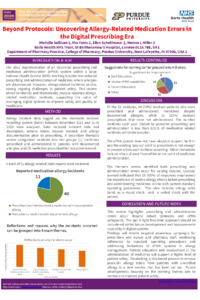
Introduction: The 2021 implementation of an electronic prescribing and medicines administration (ePMA) system within a large National Health Service (NHS) teaching hospital has reduced prescribing and administration of medicines where allergies are documented. However, allergy-related incidents persist, posing ongoing challenges to patient safety. This review aimed to identify and thematically analyse reported allergy-related medication incidents, supporting the value of leveraging digital systems to improve safety and quality in healthcare.
Methods: Allergy incident data logged via the electronic incident reporting system (Datix) between November 2021 and June 2025 were analysed. Data included incident date and description, actions taken, lessons learned, and allergy documentation prior to prescribing. A secondary thematic review categorised incidents into two groups: (1) medicines prescribed and administered to patients with documented allergies, and (2) medicines prescribed but not administered.
Results: A total of 51 allergy-related Datix reports were reviewed. Of these, 40 (78%) involved patients who were both prescribed and administered medicines despite documented allergies, while 11 (22%) involved prescriptions that were not administered. Eleven incidents (22%) were attributed to unknown allergies or incomplete documentation. Lessons learned indicated that 28 (55%) of responses emphasised the importance of routine allergy checks before prescribing and administering medicines. Most incidents were reported by nursing staff during medication administration rather than by prescribers.
Conclusion: This four-year review highlights persistent prescribing and administration errors despite robust protocols and ePMA safeguards. Findings will inform targeted awareness campaigns for prescribers and nurses, reinforcing adherence to standard operating procedures and addressing limitations of ePMA systems in allergy management.
Keywords
medication safety
allergy incidents
safe prescribing
patient centred care
medicines administration
Poster
allergy Poster V4.pdf
Improving Emergency Department Efficiency Through a Primary-Care-Led Fast Track Model: A High-Volume Hospital Experience
Artificial Intelligence for Maxillary Sinus Pathology Detection on Cone–Beam CT: A Systematic Review of Expert-Consensus Studies