Event submissions
Published
This submission belongs to the session S5. Generative AI in Clinical Practice—Evidence-Based Evaluation of Diagnostic and Therapeutic Applications of the event The 1st International Online Conference on Healthcare
Published date
20 Mar, 2026
Academic Editor
'%3e%3cpath%20d='M12.6657%2010.9104C12.4185%2010.325%2012.0599%209.79327%2011.6097%209.34482C11.1609%208.89508%2010.6293%208.5365%2010.0442%208.28888C10.0389%208.28626%2010.0337%208.28495%2010.0285%208.28233C10.8446%207.69279%2011.3752%206.73249%2011.3752%205.64904C11.3752%203.8542%209.92103%202.39999%208.1262%202.39999C6.33136%202.39999%204.87715%203.8542%204.87715%205.64904C4.87715%206.73249%205.40774%207.69279%206.22393%208.28364C6.21869%208.28626%206.21345%208.28757%206.20821%208.29019C5.62129%208.5378%205.09463%208.89284%204.64265%209.34613C4.1929%209.79493%203.83432%2010.3266%203.58671%2010.9117C3.34345%2011.4845%203.21226%2012.0987%203.20023%2012.7209C3.19988%2012.7349%203.20233%2012.7488%203.20744%2012.7619C3.21255%2012.7749%203.22022%2012.7867%203.22998%2012.7968C3.23975%2012.8068%203.25142%2012.8147%203.26431%2012.8202C3.2772%2012.8256%203.29105%2012.8284%203.30504%2012.8284H4.09109C4.14874%2012.8284%204.19459%2012.7825%204.1959%2012.7262C4.2221%2011.7148%204.62823%2010.7676%205.34617%2010.0497C6.08899%209.30683%207.0755%208.89808%208.1262%208.89808C9.17689%208.89808%2010.1634%209.30683%2010.9062%2010.0497C11.6242%2010.7676%2012.0303%2011.7148%2012.0565%2012.7262C12.0578%2012.7838%2012.1037%2012.8284%2012.1613%2012.8284H12.9474C12.9613%2012.8284%2012.9752%2012.8256%2012.9881%2012.8202C13.001%2012.8147%2013.0126%2012.8068%2013.0224%2012.7968C13.0322%2012.7867%2013.0398%2012.7749%2013.0449%2012.7619C13.0501%2012.7488%2013.0525%2012.7349%2013.0522%2012.7209C13.0391%2012.0947%2012.9094%2011.4855%2012.6657%2010.9104ZM8.1262%207.9024C7.52486%207.9024%206.9589%207.6679%206.53312%207.24211C6.10733%206.81633%205.87283%206.25037%205.87283%205.64904C5.87283%205.0477%206.10733%204.48174%206.53312%204.05596C6.9589%203.63018%207.52486%203.39567%208.1262%203.39567C8.72753%203.39567%209.29349%203.63018%209.71927%204.05596C10.1451%204.48174%2010.3796%205.0477%2010.3796%205.64904C10.3796%206.25037%2010.1451%206.81633%209.71927%207.24211C9.29349%207.6679%208.72753%207.9024%208.1262%207.9024Z'%20fill='%235D1EE1'/%3e%3c/g%3e%3c/svg%3e) Lorraine Evangelista
Lorraine EvangelistaCitation
Patrycja Chruniak, Oliwia Andrzejewska, Mateusz Fornalski, Piotr Wójcik, Michał Woś, Cezary Borysiuk, Generative AI for Automated Orthodontic Treatment Simulation in Adolescents, in Proceedings of The 1st International Online Conference on Healthcare, 25 March–26 March 2026, MDPI: Basel, Switzerland
Share
Email
Facebook
Twitter
LinkedIn
Generative AI for Automated Orthodontic Treatment Simulation in Adolescents
'%3e%3cpath%20d='M12.6647%2010.9104C12.4176%2010.325%2012.0589%209.7933%2011.6088%209.34485C11.16%208.89511%2010.6283%208.53653%2010.0432%208.28891C10.038%208.28629%2010.0327%208.28498%2010.0275%208.28236C10.8437%207.69282%2011.3743%206.73252%2011.3743%205.64907C11.3743%203.85423%209.92005%202.40002%208.12522%202.40002C6.33038%202.40002%204.87618%203.85423%204.87618%205.64907C4.87618%206.73252%205.40677%207.69282%206.22296%208.28367C6.21772%208.28629%206.21248%208.2876%206.20724%208.29022C5.62031%208.53783%205.09365%208.89287%204.64167%209.34616C4.19192%209.79496%203.83334%2010.3266%203.58573%2010.9117C3.34247%2011.4846%203.21128%2012.0987%203.19925%2012.721C3.1989%2012.735%203.20135%2012.7489%203.20646%2012.7619C3.21157%2012.7749%203.21924%2012.7868%203.22901%2012.7968C3.23877%2012.8068%203.25045%2012.8148%203.26334%2012.8202C3.27623%2012.8256%203.29007%2012.8284%203.30406%2012.8284H4.09012C4.14776%2012.8284%204.19362%2012.7825%204.19493%2012.7262C4.22113%2011.7148%204.62726%2010.7676%205.34519%2010.0497C6.08802%209.30686%207.07452%208.89811%208.12522%208.89811C9.17592%208.89811%2010.1624%209.30686%2010.9052%2010.0497C11.6232%2010.7676%2012.0293%2011.7148%2012.0555%2012.7262C12.0568%2012.7839%2012.1027%2012.8284%2012.1603%2012.8284H12.9464C12.9604%2012.8284%2012.9742%2012.8256%2012.9871%2012.8202C13%2012.8148%2013.0117%2012.8068%2013.0214%2012.7968C13.0312%2012.7868%2013.0389%2012.7749%2013.044%2012.7619C13.0491%2012.7489%2013.0515%2012.735%2013.0512%2012.721C13.0381%2012.0947%2012.9084%2011.4856%2012.6647%2010.9104ZM8.12522%207.90243C7.52388%207.90243%206.95792%207.66793%206.53214%207.24215C6.10636%206.81636%205.87185%206.2504%205.87185%205.64907C5.87185%205.04773%206.10636%204.48177%206.53214%204.05599C6.95792%203.63021%207.52388%203.3957%208.12522%203.3957C8.72655%203.3957%209.29252%203.63021%209.7183%204.05599C10.1441%204.48177%2010.3786%205.04773%2010.3786%205.64907C10.3786%206.2504%2010.1441%206.81636%209.7183%207.24215C9.29252%207.66793%208.72655%207.90243%208.12522%207.90243Z'%20fill='%235D1EE1'/%3e%3c/g%3e%3c/svg%3e)
Patrycja Chruniak 1
Oliwia Andrzejewska 1
Mateusz Fornalski 1
Piotr Wójcik 2
Michał Woś 3
Cezary Borysiuk 1
1. Medical University of Lublin, faculty of dentistry, SKN MedAI, Lublin
2. Doctoral School, Medical University of Lublin, Lublin, Poland
3. Zakład Informatyki i Statystyki Medycznej z Pracownią e-Zdrowia, SKN MedAI, Faculty of Dentistry, Medical University of Lublin, Lublin, Poland
Abstract
Background:
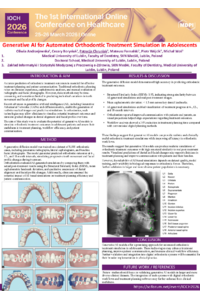
Orthodontic treatment planning requires accurate prediction of tooth movement and potential changes in facial profile over time. Traditional methods rely heavily on clinician experience and 2D cephalometric analyses, which can be time-consuming and sometimes imprecise in predicting individual variations. Generative AI models, including GANs (Generative Adversarial Networks) and diffusion models, offer the ability to simulate realistic, time-scaled treatment outcomes using baseline facial photographs, cephalometric data, and radiographs. Such AI-driven simulations can improve treatment planning, patient communication, and informed consent processes by providing visualized, personalized projections.
Methodology:
A generative diffusion model was trained on a dataset of 8,000 orthodontic cases, encompassing panoramic radiographs, lateral cephalograms, and baseline facial photographs. The model generated predicted treatment outcomes at 6-, 12-, and 18-month intervals. Orthodontists reviewed AI-generated simulations and compared them to actual post-treatment results using structural similarity indices (SSIM), mean absolute cephalometric deviations, and qualitative assessments of tooth alignment and facial profile changes. Clinicians also evaluated the practical impact of AI on treatment planning efficiency and patient communication.
Results:
The AI-generated outcomes achieved an SSIM of 0.93, indicating high structural fidelity to real post-treatment images. Mean cephalometric deviations were below 1.5 mm across key dental landmarks. Clinicians reported increased confidence in communicating expected outcomes to patients and parents, noting that visual simulations helped align expectations and reduce misunderstandings. Workflow analysis revealed a 34% reduction in planning time, demonstrating potential efficiency gains without compromising accuracy.
Conclusions:
Generative AI provides reliable, explainable simulations of orthodontic treatment outcomes, enhancing personalized planning and patient engagement. Integrating such models into clinical practice may improve informed consent, streamline workflow, and facilitate more precise, patient-centered orthodontic care. Future studies should explore real-time integration and validation across diverse populations to further optimize AI utility in orthodontics.
Keywords
Generative AI
Orthodontic treatment simulation
Diffusion models
Cephalometric analysis
Predictive modeling
Poster
poster%20konferencja.pdf
Evaluating Generative AI in Clinical Workflows: A Practical Framework for Safe and Effective Deployment
Barriers and facilitators in counselling in community pharmacy perceived by older patients: a focus group study