Event submissions
Published
This submission belongs to the session S2. Patient-Centered Care—Optimizing Care Pathways through Engagement and Outcome Measurement of the event The 1st International Online Conference on Healthcare
Published date
20 Mar, 2026
Academic Editor
'%3e%3cpath%20d='M12.6657%2010.9104C12.4185%2010.325%2012.0599%209.79327%2011.6097%209.34482C11.1609%208.89508%2010.6293%208.5365%2010.0442%208.28888C10.0389%208.28626%2010.0337%208.28495%2010.0285%208.28233C10.8446%207.69279%2011.3752%206.73249%2011.3752%205.64904C11.3752%203.8542%209.92103%202.39999%208.1262%202.39999C6.33136%202.39999%204.87715%203.8542%204.87715%205.64904C4.87715%206.73249%205.40774%207.69279%206.22393%208.28364C6.21869%208.28626%206.21345%208.28757%206.20821%208.29019C5.62129%208.5378%205.09463%208.89284%204.64265%209.34613C4.1929%209.79493%203.83432%2010.3266%203.58671%2010.9117C3.34345%2011.4845%203.21226%2012.0987%203.20023%2012.7209C3.19988%2012.7349%203.20233%2012.7488%203.20744%2012.7619C3.21255%2012.7749%203.22022%2012.7867%203.22998%2012.7968C3.23975%2012.8068%203.25142%2012.8147%203.26431%2012.8202C3.2772%2012.8256%203.29105%2012.8284%203.30504%2012.8284H4.09109C4.14874%2012.8284%204.19459%2012.7825%204.1959%2012.7262C4.2221%2011.7148%204.62823%2010.7676%205.34617%2010.0497C6.08899%209.30683%207.0755%208.89808%208.1262%208.89808C9.17689%208.89808%2010.1634%209.30683%2010.9062%2010.0497C11.6242%2010.7676%2012.0303%2011.7148%2012.0565%2012.7262C12.0578%2012.7838%2012.1037%2012.8284%2012.1613%2012.8284H12.9474C12.9613%2012.8284%2012.9752%2012.8256%2012.9881%2012.8202C13.001%2012.8147%2013.0126%2012.8068%2013.0224%2012.7968C13.0322%2012.7867%2013.0398%2012.7749%2013.0449%2012.7619C13.0501%2012.7488%2013.0525%2012.7349%2013.0522%2012.7209C13.0391%2012.0947%2012.9094%2011.4855%2012.6657%2010.9104ZM8.1262%207.9024C7.52486%207.9024%206.9589%207.6679%206.53312%207.24211C6.10733%206.81633%205.87283%206.25037%205.87283%205.64904C5.87283%205.0477%206.10733%204.48174%206.53312%204.05596C6.9589%203.63018%207.52486%203.39567%208.1262%203.39567C8.72753%203.39567%209.29349%203.63018%209.71927%204.05596C10.1451%204.48174%2010.3796%205.0477%2010.3796%205.64904C10.3796%206.25037%2010.1451%206.81633%209.71927%207.24211C9.29349%207.6679%208.72753%207.9024%208.1262%207.9024Z'%20fill='%235D1EE1'/%3e%3c/g%3e%3c/svg%3e) Lorraine Evangelista
Lorraine EvangelistaCitation
GADUGOYYALA GUNA SRI PHANI AJAY,
Closing the Outcome Gap: A Patient-Engagement Ecosystem for Smarter Clinical Pathway Design
, in Proceedings of The 1st International Online Conference on Healthcare, 25 March–26 March 2026, MDPI: Basel, Switzerland
Share
Email
Facebook
Twitter
LinkedIn
- Closing the Outcome Gap: A Patient-Engagement Ecosystem for Smarter Clinical Pathway Design
- Closing the Outcome Gap: A Patient-Engagement Ecosystem for Smarter Clinical Pathway Design
'%3e%3cpath%20d='M12.6647%2010.9104C12.4176%2010.325%2012.0589%209.7933%2011.6088%209.34485C11.16%208.89511%2010.6283%208.53653%2010.0432%208.28891C10.038%208.28629%2010.0327%208.28498%2010.0275%208.28236C10.8437%207.69282%2011.3743%206.73252%2011.3743%205.64907C11.3743%203.85423%209.92005%202.40002%208.12522%202.40002C6.33038%202.40002%204.87618%203.85423%204.87618%205.64907C4.87618%206.73252%205.40677%207.69282%206.22296%208.28367C6.21772%208.28629%206.21248%208.2876%206.20724%208.29022C5.62031%208.53783%205.09365%208.89287%204.64167%209.34616C4.19192%209.79496%203.83334%2010.3266%203.58573%2010.9117C3.34247%2011.4846%203.21128%2012.0987%203.19925%2012.721C3.1989%2012.735%203.20135%2012.7489%203.20646%2012.7619C3.21157%2012.7749%203.21924%2012.7868%203.22901%2012.7968C3.23877%2012.8068%203.25045%2012.8148%203.26334%2012.8202C3.27623%2012.8256%203.29007%2012.8284%203.30406%2012.8284H4.09012C4.14776%2012.8284%204.19362%2012.7825%204.19493%2012.7262C4.22113%2011.7148%204.62726%2010.7676%205.34519%2010.0497C6.08802%209.30686%207.07452%208.89811%208.12522%208.89811C9.17592%208.89811%2010.1624%209.30686%2010.9052%2010.0497C11.6232%2010.7676%2012.0293%2011.7148%2012.0555%2012.7262C12.0568%2012.7839%2012.1027%2012.8284%2012.1603%2012.8284H12.9464C12.9604%2012.8284%2012.9742%2012.8256%2012.9871%2012.8202C13%2012.8148%2013.0117%2012.8068%2013.0214%2012.7968C13.0312%2012.7868%2013.0389%2012.7749%2013.044%2012.7619C13.0491%2012.7489%2013.0515%2012.735%2013.0512%2012.721C13.0381%2012.0947%2012.9084%2011.4856%2012.6647%2010.9104ZM8.12522%207.90243C7.52388%207.90243%206.95792%207.66793%206.53214%207.24215C6.10636%206.81636%205.87185%206.2504%205.87185%205.64907C5.87185%205.04773%206.10636%204.48177%206.53214%204.05599C6.95792%203.63021%207.52388%203.3957%208.12522%203.3957C8.72655%203.3957%209.29252%203.63021%209.7183%204.05599C10.1441%204.48177%2010.3786%205.04773%2010.3786%205.64907C10.3786%206.2504%2010.1441%206.81636%209.7183%207.24215C9.29252%207.66793%208.72655%207.90243%208.12522%207.90243Z'%20fill='%235D1EE1'/%3e%3c/g%3e%3c/svg%3e)
GADUGOYYALA GUNA SRI PHANI AJAY 1
1. Department of Biochemistry, GSL Medical College & General Hospital, Rajahmundry, 533296, India
Abstract
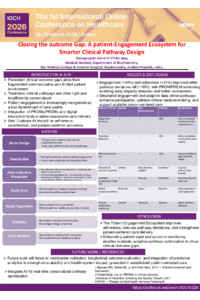
Persistent gaps in clinical outcomes often arise from fragmented communication, limited patient participation, and care pathways that fail to adapt to individual needs. This study introduces an innovative Patient-Engagement Ecosystem, a multidimensional framework designed to transform traditional pathways into responsive, data-driven, and patient-aligned care processes. The ecosystem leverages structured engagement strategies, digital interaction tools, and real-time outcome monitoring to continuously refine clinical decision-making.
The model was implemented across multidisciplinary clinics serving diverse patient populations. Core components included: (1) Engagement Enablement, driven by personalized counselling, shared decision-making aids, and proactive digital touchpoints; (2) Outcome Intelligence, integrating patient-reported outcomes and experiences (PROMs and PREMs) into routine workflow; and (3) Adaptive Pathway Engineering, where aggregated engagement–outcome data informed dynamic pathway redesign through weekly multidisciplinary reviews.
Results demonstrated compelling improvements across domains central to patient-centered care. Engagement activation improved by 34%, treatment adherence increased by 21%, and pathway deviation rates decreased by 18%. Importantly, early detection of emerging outcome disparities enabled rapid, targeted interventions, reducing avoidable complications in high-risk subgroups. Qualitative feedback indicated heightened patient empowerment, improved trust, and a clearer understanding of treatment expectations, whereas clinicians reported more efficient coordination and greater decision confidence.
This study presents a novel, scalable ecosystem that positions patient engagement as a foundational driver of care quality. By embedding patient voices, preferences, and outcomes at every step of pathway design, healthcare systems can close persistent outcome gaps and deliver care that is not only efficient but truly person-centered. The findings highlight a transformative model with the potential to redefine modern clinical pathway optimisation at scale.
Keywords
Patient-Centered Care
Patient Engagement
Clinical Pathways
Outcome Measurement
PROMs
PREMs
Digital Health
Care Optimization
Shared Decision-Making
Adaptive Pathway Design
Poster
ebb0681a214a77d51e96ce1d330cf3f3 copy.pdf
Survival is the priority; side effects can be "Tolerated": Symptom management experience and guided self-help intervention needs of breast cancer women treated with ovarian function suppression.
Medication Safety Management of Cancer Patients' Participation in Intravenous Anticancer Therapy Based on the Theory of Planned Behavior: A qualitative study