Event submissions
Published
This submission belongs to the session S2. Patient-Centered Care—Optimizing Care Pathways through Engagement and Outcome Measurement of the event The 1st International Online Conference on Healthcare
Published date
20 Mar, 2026
Academic Editor
'%3e%3cpath%20d='M12.6657%2010.9104C12.4185%2010.325%2012.0599%209.79327%2011.6097%209.34482C11.1609%208.89508%2010.6293%208.5365%2010.0442%208.28888C10.0389%208.28626%2010.0337%208.28495%2010.0285%208.28233C10.8446%207.69279%2011.3752%206.73249%2011.3752%205.64904C11.3752%203.8542%209.92103%202.39999%208.1262%202.39999C6.33136%202.39999%204.87715%203.8542%204.87715%205.64904C4.87715%206.73249%205.40774%207.69279%206.22393%208.28364C6.21869%208.28626%206.21345%208.28757%206.20821%208.29019C5.62129%208.5378%205.09463%208.89284%204.64265%209.34613C4.1929%209.79493%203.83432%2010.3266%203.58671%2010.9117C3.34345%2011.4845%203.21226%2012.0987%203.20023%2012.7209C3.19988%2012.7349%203.20233%2012.7488%203.20744%2012.7619C3.21255%2012.7749%203.22022%2012.7867%203.22998%2012.7968C3.23975%2012.8068%203.25142%2012.8147%203.26431%2012.8202C3.2772%2012.8256%203.29105%2012.8284%203.30504%2012.8284H4.09109C4.14874%2012.8284%204.19459%2012.7825%204.1959%2012.7262C4.2221%2011.7148%204.62823%2010.7676%205.34617%2010.0497C6.08899%209.30683%207.0755%208.89808%208.1262%208.89808C9.17689%208.89808%2010.1634%209.30683%2010.9062%2010.0497C11.6242%2010.7676%2012.0303%2011.7148%2012.0565%2012.7262C12.0578%2012.7838%2012.1037%2012.8284%2012.1613%2012.8284H12.9474C12.9613%2012.8284%2012.9752%2012.8256%2012.9881%2012.8202C13.001%2012.8147%2013.0126%2012.8068%2013.0224%2012.7968C13.0322%2012.7867%2013.0398%2012.7749%2013.0449%2012.7619C13.0501%2012.7488%2013.0525%2012.7349%2013.0522%2012.7209C13.0391%2012.0947%2012.9094%2011.4855%2012.6657%2010.9104ZM8.1262%207.9024C7.52486%207.9024%206.9589%207.6679%206.53312%207.24211C6.10733%206.81633%205.87283%206.25037%205.87283%205.64904C5.87283%205.0477%206.10733%204.48174%206.53312%204.05596C6.9589%203.63018%207.52486%203.39567%208.1262%203.39567C8.72753%203.39567%209.29349%203.63018%209.71927%204.05596C10.1451%204.48174%2010.3796%205.0477%2010.3796%205.64904C10.3796%206.25037%2010.1451%206.81633%209.71927%207.24211C9.29349%207.6679%208.72753%207.9024%208.1262%207.9024Z'%20fill='%235D1EE1'/%3e%3c/g%3e%3c/svg%3e) Lorraine S. Evangelista
Lorraine S. EvangelistaCitation
Carlos Salgado, Maria Sonsoles Valdivia Salas, Marisa Páez Blarrina, Isabel Palomero-Moro, The Personal Values-based Care Model (ACIP): A Proposal for Supporting and Restoring Life Projects in Vulnerable Populations, in Proceedings of The 1st International Online Conference on Healthcare, 25 March–26 March 2026, MDPI: Basel, Switzerland
Share
Email
Facebook
Twitter
LinkedIn
The Personal Values-based Care Model (ACIP): A Proposal for Supporting and Restoring Life Projects in Vulnerable Populations
'%3e%3cpath%20d='M12.6647%2010.9104C12.4176%2010.325%2012.0589%209.7933%2011.6088%209.34485C11.16%208.89511%2010.6283%208.53653%2010.0432%208.28891C10.038%208.28629%2010.0327%208.28498%2010.0275%208.28236C10.8437%207.69282%2011.3743%206.73252%2011.3743%205.64907C11.3743%203.85423%209.92005%202.40002%208.12522%202.40002C6.33038%202.40002%204.87618%203.85423%204.87618%205.64907C4.87618%206.73252%205.40677%207.69282%206.22296%208.28367C6.21772%208.28629%206.21248%208.2876%206.20724%208.29022C5.62031%208.53783%205.09365%208.89287%204.64167%209.34616C4.19192%209.79496%203.83334%2010.3266%203.58573%2010.9117C3.34247%2011.4846%203.21128%2012.0987%203.19925%2012.721C3.1989%2012.735%203.20135%2012.7489%203.20646%2012.7619C3.21157%2012.7749%203.21924%2012.7868%203.22901%2012.7968C3.23877%2012.8068%203.25045%2012.8148%203.26334%2012.8202C3.27623%2012.8256%203.29007%2012.8284%203.30406%2012.8284H4.09012C4.14776%2012.8284%204.19362%2012.7825%204.19493%2012.7262C4.22113%2011.7148%204.62726%2010.7676%205.34519%2010.0497C6.08802%209.30686%207.07452%208.89811%208.12522%208.89811C9.17592%208.89811%2010.1624%209.30686%2010.9052%2010.0497C11.6232%2010.7676%2012.0293%2011.7148%2012.0555%2012.7262C12.0568%2012.7839%2012.1027%2012.8284%2012.1603%2012.8284H12.9464C12.9604%2012.8284%2012.9742%2012.8256%2012.9871%2012.8202C13%2012.8148%2013.0117%2012.8068%2013.0214%2012.7968C13.0312%2012.7868%2013.0389%2012.7749%2013.044%2012.7619C13.0491%2012.7489%2013.0515%2012.735%2013.0512%2012.721C13.0381%2012.0947%2012.9084%2011.4856%2012.6647%2010.9104ZM8.12522%207.90243C7.52388%207.90243%206.95792%207.66793%206.53214%207.24215C6.10636%206.81636%205.87185%206.2504%205.87185%205.64907C5.87185%205.04773%206.10636%204.48177%206.53214%204.05599C6.95792%203.63021%207.52388%203.3957%208.12522%203.3957C8.72655%203.3957%209.29252%203.63021%209.7183%204.05599C10.1441%204.48177%2010.3786%205.04773%2010.3786%205.64907C10.3786%206.2504%2010.1441%206.81636%209.7183%207.24215C9.29252%207.66793%208.72655%207.90243%208.12522%207.90243Z'%20fill='%235D1EE1'/%3e%3c/g%3e%3c/svg%3e)
Carlos Salgado 1

Maria Sonsoles Valdivia Salas 2
Marisa Páez Blarrina 3
Isabel Palomero-Moro 4
1. Department of Social Challenges and Policy Studies, INTRAS Foundation, Valladolid 47016, Spain
2. Department of Psychology and Sociology, University of Zaragoza, Teruel, 44003, Spain
3. Department of Continuing Professional Development and Outreach, ACT Institute, Madrid, 28036, Spain
4. Socio-Legal Consulting Department, PsicACT Psychology Clinic, Valladolid 47008, Spain
Abstract
Introduction:
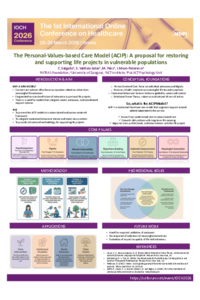
This article presents the ACIP model as an adaptation of contextual acceptance-and-values-based psychological interventions to community health and social care contexts prioritizing person-centered attention. While ACT focuses on psychological flexibility through mindfulness, acceptance, and committed action guided by values, ACIP extends these principles to structured support of individuals’ life projects within care systems. ACIP aims to enhance autonomy, dignity, and meaningful engagement in life by operationalizing ACT concepts in a coordinated and contextualized care framework.
Methods:
The ACIP model was conceptualized through a comprehensive synthesis of literature on person-centered care, behavioral science, and values-based interventions, rooted philosophically in functional contextualism and methodologically in ACT’s six processes. Its structured three-phase methodology supports life projects by clarifying essential values, planning value-consistent actions, and ongoing monitoring and adaptive accompaniment, ensuring continuity and coherence between personal objectives and care.
Results:
ACIP is structured on six pillars: depathologization, dignity, shared vulnerability, construction, authentic empowerment, and social connection. It promotes a shift from fragmented care towards an integrated system centered on the individual's life narrative. Unlike traditional person-centered models, it explicitly links support actions to valued outcomes related to life’s meaning and purpose, using measures aligned with daily action adjustment and sustained motivation.
Conclusions:
ACIP represents a novel application of ACT to community intervention, prioritizing evaluation of effectiveness not by symptom reduction and service utilization alone but through progress in meaningful living aligned with personal values. This approach fosters engaged, purposeful care across diverse populations and life stages, enhancing the relevance and impact of person-centered support.
Keywords
person-centered attention
community health
acceptance and commitment therapy
values-based intervention
purpose in life
meaning in life
Poster
ACIP for IOCH2026.pdf
Medication Safety Management of Cancer Patients' Participation in Intravenous Anticancer Therapy Based on the Theory of Planned Behavior: A qualitative study
Heterogeneity of patients' engagement in patient safety during systemic antineoplastic therapy: application of latent profile analysis and network analysis