Event submissions
Published
This submission belongs to the session S2. Patient-Centered Care—Optimizing Care Pathways through Engagement and Outcome Measurement of the event The 1st International Online Conference on Healthcare
Published date
20 Mar, 2026
Academic Editor
'%3e%3cpath%20d='M12.6657%2010.9104C12.4185%2010.325%2012.0599%209.79327%2011.6097%209.34482C11.1609%208.89508%2010.6293%208.5365%2010.0442%208.28888C10.0389%208.28626%2010.0337%208.28495%2010.0285%208.28233C10.8446%207.69279%2011.3752%206.73249%2011.3752%205.64904C11.3752%203.8542%209.92103%202.39999%208.1262%202.39999C6.33136%202.39999%204.87715%203.8542%204.87715%205.64904C4.87715%206.73249%205.40774%207.69279%206.22393%208.28364C6.21869%208.28626%206.21345%208.28757%206.20821%208.29019C5.62129%208.5378%205.09463%208.89284%204.64265%209.34613C4.1929%209.79493%203.83432%2010.3266%203.58671%2010.9117C3.34345%2011.4845%203.21226%2012.0987%203.20023%2012.7209C3.19988%2012.7349%203.20233%2012.7488%203.20744%2012.7619C3.21255%2012.7749%203.22022%2012.7867%203.22998%2012.7968C3.23975%2012.8068%203.25142%2012.8147%203.26431%2012.8202C3.2772%2012.8256%203.29105%2012.8284%203.30504%2012.8284H4.09109C4.14874%2012.8284%204.19459%2012.7825%204.1959%2012.7262C4.2221%2011.7148%204.62823%2010.7676%205.34617%2010.0497C6.08899%209.30683%207.0755%208.89808%208.1262%208.89808C9.17689%208.89808%2010.1634%209.30683%2010.9062%2010.0497C11.6242%2010.7676%2012.0303%2011.7148%2012.0565%2012.7262C12.0578%2012.7838%2012.1037%2012.8284%2012.1613%2012.8284H12.9474C12.9613%2012.8284%2012.9752%2012.8256%2012.9881%2012.8202C13.001%2012.8147%2013.0126%2012.8068%2013.0224%2012.7968C13.0322%2012.7867%2013.0398%2012.7749%2013.0449%2012.7619C13.0501%2012.7488%2013.0525%2012.7349%2013.0522%2012.7209C13.0391%2012.0947%2012.9094%2011.4855%2012.6657%2010.9104ZM8.1262%207.9024C7.52486%207.9024%206.9589%207.6679%206.53312%207.24211C6.10733%206.81633%205.87283%206.25037%205.87283%205.64904C5.87283%205.0477%206.10733%204.48174%206.53312%204.05596C6.9589%203.63018%207.52486%203.39567%208.1262%203.39567C8.72753%203.39567%209.29349%203.63018%209.71927%204.05596C10.1451%204.48174%2010.3796%205.0477%2010.3796%205.64904C10.3796%206.25037%2010.1451%206.81633%209.71927%207.24211C9.29349%207.6679%208.72753%207.9024%208.1262%207.9024Z'%20fill='%235D1EE1'/%3e%3c/g%3e%3c/svg%3e) Lorraine S. Evangelista
Lorraine S. EvangelistaCitation
lu zhou, Runli Yang, Yue Liu, Qinghua Zhao, Mingzhao Xiao, Heterogeneity of patients' engagement in patient safety during systemic antineoplastic therapy: application of latent profile analysis and network analysis, in Proceedings of The 1st International Online Conference on Healthcare, 25 March–26 March 2026, MDPI: Basel, Switzerland
Share
Email
Facebook
Twitter
LinkedIn
Heterogeneity of patients' engagement in patient safety during systemic antineoplastic therapy: application of latent profile analysis and network analysis
'%3e%3cpath%20d='M12.6647%2010.9104C12.4176%2010.325%2012.0589%209.7933%2011.6088%209.34485C11.16%208.89511%2010.6283%208.53653%2010.0432%208.28891C10.038%208.28629%2010.0327%208.28498%2010.0275%208.28236C10.8437%207.69282%2011.3743%206.73252%2011.3743%205.64907C11.3743%203.85423%209.92005%202.40002%208.12522%202.40002C6.33038%202.40002%204.87618%203.85423%204.87618%205.64907C4.87618%206.73252%205.40677%207.69282%206.22296%208.28367C6.21772%208.28629%206.21248%208.2876%206.20724%208.29022C5.62031%208.53783%205.09365%208.89287%204.64167%209.34616C4.19192%209.79496%203.83334%2010.3266%203.58573%2010.9117C3.34247%2011.4846%203.21128%2012.0987%203.19925%2012.721C3.1989%2012.735%203.20135%2012.7489%203.20646%2012.7619C3.21157%2012.7749%203.21924%2012.7868%203.22901%2012.7968C3.23877%2012.8068%203.25045%2012.8148%203.26334%2012.8202C3.27623%2012.8256%203.29007%2012.8284%203.30406%2012.8284H4.09012C4.14776%2012.8284%204.19362%2012.7825%204.19493%2012.7262C4.22113%2011.7148%204.62726%2010.7676%205.34519%2010.0497C6.08802%209.30686%207.07452%208.89811%208.12522%208.89811C9.17592%208.89811%2010.1624%209.30686%2010.9052%2010.0497C11.6232%2010.7676%2012.0293%2011.7148%2012.0555%2012.7262C12.0568%2012.7839%2012.1027%2012.8284%2012.1603%2012.8284H12.9464C12.9604%2012.8284%2012.9742%2012.8256%2012.9871%2012.8202C13%2012.8148%2013.0117%2012.8068%2013.0214%2012.7968C13.0312%2012.7868%2013.0389%2012.7749%2013.044%2012.7619C13.0491%2012.7489%2013.0515%2012.735%2013.0512%2012.721C13.0381%2012.0947%2012.9084%2011.4856%2012.6647%2010.9104ZM8.12522%207.90243C7.52388%207.90243%206.95792%207.66793%206.53214%207.24215C6.10636%206.81636%205.87185%206.2504%205.87185%205.64907C5.87185%205.04773%206.10636%204.48177%206.53214%204.05599C6.95792%203.63021%207.52388%203.3957%208.12522%203.3957C8.72655%203.3957%209.29252%203.63021%209.7183%204.05599C10.1441%204.48177%2010.3786%205.04773%2010.3786%205.64907C10.3786%206.2504%2010.1441%206.81636%209.7183%207.24215C9.29252%207.66793%208.72655%207.90243%208.12522%207.90243Z'%20fill='%235D1EE1'/%3e%3c/g%3e%3c/svg%3e)
lu zhou 1
Runli Yang 2
Yue Liu 2
Qinghua Zhao 2
Mingzhao Xiao 2
1. International Medical Center, The First Affiliated Hospital of Chongqing Medical University, Chongqing 400016, China
2. International Medical Center / Department of Nursing, The First Affiliated Hospital of Chongqing Medical University, Chongqing 400000, China
Abstract
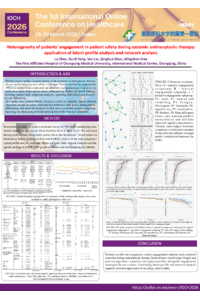
Objectives: Patient safety in systemic antineoplastic therapy is critical but heterogeneous due to diverse symptom profiles and engagement behaviors. Existing studies lack insights into subgroup differences in patient involvement and symptom interactions. This study aimed to identify latent profiles of patient safety engagement and characterize symptom network heterogeneity among cancer patients undergoing chemotherapy.
Method: A cross-sectional study recruited 489 adult cancer patients receiving non-initial chemotherapy at a tertiary hospital (October 2024–May 2025). Data included demographics, Inpatients' Involvement in Medication Safety Scale (IIMSS), and EORTC QLQ-C30 symptoms (9 symptoms: pain, nausea, fatigue, dyspnea, insomnia, appetite loss, constipation, diarrhea, financial difficulty). Latent profile analysis (LPA) identified engagement subgroups, and network analysis compared symptom associations (edge weights, centrality) across subgroups using bootstrapping and Qgraph in R.
Results: A cross-sectional study recruited 489 adult cancer patients receiving non-initial chemotherapy at a tertiary hospital (October 2024–May 2025). Data included demographics, Inpatients' Involvement in Medication Safety Scale (IIMSS), and EORTC QLQ-C30 symptoms (9 symptoms: pain, nausea, fatigue, dyspnea, insomnia, appetite loss, constipation, diarrhea, financial difficulty). Latent profile analysis (LPA) identified engagement subgroups, and network analysis compared symptom associations (edge weights, centrality) across subgroups using bootstrapping and Qgraph in R.Network stability analysis confirmed robust edges in Profile A (e.g., nausea–constipation, bootstrap CI=0.41–0.63) and Profile C (constipation–diarrhea, CI=0.51–0.67). Demographics (e.g., education, income) and treatment-related factors (adverse events) significantly predicted profile membership (p<0.05).
Conclusion: Patients undergoing systemic antineoplastic therapy demonstrate heterogeneous safety engagement patterns and symptom networks. Targeted interventions are needed; for example, Profile A requires fatigue-focused symptom management, Profile B needs dyspnea-centric supportive care, and Profile C demands constipation/diarrhea monitoring with engagement promotion. LPA combined with network analysis identifies subgroup-specific safety priorities, advancing precision patient safety in oncology.
Keywords
Patient safety
neoplasms
chemotherapy
latent profile analysis
symptom networks
patient engagement
Poster
Lu Zhou-Heterogeneity of patients' engagement in patient safety during systemic antineoplastic therapy application of latent profile analysis and network analysis.pdf
The Personal Values-based Care Model (ACIP): A Proposal for Supporting and Restoring Life Projects in Vulnerable Populations
The Engagement Barriers Encountered Among Females from Rural Religiously Strict Microcultures of the United States in Healthcare Provider Screening for Non-Physical Intimate Partner Violence