Event submissions
Published
This submission belongs to the session S2. Patient-Centered Care—Optimizing Care Pathways through Engagement and Outcome Measurement of the event The 1st International Online Conference on Healthcare
Published date
20 Mar, 2026
Academic Editor
'%3e%3cpath%20d='M12.6657%2010.9104C12.4185%2010.325%2012.0599%209.79327%2011.6097%209.34482C11.1609%208.89508%2010.6293%208.5365%2010.0442%208.28888C10.0389%208.28626%2010.0337%208.28495%2010.0285%208.28233C10.8446%207.69279%2011.3752%206.73249%2011.3752%205.64904C11.3752%203.8542%209.92103%202.39999%208.1262%202.39999C6.33136%202.39999%204.87715%203.8542%204.87715%205.64904C4.87715%206.73249%205.40774%207.69279%206.22393%208.28364C6.21869%208.28626%206.21345%208.28757%206.20821%208.29019C5.62129%208.5378%205.09463%208.89284%204.64265%209.34613C4.1929%209.79493%203.83432%2010.3266%203.58671%2010.9117C3.34345%2011.4845%203.21226%2012.0987%203.20023%2012.7209C3.19988%2012.7349%203.20233%2012.7488%203.20744%2012.7619C3.21255%2012.7749%203.22022%2012.7867%203.22998%2012.7968C3.23975%2012.8068%203.25142%2012.8147%203.26431%2012.8202C3.2772%2012.8256%203.29105%2012.8284%203.30504%2012.8284H4.09109C4.14874%2012.8284%204.19459%2012.7825%204.1959%2012.7262C4.2221%2011.7148%204.62823%2010.7676%205.34617%2010.0497C6.08899%209.30683%207.0755%208.89808%208.1262%208.89808C9.17689%208.89808%2010.1634%209.30683%2010.9062%2010.0497C11.6242%2010.7676%2012.0303%2011.7148%2012.0565%2012.7262C12.0578%2012.7838%2012.1037%2012.8284%2012.1613%2012.8284H12.9474C12.9613%2012.8284%2012.9752%2012.8256%2012.9881%2012.8202C13.001%2012.8147%2013.0126%2012.8068%2013.0224%2012.7968C13.0322%2012.7867%2013.0398%2012.7749%2013.0449%2012.7619C13.0501%2012.7488%2013.0525%2012.7349%2013.0522%2012.7209C13.0391%2012.0947%2012.9094%2011.4855%2012.6657%2010.9104ZM8.1262%207.9024C7.52486%207.9024%206.9589%207.6679%206.53312%207.24211C6.10733%206.81633%205.87283%206.25037%205.87283%205.64904C5.87283%205.0477%206.10733%204.48174%206.53312%204.05596C6.9589%203.63018%207.52486%203.39567%208.1262%203.39567C8.72753%203.39567%209.29349%203.63018%209.71927%204.05596C10.1451%204.48174%2010.3796%205.0477%2010.3796%205.64904C10.3796%206.25037%2010.1451%206.81633%209.71927%207.24211C9.29349%207.6679%208.72753%207.9024%208.1262%207.9024Z'%20fill='%235D1EE1'/%3e%3c/g%3e%3c/svg%3e) Lorraine S. Evangelista
Lorraine S. EvangelistaCitation
Akanksha Sharma, IoT-Enabled Smart Toothbrushes for Oral Hygiene Monitoring: A Multi-Group Comparative Study Among Undergraduates, Dental Students, and Patients Across Educational and Clinical Settings in District Mandi, India, in Proceedings of The 1st International Online Conference on Healthcare, 25 March–26 March 2026, MDPI: Basel, Switzerland
Share
Email
Facebook
Twitter
LinkedIn
IoT-Enabled Smart Toothbrushes for Oral Hygiene Monitoring: A Multi-Group Comparative Study Among Undergraduates, Dental Students, and Patients Across Educational and Clinical Settings in District Mandi, India
'%3e%3cpath%20d='M12.6647%2010.9104C12.4176%2010.325%2012.0589%209.7933%2011.6088%209.34485C11.16%208.89511%2010.6283%208.53653%2010.0432%208.28891C10.038%208.28629%2010.0327%208.28498%2010.0275%208.28236C10.8437%207.69282%2011.3743%206.73252%2011.3743%205.64907C11.3743%203.85423%209.92005%202.40002%208.12522%202.40002C6.33038%202.40002%204.87618%203.85423%204.87618%205.64907C4.87618%206.73252%205.40677%207.69282%206.22296%208.28367C6.21772%208.28629%206.21248%208.2876%206.20724%208.29022C5.62031%208.53783%205.09365%208.89287%204.64167%209.34616C4.19192%209.79496%203.83334%2010.3266%203.58573%2010.9117C3.34247%2011.4846%203.21128%2012.0987%203.19925%2012.721C3.1989%2012.735%203.20135%2012.7489%203.20646%2012.7619C3.21157%2012.7749%203.21924%2012.7868%203.22901%2012.7968C3.23877%2012.8068%203.25045%2012.8148%203.26334%2012.8202C3.27623%2012.8256%203.29007%2012.8284%203.30406%2012.8284H4.09012C4.14776%2012.8284%204.19362%2012.7825%204.19493%2012.7262C4.22113%2011.7148%204.62726%2010.7676%205.34519%2010.0497C6.08802%209.30686%207.07452%208.89811%208.12522%208.89811C9.17592%208.89811%2010.1624%209.30686%2010.9052%2010.0497C11.6232%2010.7676%2012.0293%2011.7148%2012.0555%2012.7262C12.0568%2012.7839%2012.1027%2012.8284%2012.1603%2012.8284H12.9464C12.9604%2012.8284%2012.9742%2012.8256%2012.9871%2012.8202C13%2012.8148%2013.0117%2012.8068%2013.0214%2012.7968C13.0312%2012.7868%2013.0389%2012.7749%2013.044%2012.7619C13.0491%2012.7489%2013.0515%2012.735%2013.0512%2012.721C13.0381%2012.0947%2012.9084%2011.4856%2012.6647%2010.9104ZM8.12522%207.90243C7.52388%207.90243%206.95792%207.66793%206.53214%207.24215C6.10636%206.81636%205.87185%206.2504%205.87185%205.64907C5.87185%205.04773%206.10636%204.48177%206.53214%204.05599C6.95792%203.63021%207.52388%203.3957%208.12522%203.3957C8.72655%203.3957%209.29252%203.63021%209.7183%204.05599C10.1441%204.48177%2010.3786%205.04773%2010.3786%205.64907C10.3786%206.2504%2010.1441%206.81636%209.7183%207.24215C9.29252%207.66793%208.72655%207.90243%208.12522%207.90243Z'%20fill='%235D1EE1'/%3e%3c/g%3e%3c/svg%3e)
Akanksha Sharma 1
1. Department of Public Health Dentistry, Himachal Dental College, Sundernagar, 175002, India
Abstract
Background: The integration of Internet-of-Things (IoT) technologies into oral healthcare enables real-time monitoring of brushing behaviour through smart toothbrushes. These devices track brushing duration, technique, and frequency, providing personalized feedback to enhance oral hygiene.
Aim: To assess and compare the knowledge, attitude, and practices (KAP) related to IoT-enabled smart toothbrushes among undergraduate students, dental students, and dental patients across educational and clinical settings in District Mandi, India, and to evaluate whether real-time brushing data can improve compliance.
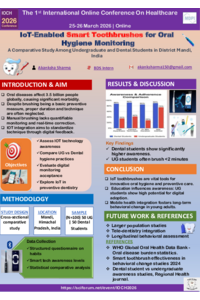
Materials and Methods: A cross-sectional survey was conducted among 885 participants, comprising undergraduate students (n=295), dental students (n=295), and dental patients (n=295). A prevalidated 32-item questionnaire assessed demographics and KAP toward IoT-based smart toothbrushes, including awareness of IoT, understanding of smart toothbrush functions, perceptions of real-time feedback, and usage patterns. Data were analysed using descriptive statistics, Chi-square tests for categorical variables, and one-way ANOVA for continuous variables, followed by post-hoc tests. Statistical significance was set at p < 0.05.
Results: Of the 1,014 questionnaires distributed, 885 were completed (response rate: 87.35%). Significant differences were observed across all KAP domains. Dental students showed the highest knowledge scores (8.12 ± 1.4), followed by undergraduates (5.96 ± 1.9) and patients (4.85 ± 2.1), with ANOVA showing p < 0.001. Post-hoc analysis confirmed significant pairwise differences: dental students vs. undergraduates (p < 0.001), dental students vs. patients (p < 0.001), and undergraduates vs. patients (p = 0.004). Attitude differences were significant (p = 0.008), with 78% of dental students, 61% of undergraduates, and 54% of patients agreeing that real-time data improves compliance; pairwise differences were significant (p = 0.01 and p = 0.04). Practice patterns also varied significantly (p = 0.02). Additional differences were noted in perceived usefulness (p = 0.01), willingness to adopt smart toothbrushes (p = 0.03), and data privacy concerns (p = 0.047).
Conclusion: IoT-enabled smart toothbrushes have strong potential to improve oral hygiene compliance. Despite positive attitudes, significant gaps in knowledge and usage persist, indicating the need for targeted awareness and cost-effective implementation strategies in District Mandi.
Keywords
Keywords: IoT
smart toothbrush
oral hygiene
real-time data
compliance.
Poster
Akankshaposter.pdf
Airway Complications in Morbidly Obese Patients Undergoing General Anaesthesia: a Systematic Review
Nurses’ Knowledge Levels Regarding Medical Device-Related Pressure Injury Risk Factors: A Descriptive Study