Event submissions
Published
This submission belongs to the session S2. Patient-Centered Care—Optimizing Care Pathways through Engagement and Outcome Measurement of the event The 1st International Online Conference on Healthcare
Published date
20 Mar, 2026
Academic Editor
'%3e%3cpath%20d='M12.6657%2010.9104C12.4185%2010.325%2012.0599%209.79327%2011.6097%209.34482C11.1609%208.89508%2010.6293%208.5365%2010.0442%208.28888C10.0389%208.28626%2010.0337%208.28495%2010.0285%208.28233C10.8446%207.69279%2011.3752%206.73249%2011.3752%205.64904C11.3752%203.8542%209.92103%202.39999%208.1262%202.39999C6.33136%202.39999%204.87715%203.8542%204.87715%205.64904C4.87715%206.73249%205.40774%207.69279%206.22393%208.28364C6.21869%208.28626%206.21345%208.28757%206.20821%208.29019C5.62129%208.5378%205.09463%208.89284%204.64265%209.34613C4.1929%209.79493%203.83432%2010.3266%203.58671%2010.9117C3.34345%2011.4845%203.21226%2012.0987%203.20023%2012.7209C3.19988%2012.7349%203.20233%2012.7488%203.20744%2012.7619C3.21255%2012.7749%203.22022%2012.7867%203.22998%2012.7968C3.23975%2012.8068%203.25142%2012.8147%203.26431%2012.8202C3.2772%2012.8256%203.29105%2012.8284%203.30504%2012.8284H4.09109C4.14874%2012.8284%204.19459%2012.7825%204.1959%2012.7262C4.2221%2011.7148%204.62823%2010.7676%205.34617%2010.0497C6.08899%209.30683%207.0755%208.89808%208.1262%208.89808C9.17689%208.89808%2010.1634%209.30683%2010.9062%2010.0497C11.6242%2010.7676%2012.0303%2011.7148%2012.0565%2012.7262C12.0578%2012.7838%2012.1037%2012.8284%2012.1613%2012.8284H12.9474C12.9613%2012.8284%2012.9752%2012.8256%2012.9881%2012.8202C13.001%2012.8147%2013.0126%2012.8068%2013.0224%2012.7968C13.0322%2012.7867%2013.0398%2012.7749%2013.0449%2012.7619C13.0501%2012.7488%2013.0525%2012.7349%2013.0522%2012.7209C13.0391%2012.0947%2012.9094%2011.4855%2012.6657%2010.9104ZM8.1262%207.9024C7.52486%207.9024%206.9589%207.6679%206.53312%207.24211C6.10733%206.81633%205.87283%206.25037%205.87283%205.64904C5.87283%205.0477%206.10733%204.48174%206.53312%204.05596C6.9589%203.63018%207.52486%203.39567%208.1262%203.39567C8.72753%203.39567%209.29349%203.63018%209.71927%204.05596C10.1451%204.48174%2010.3796%205.0477%2010.3796%205.64904C10.3796%206.25037%2010.1451%206.81633%209.71927%207.24211C9.29349%207.6679%208.72753%207.9024%208.1262%207.9024Z'%20fill='%235D1EE1'/%3e%3c/g%3e%3c/svg%3e) Lorraine Evangelista
Lorraine EvangelistaCitation
HuiJun Sun, The Mediating Role of Out-of-Hospital Adherence between Health Literacy and Quality of Life in Chinese Stroke Survivors: A Cross-Sectional Study, in Proceedings of The 1st International Online Conference on Healthcare, 25 March–26 March 2026, MDPI: Basel, Switzerland
Share
Email
Facebook
Twitter
LinkedIn
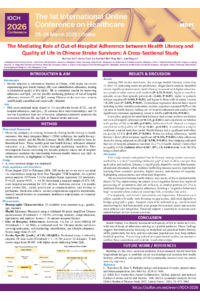
The Mediating Role of Out-of-Hospital Adherence between Health Literacy and Quality of Life in Chinese Stroke Survivors: A Cross-Sectional Study
'%3e%3cpath%20d='M12.6647%2010.9104C12.4176%2010.325%2012.0589%209.7933%2011.6088%209.34485C11.16%208.89511%2010.6283%208.53653%2010.0432%208.28891C10.038%208.28629%2010.0327%208.28498%2010.0275%208.28236C10.8437%207.69282%2011.3743%206.73252%2011.3743%205.64907C11.3743%203.85423%209.92005%202.40002%208.12522%202.40002C6.33038%202.40002%204.87618%203.85423%204.87618%205.64907C4.87618%206.73252%205.40677%207.69282%206.22296%208.28367C6.21772%208.28629%206.21248%208.2876%206.20724%208.29022C5.62031%208.53783%205.09365%208.89287%204.64167%209.34616C4.19192%209.79496%203.83334%2010.3266%203.58573%2010.9117C3.34247%2011.4846%203.21128%2012.0987%203.19925%2012.721C3.1989%2012.735%203.20135%2012.7489%203.20646%2012.7619C3.21157%2012.7749%203.21924%2012.7868%203.22901%2012.7968C3.23877%2012.8068%203.25045%2012.8148%203.26334%2012.8202C3.27623%2012.8256%203.29007%2012.8284%203.30406%2012.8284H4.09012C4.14776%2012.8284%204.19362%2012.7825%204.19493%2012.7262C4.22113%2011.7148%204.62726%2010.7676%205.34519%2010.0497C6.08802%209.30686%207.07452%208.89811%208.12522%208.89811C9.17592%208.89811%2010.1624%209.30686%2010.9052%2010.0497C11.6232%2010.7676%2012.0293%2011.7148%2012.0555%2012.7262C12.0568%2012.7839%2012.1027%2012.8284%2012.1603%2012.8284H12.9464C12.9604%2012.8284%2012.9742%2012.8256%2012.9871%2012.8202C13%2012.8148%2013.0117%2012.8068%2013.0214%2012.7968C13.0312%2012.7868%2013.0389%2012.7749%2013.044%2012.7619C13.0491%2012.7489%2013.0515%2012.735%2013.0512%2012.721C13.0381%2012.0947%2012.9084%2011.4856%2012.6647%2010.9104ZM8.12522%207.90243C7.52388%207.90243%206.95792%207.66793%206.53214%207.24215C6.10636%206.81636%205.87185%206.2504%205.87185%205.64907C5.87185%205.04773%206.10636%204.48177%206.53214%204.05599C6.95792%203.63021%207.52388%203.3957%208.12522%203.3957C8.72655%203.3957%209.29252%203.63021%209.7183%204.05599C10.1441%204.48177%2010.3786%205.04773%2010.3786%205.64907C10.3786%206.2504%2010.1441%206.81636%209.7183%207.24215C9.29252%207.66793%208.72655%207.90243%208.12522%207.90243Z'%20fill='%235D1EE1'/%3e%3c/g%3e%3c/svg%3e)
HuiJun Sun 1
1. Nursing Department, Shanghai Clinical Research and Trial Center, Shanghaitech University, Shanghai, 201210, China
Abstract
Background: Stroke, the second foremost cause of mortality globally, imposes a considerable disease burden in China. Patients currently have inadequate health literacy and poor adherence to rehabilitation, resulting in a notable deterioration in quality of life. Health literacy is a crucial element in disrupting the loop of poor adherence and diminished quality of life; nevertheless, its relationship with adherence and quality of life necessitates empirical validation.
Objective: To investigate the structural relationship among health literacy, out-of-hospital adherence, and quality of life in Chinese stroke survivors, explore the mediating role of adherence between health literacy and quality of life, and inform the development of targeted interventions.
Methods: A cross-sectional study was conducted with 509 stroke survivors recruited from four traditional Chinese medicine hospitals in Shanghai (94.43% response rate). Data were collected using validated scales for health literacy, out-of-hospital adherence, and stroke-specific quality of life. Mediation analysis was performed using the PROCESS macro with 5000 bootstrap samples to examine whether adherence mediates the association between health literacy and quality of life.
Results: Stroke survivors' health literacy averaged 31.40±1.33 (below threshold), with analysis skills scoring lowest (5.37±1.17); HL moderately correlated with quality of life (r=0.409, p<0.001) but weakly with out-of-hospital adherence (r=0.223, p<0.001), while adherence strongly linked to QoL (r=0.461, p<0.001). Adherence mediated 21.3% (95% CI: 0.048–0.134) of HL's association with QoL (total effect 0.409; direct effect 78.7%). Key HL predictors included education, residence, income, and recurrence history
Conclusion: Health literacy was directly associated with stroke survivors' quality of life, with out-of-hospital adherence acting as a partial mediator. Our findings suggest that interventions focusing on analytical and practical health literacy skills may be essential to address the "low health literacy, poor adherence, reduced quality of life" cycle.
Keywords
Stroke,Health literacy,Adherence,Quality of life,Influencing factors
Poster
展板.pdf
The application of Comprehensive Unit-Based Safety Program for Fall Prevention in High-Risk Hospitalized Patients
Clinical Impact of Digital Health Education for Patients with Heart Failure: A Systematic Review and Meta-Analysis