Event submissions
Published
This submission belongs to the session S2. Optoelectronics & Optical Engineering of the event The 1st International Online Conference on Optics
Published date
20 Mar, 2026
Academic Editor
'%3e%3cpath%20d='M12.6657%2010.9104C12.4185%2010.325%2012.0599%209.79327%2011.6097%209.34482C11.1609%208.89508%2010.6293%208.5365%2010.0442%208.28888C10.0389%208.28626%2010.0337%208.28495%2010.0285%208.28233C10.8446%207.69279%2011.3752%206.73249%2011.3752%205.64904C11.3752%203.8542%209.92103%202.39999%208.1262%202.39999C6.33136%202.39999%204.87715%203.8542%204.87715%205.64904C4.87715%206.73249%205.40774%207.69279%206.22393%208.28364C6.21869%208.28626%206.21345%208.28757%206.20821%208.29019C5.62129%208.5378%205.09463%208.89284%204.64265%209.34613C4.1929%209.79493%203.83432%2010.3266%203.58671%2010.9117C3.34345%2011.4845%203.21226%2012.0987%203.20023%2012.7209C3.19988%2012.7349%203.20233%2012.7488%203.20744%2012.7619C3.21255%2012.7749%203.22022%2012.7867%203.22998%2012.7968C3.23975%2012.8068%203.25142%2012.8147%203.26431%2012.8202C3.2772%2012.8256%203.29105%2012.8284%203.30504%2012.8284H4.09109C4.14874%2012.8284%204.19459%2012.7825%204.1959%2012.7262C4.2221%2011.7148%204.62823%2010.7676%205.34617%2010.0497C6.08899%209.30683%207.0755%208.89808%208.1262%208.89808C9.17689%208.89808%2010.1634%209.30683%2010.9062%2010.0497C11.6242%2010.7676%2012.0303%2011.7148%2012.0565%2012.7262C12.0578%2012.7838%2012.1037%2012.8284%2012.1613%2012.8284H12.9474C12.9613%2012.8284%2012.9752%2012.8256%2012.9881%2012.8202C13.001%2012.8147%2013.0126%2012.8068%2013.0224%2012.7968C13.0322%2012.7867%2013.0398%2012.7749%2013.0449%2012.7619C13.0501%2012.7488%2013.0525%2012.7349%2013.0522%2012.7209C13.0391%2012.0947%2012.9094%2011.4855%2012.6657%2010.9104ZM8.1262%207.9024C7.52486%207.9024%206.9589%207.6679%206.53312%207.24211C6.10733%206.81633%205.87283%206.25037%205.87283%205.64904C5.87283%205.0477%206.10733%204.48174%206.53312%204.05596C6.9589%203.63018%207.52486%203.39567%208.1262%203.39567C8.72753%203.39567%209.29349%203.63018%209.71927%204.05596C10.1451%204.48174%2010.3796%205.0477%2010.3796%205.64904C10.3796%206.25037%2010.1451%206.81633%209.71927%207.24211C9.29349%207.6679%208.72753%207.9024%208.1262%207.9024Z'%20fill='%235D1EE1'/%3e%3c/g%3e%3c/svg%3e) Yuriy Garbovskiy
Yuriy GarbovskiyCitation
Gianfranco Carotenuto, ACCURATE DETERMINATION OF THIN PET FILM STRUCTURAL DISORDER AND BANDGAP ENERGY BY ABSORPTION OPTICAL SPECTROSCOPY, in Proceedings of The 1st International Online Conference on Optics, 25 March–27 March 2026, MDPI: Basel, Switzerland
Share
Email
Facebook
Twitter
LinkedIn
ACCURATE DETERMINATION OF THIN PET FILM STRUCTURAL DISORDER AND BANDGAP ENERGY BY ABSORPTION OPTICAL SPECTROSCOPY

Gianfranco Carotenuto 1
1. Institute for Polymers, Composites and Biomaterials (IPCB-CNR), National Research Council, Piazzale E. Fermi, 1-80055 Portici, Italy
Abstract
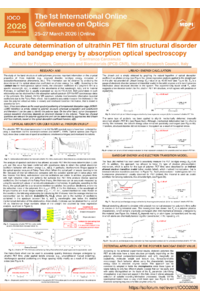
Absorption optical spectroscopy allows measuring structural disorder and fundamental electronic properties (e.g., bandgap energy, Eg) of solid polymers by combining the interferometric and extinction information contained in UV-Vis-NIR spectra. Here, as an example, a thin polyethylene terephthalate (PET) film has been optically investigated before and after mild uniaxial/biaxial hand stretching, in order to establish the effect of such mechanical deformation on thickness, structural disorder, and bandgap energy. Thin PET films are frequently used in electronic packaging, magnetic tapes, and adhesive tape for various electronic purposes, like thermal insulators for battery, LCD and electromagnetic absorption board fixings, etc. These polymeric films typically undergo hand stretching during their use/application. The PET film thickness has been accurately calculated on the basis of the interference fringe spacing in the optical spectrum, and these values have been used for calculating the absorption coefficient and building Urbach and Tauc plots. The optical spectrum of thin PET film shows a cutoff threshold (transparent-opaque transition) at 300nm, corresponding to an Eg value of 3.96 eV. Such a transparent-opaque transition is characterized by sharp behavior (Urbach energy of 45.0 eV), which is indicative of a low structural disorder of the unstretched polymer. It has been verified that disorder and electronic structure remain practically unmodified by the slight stretching deformation (i.e., Urbach and bandgap energies do not change). Since the PET film Eg value does not depend on the deformation degree, this physical parameter can be considered as a ‘fingerprint’ of the solid polymer, thus allowing its distinction from other types of polymeric solids. Accurate Eg determination for solid polymer identification is a pivotal issue in the area of microplastics, where the required remediation/recycling approach strictly depends on plastic nature.
Keywords
Absorption optical spectroscopy
Interferometry
Tauc plot
Urbach energy
Structural disorder
Bandgap energy
Poster
Poster_GIANFRANCO CAROTENUTO.pdf
Design and Analysis of Achromatic Metalenses in the Visible Regime
Laboratory Tests of a Low-Cost Multispectral Camera for Environmental Monitoring