Event submissions
Published
This submission belongs to the session S2. Optoelectronics & Optical Engineering of the event The 1st International Online Conference on Optics
Published date
20 Mar, 2026
Academic Editor
'%3e%3cpath%20d='M12.6657%2010.9104C12.4185%2010.325%2012.0599%209.79327%2011.6097%209.34482C11.1609%208.89508%2010.6293%208.5365%2010.0442%208.28888C10.0389%208.28626%2010.0337%208.28495%2010.0285%208.28233C10.8446%207.69279%2011.3752%206.73249%2011.3752%205.64904C11.3752%203.8542%209.92103%202.39999%208.1262%202.39999C6.33136%202.39999%204.87715%203.8542%204.87715%205.64904C4.87715%206.73249%205.40774%207.69279%206.22393%208.28364C6.21869%208.28626%206.21345%208.28757%206.20821%208.29019C5.62129%208.5378%205.09463%208.89284%204.64265%209.34613C4.1929%209.79493%203.83432%2010.3266%203.58671%2010.9117C3.34345%2011.4845%203.21226%2012.0987%203.20023%2012.7209C3.19988%2012.7349%203.20233%2012.7488%203.20744%2012.7619C3.21255%2012.7749%203.22022%2012.7867%203.22998%2012.7968C3.23975%2012.8068%203.25142%2012.8147%203.26431%2012.8202C3.2772%2012.8256%203.29105%2012.8284%203.30504%2012.8284H4.09109C4.14874%2012.8284%204.19459%2012.7825%204.1959%2012.7262C4.2221%2011.7148%204.62823%2010.7676%205.34617%2010.0497C6.08899%209.30683%207.0755%208.89808%208.1262%208.89808C9.17689%208.89808%2010.1634%209.30683%2010.9062%2010.0497C11.6242%2010.7676%2012.0303%2011.7148%2012.0565%2012.7262C12.0578%2012.7838%2012.1037%2012.8284%2012.1613%2012.8284H12.9474C12.9613%2012.8284%2012.9752%2012.8256%2012.9881%2012.8202C13.001%2012.8147%2013.0126%2012.8068%2013.0224%2012.7968C13.0322%2012.7867%2013.0398%2012.7749%2013.0449%2012.7619C13.0501%2012.7488%2013.0525%2012.7349%2013.0522%2012.7209C13.0391%2012.0947%2012.9094%2011.4855%2012.6657%2010.9104ZM8.1262%207.9024C7.52486%207.9024%206.9589%207.6679%206.53312%207.24211C6.10733%206.81633%205.87283%206.25037%205.87283%205.64904C5.87283%205.0477%206.10733%204.48174%206.53312%204.05596C6.9589%203.63018%207.52486%203.39567%208.1262%203.39567C8.72753%203.39567%209.29349%203.63018%209.71927%204.05596C10.1451%204.48174%2010.3796%205.0477%2010.3796%205.64904C10.3796%206.25037%2010.1451%206.81633%209.71927%207.24211C9.29349%207.6679%208.72753%207.9024%208.1262%207.9024Z'%20fill='%235D1EE1'/%3e%3c/g%3e%3c/svg%3e) Yuriy Garbovskiy
Yuriy GarbovskiyCitation
AL AMIN, MOHD ZAMANI ZULKIFLI, CORRELATING STRUCTURAL DISORDER AND REFRACTIVE INDEX SENSITIVITY IN PMMA FIBERS, in Proceedings of The 1st International Online Conference on Optics, 25 March–27 March 2026, MDPI: Basel, Switzerland
Share
Email
Facebook
Twitter
LinkedIn
CORRELATING STRUCTURAL DISORDER AND REFRACTIVE INDEX SENSITIVITY IN PMMA FIBERS
'%3e%3cpath%20d='M12.6647%2010.9104C12.4176%2010.325%2012.0589%209.7933%2011.6088%209.34485C11.16%208.89511%2010.6283%208.53653%2010.0432%208.28891C10.038%208.28629%2010.0327%208.28498%2010.0275%208.28236C10.8437%207.69282%2011.3743%206.73252%2011.3743%205.64907C11.3743%203.85423%209.92005%202.40002%208.12522%202.40002C6.33038%202.40002%204.87618%203.85423%204.87618%205.64907C4.87618%206.73252%205.40677%207.69282%206.22296%208.28367C6.21772%208.28629%206.21248%208.2876%206.20724%208.29022C5.62031%208.53783%205.09365%208.89287%204.64167%209.34616C4.19192%209.79496%203.83334%2010.3266%203.58573%2010.9117C3.34247%2011.4846%203.21128%2012.0987%203.19925%2012.721C3.1989%2012.735%203.20135%2012.7489%203.20646%2012.7619C3.21157%2012.7749%203.21924%2012.7868%203.22901%2012.7968C3.23877%2012.8068%203.25045%2012.8148%203.26334%2012.8202C3.27623%2012.8256%203.29007%2012.8284%203.30406%2012.8284H4.09012C4.14776%2012.8284%204.19362%2012.7825%204.19493%2012.7262C4.22113%2011.7148%204.62726%2010.7676%205.34519%2010.0497C6.08802%209.30686%207.07452%208.89811%208.12522%208.89811C9.17592%208.89811%2010.1624%209.30686%2010.9052%2010.0497C11.6232%2010.7676%2012.0293%2011.7148%2012.0555%2012.7262C12.0568%2012.7839%2012.1027%2012.8284%2012.1603%2012.8284H12.9464C12.9604%2012.8284%2012.9742%2012.8256%2012.9871%2012.8202C13%2012.8148%2013.0117%2012.8068%2013.0214%2012.7968C13.0312%2012.7868%2013.0389%2012.7749%2013.044%2012.7619C13.0491%2012.7489%2013.0515%2012.735%2013.0512%2012.721C13.0381%2012.0947%2012.9084%2011.4856%2012.6647%2010.9104ZM8.12522%207.90243C7.52388%207.90243%206.95792%207.66793%206.53214%207.24215C6.10636%206.81636%205.87185%206.2504%205.87185%205.64907C5.87185%205.04773%206.10636%204.48177%206.53214%204.05599C6.95792%203.63021%207.52388%203.3957%208.12522%203.3957C8.72655%203.3957%209.29252%203.63021%209.7183%204.05599C10.1441%204.48177%2010.3786%205.04773%2010.3786%205.64907C10.3786%206.2504%2010.1441%206.81636%209.7183%207.24215C9.29252%207.66793%208.72655%207.90243%208.12522%207.90243Z'%20fill='%235D1EE1'/%3e%3c/g%3e%3c/svg%3e)
AL AMIN 1
MOHD ZAMANI ZULKIFLI 1
1. IIUM Photonics and Quantum Center, Kulliyyah of Science, Department of Physics, International Islamic University Malaysia, 25200 Kuantan, Pahang, Malaysia
Abstract
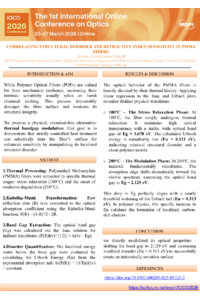
While Polymer Optical Fibers (POFs) are favored for their mechanical resilience, increasing their sensitivity typically requires hazardous chemical etching that damages the fiber surface. To avoid these chemical defects, we propose a physical alternative: a "thermal bandgap modulation" protocol. The core idea was to determine if heat treatment alone could tune the fiber’s surface for better sensitivity, while avoiding the structural damage often caused by chemical methods. We tested Polymethyl Methacrylate (PMMA) fibers across three distinct thermal stages: stress relaxation (100°C), viscoelastic transition (150°C), and the onset of oxidative degradation (200°C). Rather than relying on standard transmission methods, we analyzed the fibers using reflection spectroscopy in the 300–700 nm range. By applying the Kubelka–Munk transformation to this reflection data, we were able to calculate the optical band gap (Eg) and Urbach energy (Eu)—metrics that are rarely used in macroscopic sensor fabrication.
Our results show a clear difference in how the material behaves based on its thermal history. At 100°C, the fiber simply relaxes, keeping its transparency and a stable UV-limit band gap. However, at 200°C, we observed a distinct narrowing of the optical band gap as the absorption edge moved toward the visible spectrum. This shift matched a widening of the Urbach tail, which indicates the formation of carbon-rich clusters and increased structural disorder. We found that this induced disorder is not just damage; it acts as a tunable parameter that is directly linked to a significant rise in sensitivity. By carefully managing the thermodynamic state of the polymer, we present a sustainable, high-precision way to build intrinsic fiber optic sensors.
Keywords
PMMA Fiber
Kubelka-Munk
Tauc Plot
Reflection Spectroscopy
Structural Disorder.
Poster
sciforum-163126.pdf
Fano-Resonant Coupled Sagnac Loop Resonator for Enhanced Integrated Refractive Index Sensing
Biofilm prevention through irradiation with visible light?