Event submissions
Published
This submission belongs to the session S1. Biomedical Optics of the event The 1st International Online Conference on Optics
Published date
20 Mar, 2026
Academic Editor
'%3e%3cpath%20d='M12.6657%2010.9104C12.4185%2010.325%2012.0599%209.79327%2011.6097%209.34482C11.1609%208.89508%2010.6293%208.5365%2010.0442%208.28888C10.0389%208.28626%2010.0337%208.28495%2010.0285%208.28233C10.8446%207.69279%2011.3752%206.73249%2011.3752%205.64904C11.3752%203.8542%209.92103%202.39999%208.1262%202.39999C6.33136%202.39999%204.87715%203.8542%204.87715%205.64904C4.87715%206.73249%205.40774%207.69279%206.22393%208.28364C6.21869%208.28626%206.21345%208.28757%206.20821%208.29019C5.62129%208.5378%205.09463%208.89284%204.64265%209.34613C4.1929%209.79493%203.83432%2010.3266%203.58671%2010.9117C3.34345%2011.4845%203.21226%2012.0987%203.20023%2012.7209C3.19988%2012.7349%203.20233%2012.7488%203.20744%2012.7619C3.21255%2012.7749%203.22022%2012.7867%203.22998%2012.7968C3.23975%2012.8068%203.25142%2012.8147%203.26431%2012.8202C3.2772%2012.8256%203.29105%2012.8284%203.30504%2012.8284H4.09109C4.14874%2012.8284%204.19459%2012.7825%204.1959%2012.7262C4.2221%2011.7148%204.62823%2010.7676%205.34617%2010.0497C6.08899%209.30683%207.0755%208.89808%208.1262%208.89808C9.17689%208.89808%2010.1634%209.30683%2010.9062%2010.0497C11.6242%2010.7676%2012.0303%2011.7148%2012.0565%2012.7262C12.0578%2012.7838%2012.1037%2012.8284%2012.1613%2012.8284H12.9474C12.9613%2012.8284%2012.9752%2012.8256%2012.9881%2012.8202C13.001%2012.8147%2013.0126%2012.8068%2013.0224%2012.7968C13.0322%2012.7867%2013.0398%2012.7749%2013.0449%2012.7619C13.0501%2012.7488%2013.0525%2012.7349%2013.0522%2012.7209C13.0391%2012.0947%2012.9094%2011.4855%2012.6657%2010.9104ZM8.1262%207.9024C7.52486%207.9024%206.9589%207.6679%206.53312%207.24211C6.10733%206.81633%205.87283%206.25037%205.87283%205.64904C5.87283%205.0477%206.10733%204.48174%206.53312%204.05596C6.9589%203.63018%207.52486%203.39567%208.1262%203.39567C8.72753%203.39567%209.29349%203.63018%209.71927%204.05596C10.1451%204.48174%2010.3796%205.0477%2010.3796%205.64904C10.3796%206.25037%2010.1451%206.81633%209.71927%207.24211C9.29349%207.6679%208.72753%207.9024%208.1262%207.9024Z'%20fill='%235D1EE1'/%3e%3c/g%3e%3c/svg%3e) Francesco Chiavaioli
Francesco ChiavaioliCitation
Martin Hessling, Ben Sicks, Klea Lila, Felix Capanni, Vinzent Forstmeier, Biofilm prevention through irradiation with visible light?, in Proceedings of The 1st International Online Conference on Optics, 25 March–27 March 2026, MDPI: Basel, Switzerland
Share
Email
Facebook
Twitter
LinkedIn
Biofilm prevention through irradiation with visible light?
'%3e%3cpath%20d='M12.6647%2010.9104C12.4176%2010.325%2012.0589%209.7933%2011.6088%209.34485C11.16%208.89511%2010.6283%208.53653%2010.0432%208.28891C10.038%208.28629%2010.0327%208.28498%2010.0275%208.28236C10.8437%207.69282%2011.3743%206.73252%2011.3743%205.64907C11.3743%203.85423%209.92005%202.40002%208.12522%202.40002C6.33038%202.40002%204.87618%203.85423%204.87618%205.64907C4.87618%206.73252%205.40677%207.69282%206.22296%208.28367C6.21772%208.28629%206.21248%208.2876%206.20724%208.29022C5.62031%208.53783%205.09365%208.89287%204.64167%209.34616C4.19192%209.79496%203.83334%2010.3266%203.58573%2010.9117C3.34247%2011.4846%203.21128%2012.0987%203.19925%2012.721C3.1989%2012.735%203.20135%2012.7489%203.20646%2012.7619C3.21157%2012.7749%203.21924%2012.7868%203.22901%2012.7968C3.23877%2012.8068%203.25045%2012.8148%203.26334%2012.8202C3.27623%2012.8256%203.29007%2012.8284%203.30406%2012.8284H4.09012C4.14776%2012.8284%204.19362%2012.7825%204.19493%2012.7262C4.22113%2011.7148%204.62726%2010.7676%205.34519%2010.0497C6.08802%209.30686%207.07452%208.89811%208.12522%208.89811C9.17592%208.89811%2010.1624%209.30686%2010.9052%2010.0497C11.6232%2010.7676%2012.0293%2011.7148%2012.0555%2012.7262C12.0568%2012.7839%2012.1027%2012.8284%2012.1603%2012.8284H12.9464C12.9604%2012.8284%2012.9742%2012.8256%2012.9871%2012.8202C13%2012.8148%2013.0117%2012.8068%2013.0214%2012.7968C13.0312%2012.7868%2013.0389%2012.7749%2013.044%2012.7619C13.0491%2012.7489%2013.0515%2012.735%2013.0512%2012.721C13.0381%2012.0947%2012.9084%2011.4856%2012.6647%2010.9104ZM8.12522%207.90243C7.52388%207.90243%206.95792%207.66793%206.53214%207.24215C6.10636%206.81636%205.87185%206.2504%205.87185%205.64907C5.87185%205.04773%206.10636%204.48177%206.53214%204.05599C6.95792%203.63021%207.52388%203.3957%208.12522%203.3957C8.72655%203.3957%209.29252%203.63021%209.7183%204.05599C10.1441%204.48177%2010.3786%205.04773%2010.3786%205.64907C10.3786%206.2504%2010.1441%206.81636%209.7183%207.24215C9.29252%207.66793%208.72655%207.90243%208.12522%207.90243Z'%20fill='%235D1EE1'/%3e%3c/g%3e%3c/svg%3e)
Martin Hessling 1
Ben Sicks 1
Klea Lila 1
Felix Capanni 1
Vinzent Forstmeier 2
1. Institute of Medical Engineering and Mechatronics, Technische Hochschule Ulm (University of Applied Science), Albert-Einstein-Allee 55, 89081 Ulm, Germany
2. Department of Trauma, Orthopedic and Reconstructive Surgery and Sportsmedicine, German Armed Forces Hospital Ulm, Oberer Eselsberg 40, 89081 Ulm, Germany
Abstract
Introduction:
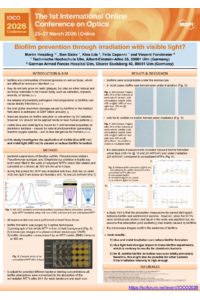
Biofilms are communities of microorganisms on moist surfaces that are difficult to remove and can repeatedly release microorganisms. This causes significant problems in many areas, such as food technology and medicine as biofilms can cause infections in patients that can be potentially fatal. One approach to preventing biofilm formation on surfaces that has not yet been extensively researched is to irradiate them with visible blue or violet light, both of which are known for their antimicrobial effect on planktonic bacteria.
Methods:
Various bacterial suspensions (Bacillus subtilis, Pseudomonas stutzeri, Streptococcus cristatus and Pseudomonas syringae) were placed in 24-well MTPs (microtiter plates) and irradiated with violet or blue light for up to 6 days. During this time, they were shaken at room temperature at a frequency of 100 rpm. The irradiation intensities were 0 mW/cm², 10 mW/cm², or 20 mW/cm². After each day, the bacterial suspension was aspirated and the biofilm at the bottom of the well was assessed by absorption measurement and microscopy imaging.
Results:
In almost all experiments, thin biofilms were found on the well bottoms after 24 hours, even on the irradiated microtiter plates. In general, however, the level of absorption or biofilm formation was lower on the irradiated MTPs than on the non-irradiated ones. For Bacillus subtilis, irradiation prevented biofilm formation during the observation period. Surprisingly, in most experiments, blue light had a stronger effect than violet light, which does not correspond to previous reports regarding their effect on planktonic bacteria.
Conclusion:
Violet and blue light have a positive effect on suppressing the formation of new biofilm, but the applied maximum irradiance of 20 mW/cm2 was not able to prevent the formation of new biofilms. Further investigations with higher irradiance levels are necessary to determine whether it is possible to inhibit the formation of new biofilms altogether.
Keywords
bacterial biofilm
biofilm prevention
blue light
violet light
Poster
Poster Biofilm prevention through irradiation with visible light V5.pdf
CORRELATING STRUCTURAL DISORDER AND REFRACTIVE INDEX SENSITIVITY IN PMMA FIBERS
Modeling of a High-Frequency SAW Resonator on Si/AlN/SiO₂/LiNbO₃ Multilayer Substrate